A real additive function that is continuous at one point is continuous everywhere and has form . Indeed , and as . Then for every . Additivity gives for every rational number; continuity and the density of the rational numbers extend this identity to every real argument.
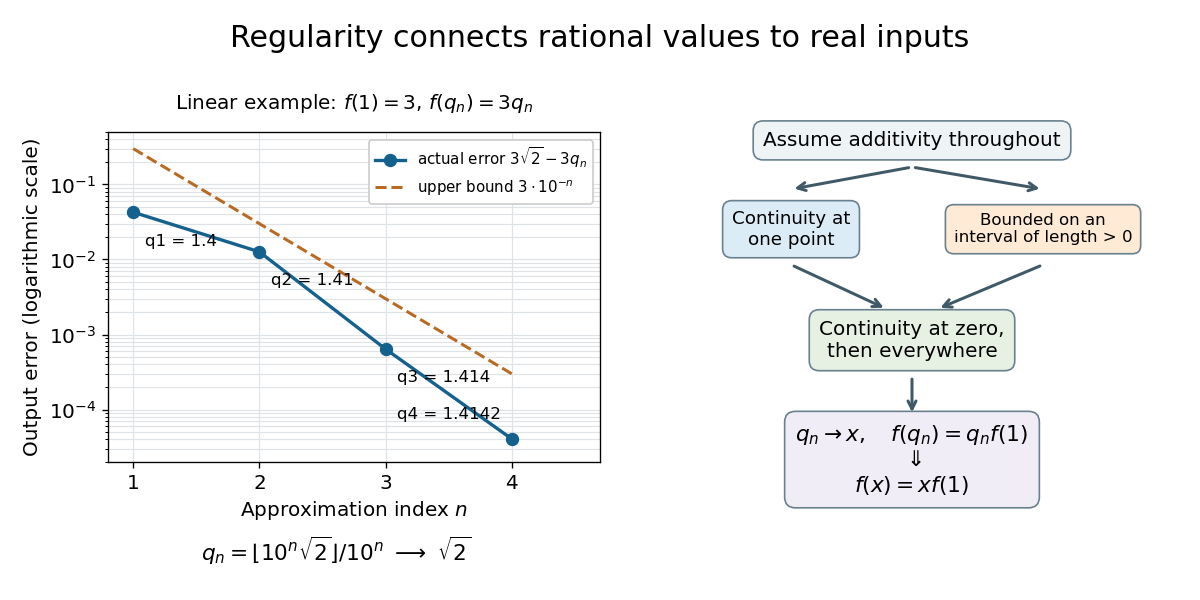
The step from the rational numbers to the real numbers can be made explicit. Put . For an arbitrary real number , the density of the rational numbers supplies a sequence of rational numbers . Because continuity at the original point already implied continuity everywhere,This is where continuity enters: knowing all the rational values alone does not justify the first equality.
For an original numerical example, use the floor function to define the rational lower approximants . They obey . When and is continuous at one point, rational homogeneity of an additive function and the preceding argument giveThe error bound here follows from the resulting linear map, rather than from a quantitative bound on the initially assumed continuity.

Articles by others on the same topic
There are currently no matching articles.