For real numbers, an additive function is a group homomorphism from to itself. It preserves scalar multiplication by every rational number, so it is a linear map when domain and codomain are viewed as vector spaces over the rational numbers. Being a linear map over the real numbers additionally requires for every real number . On the real line this stronger condition is equivalent to . Additivity alone does not imply it.
For every additive function , every real number , and every rational number , one has . This is the scalar multiplication part of being a linear map over the rational numbers.
First gives , and gives . Repeated addition gives for each positive integer , and the negative case follows from the sign identity. If with and , thenNo continuity was used. In particular fixes , , and every other rational value, even for a discontinuous additive function.
A real additive function that is continuous at one point is continuous everywhere and has form . Indeed , and as . Then for every . Additivity gives for every rational number; continuity and the density of the rational numbers extend this identity to every real argument.
The step from the rational numbers to the real numbers can be made explicit. Put . For an arbitrary real number , the density of the rational numbers supplies a sequence of rational numbers . Because continuity at the original point already implied continuity everywhere,This is where continuity enters: knowing all the rational values alone does not justify the first equality.
For an original numerical example, use the floor function to define the rational lower approximants . They obey . When and is continuous at one point, rational homogeneity of an additive function and the preceding argument giveThe error bound here follows from the resulting linear map, rather than from a quantitative bound on the initially assumed continuity.
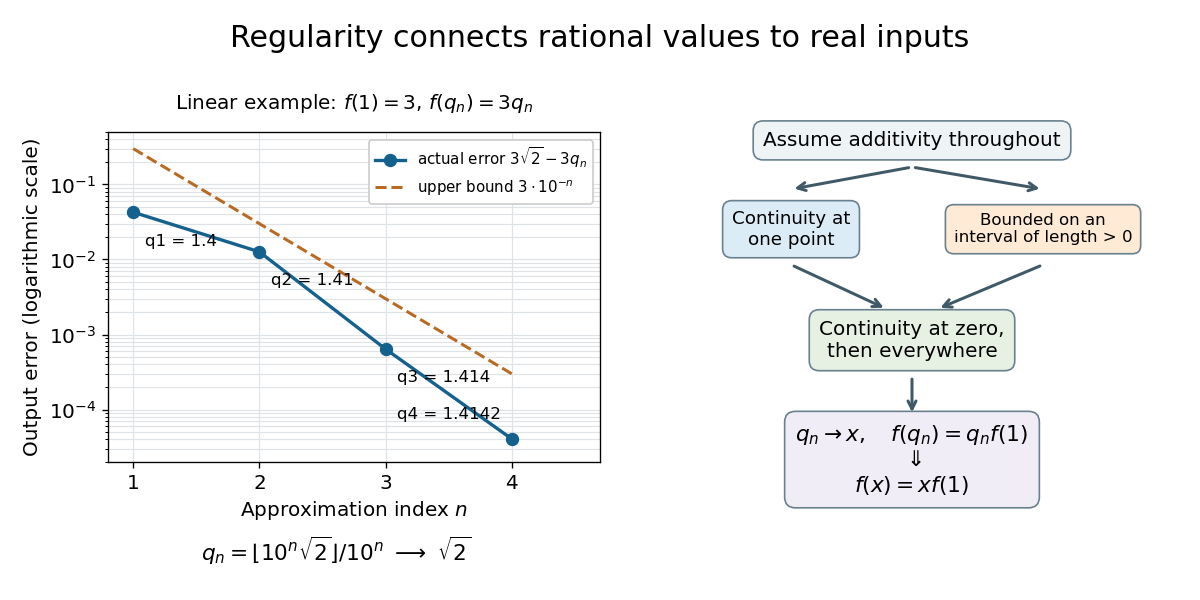
Continuity connects exact rational values to an irrational limit; either one-point continuity or boundedness on an interval forces f(x)=xf(1)
. Details. 
Let be an additive function. Suppose for all in a nondegenerate interval , meaning . Then is continuous everywhere and . A finite bound on even one such interval is enough; a bound at one isolated point is not.
Here is a proof outline that turns a finite bound into arbitrarily small outputs. Set and . If , then both and lie in , so Cauchy's functional equation givesGiven , choose a positive integer with . For , the argument lies in , and rational homogeneity of an additive function givesThis proves continuity at zero. Now additive function continuous at one point is linear completes the proof. The key mechanism is that repeated addition magnifies a tiny input without escaping the bounded region, forcing the original output to be small.
Every Lebesgue-measurable additive function is continuous. Small-value preimages are measurable; one of their integer dilates has positive measure, so the Steinhaus theorem puts a neighbourhood of zero in their difference set. Additivity then makes small on that neighbourhood.
If is continuous and is an additive function, then . Additivity proves this first for nonnegative rational numbers; because is continuous, the identity extends to every nonnegative real number.
Assuming the axiom of choice, Cauchy's functional equation has solutions that are not linear maps over the real numbers. Regard as a vector space over the rational numbers. Because is an irrational number, and are linearly independent over . Zorn's lemma extends them to a Hamel basis ; assigning arbitrary real outputs to its basis vectors and extending by finite rational linear combinations gives an additive function.[ref]
Zorn’s Lemma and Some Applications by Keith Conrad. §4, printed pp. 19–20, Corollaries 4.2 and 4.5: basis extension and an additive map not of the form cx
For a particular choice, assign and for every . Every real number has a unique finite linear combination with finite and . Definewhere the coefficient is zero if . The uniqueness of the Hamel basis representation makes this definition unambiguous, and adding the coefficients proves . On the rational two-dimensional vector subspace spanned by and , the rule is particularly simple:For instance, and give , , and . Thus the map still preserves addition, even though rules out being a linear map over the real numbers.
The rational approximants from additive function continuous at one point is linear expose the failure of continuity: but . Moreover while . The map is continuous nowhere, since continuity at any point would imply additive function continuous at one point is linear. It is unbounded on every interval of positive length by additive function bounded on an interval is linear.
The axiom of choice is used to obtain the Hamel basis; the coefficient rule does not provide an explicit way to find the representation of an arbitrary real number. A plot sampled only at rational numbers would show exactly the same values as , so that plot cannot reveal this discontinuous additive function.
Articles by others on the same topic
There are currently no matching articles.