The Null Raychaudhuri equation is the light-ray version of the Raychaudhuri equation associated with Amal Kumar Raychaudhuri. His original work concerned relativistic cosmology.[ref]
Amal Kumar Raychaudhuri by Jayant Vishnu Narlikar. research discussion, PDF pp. 4–6, the 1955 paper Relativistic Cosmology
For the normal null geodesic congruence before its first focal point, null twist vanishes. With an affine parameter , the four-dimensional equation reduces to the displayed ordinary differential equation. The null shear contraction is nonnegative on the transverse screen space, and the null convergence condition makes the other part of nonnegative. Consequently .For , put . ThenA regular negative null expansion therefore cannot persist beyond if the null geodesic extends that far. The null focusing theorem turns this estimate into a focal-point bound. The number refers to an affine parameter, not the proper time of a light ray, which is zero.
For an original soluble model, prescribe constant along one twist-free beam; this does not specify an entire solution of the Einstein field equations. Introduce a positive affine scale and the dimensionless variablesFor an infinitesimal area define before the first zero. Since , where primes now mean , the same model becomesTwo independently checkable solutions areThe nonnegative extra focusing term moves the first zero earlier. Direct substitution into both ordinary differential equations verifies the solutions; numerical integration of the nonlinear equation provides a separate comparison with the linear beam equation.
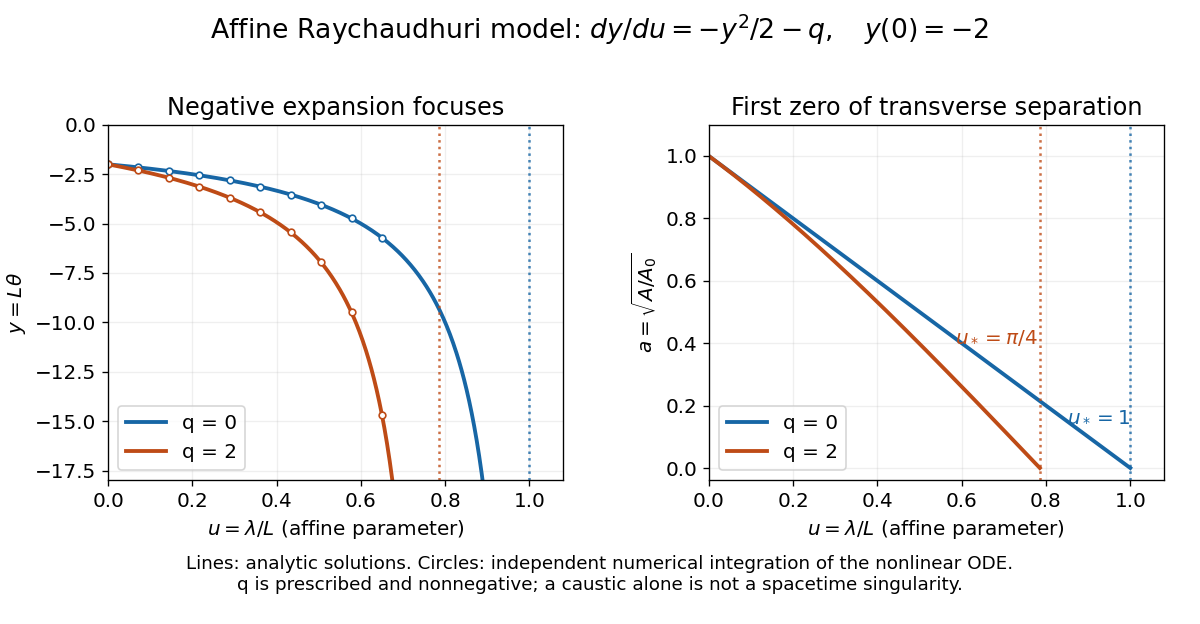
Finite affine focusing in two explicitly defined Raychaudhuri models
. Both beams start with . Curves show the exact solutions for and ; circles independently integrate . The first zeros occur at and , respectively. These are illustrative ordinary differential equation models, not fitted collapse data. Details.
A focal point makes this beam description degenerate, but individual null geodesics may continue smoothly through it. Even converging light in Minkowski spacetime can form a caustic. Converting local focusing into null geodesic incompleteness requires the global step below.
Articles by others on the same topic
There are currently no matching articles.