The geometry of affine spaces, studying incidence and parallelism without choosing an origin or a metric.
A nonempty set equipped with a group action of the additive group of a vector space , such that for every there is a unique with . There is no distinguished origin. Choosing one identifies with ; changing it gives a translation.
Choosing a new origin in a vector space transports its operations along . Since and , every vector space axiom transfers through this bijection. The new additive identity is and the additive inverse of is . This illustrates why an affine space has no preferred origin even though choosing one produces a vector space.
Points in an affine space are affinely independent if the only affine dependence displayed above has all coefficients zero, using any choice of origin to read the vector equation. Since the coefficients sum to zero, replacing the origin leaves that equation unchanged. Substituting shows that this condition is equivalent to linear independence of . It also says that an affine combination of the points has unique coefficients. In , at most points can be affinely independent; such points span a full-dimensional simplex.
The points with integer coordinates in a real d-dimensional affine space with a chosen origin and coordinate basis. Translations by integer vectors and dilations by positive integers preserve this set. The Gallai theorem for an integer lattice concerns finite colourings of these points and homothetic copies of finite configurations of them.
A translation and positive uniform scaling of a finite configuration in a real vector space. It preserves the ratios and directions of differences between its points. In an integer lattice, the Gallai theorem for an integer lattice guarantees a monochromatic homothetic copy of every finite pattern in any finite colouring, with positive integer scaling factor.
An affine combination is a weighted point with . The coefficients can be negative. The sum is meaningful in an affine space without selecting a preferred origin: relative to any point , it means . Affine maps preserve these weighted points. [ref]
For an original example in the Euclidean plane, take , and . Then lies inside their triangle. Its coefficients are nonnegative, making it a convex combination. In contrast, is beyond : it is an affine combination but not a convex combination of these three points. Negative weights allow extrapolation, rather than only interpolation inside the convex hull.
For the affine map , the same weights produce from , and produce from . Thus one can compute a weighted point before transforming the vertices or afterwards, obtaining exactly the same point.
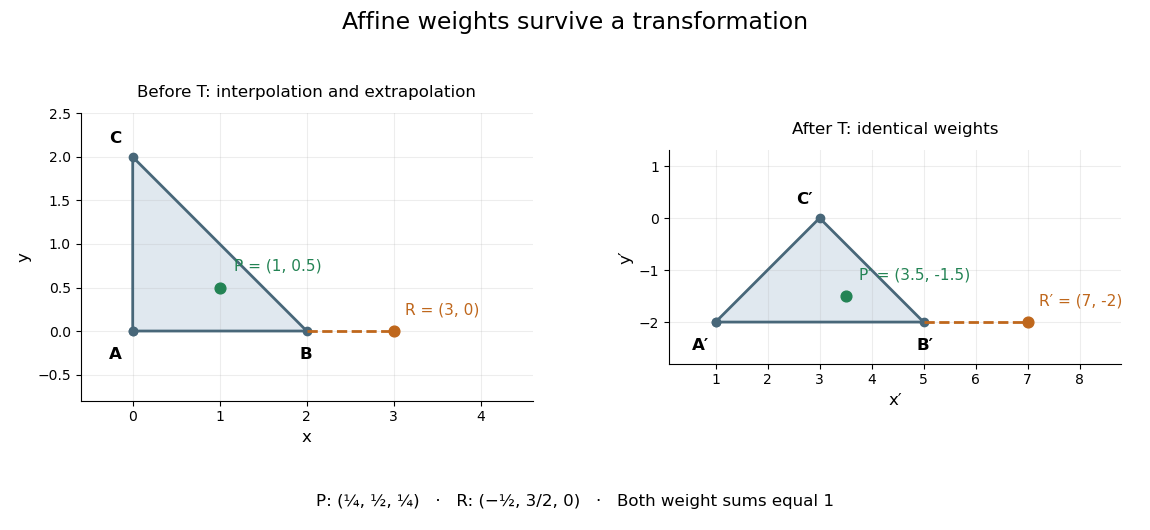
This is useful whenever an object is built from weighted control points: its construction commutes with an affine map, so transforming the control points transforms the constructed object as well. The sum of the weights is the essential condition; no assumption about lengths or angles is needed.
Keep the basis fixed and replace the origin by a point with old coordinates . Each point's coordinates change from to . For coefficients with sum one, the weighted coordinates becomeAdding the new origin gives the original point. This proves origin independence rather than asserting that the coordinate tuples themselves stay unchanged.
The requirement cannot be omitted. In the example , , blindly treating as a point gives in the old coordinates. If the new origin is , the two coordinates become and ; adding them and restoring instead gives . The coefficients sum to two, so this procedure has no origin-independent interpretation as a weighted point.
An affine map combines a linear map with a translation. After choosing coordinate origins, it has the form , , where the matrix is its linear part of an affine map and is a fixed vector. Equivalently, it preserves every affine combination. [ref]
Curves and Surfaces in Geometric Modeling: Theory and Algorithms by Jean Gallier. §2.7, Definition 2.7.1 and linear-map construction, pp. 37–38
An original planar example isIt stretches horizontally, applies a shear mapping, and then translates. The vertices , and become , and . A square grid becomes a grid of parallelograms; straight edges and their weighted points still fit together.
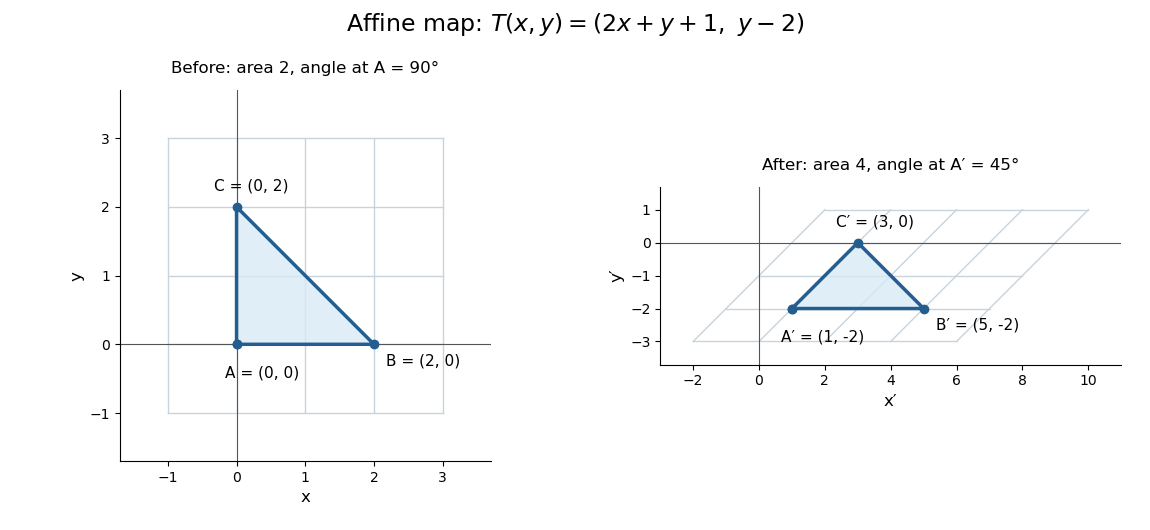
This map is not a linear map with respect to the displayed origins, because rather than zero. It also is not a Euclidean similarity: has length and has length , while the right angle at becomes . Its determinant is , so it doubles planar area. These metric changes explain why affine geometry studies straightness, incidence and weighted points rather than treating every transformation as an isometry.
The linear part is an invertible matrix, giving the concise inverse . More generally an affine map is bijective exactly when its linear part of an affine map is bijective. Between equal finite-dimensional spaces, this means an invertible matrix; the translation cannot repair a loss of rank of a linear map.
For coefficients with sum one, the defining identity follows from linearity:The translation appears once on both sides precisely because . In particular, midpoints map to midpoints, and a parameterized line segment , , maps to . A whole line has the same formula with ; its image is a line if , and a single point otherwise.
An affine map need not be injective. For , the direction belongs to the kernel of its linear part of an affine map. Consequently the whole line maps to , and every parallel line maps to . These are collapsed lines, not images with a surviving direction. Assertions that an affine map preserves distinct parallel lines require the appropriate noncollapse or injectivity hypothesis.
A Euclidean similarity is a map satisfying for a fixed . It has the form with orthogonal: after subtracting and dividing by , the map fixes zero and preserves distances, hence inner products by polarization, so it is a linear orthogonal map. It is a contraction if . Contracting Euclidean similarities define self-similar compact sets; the open set condition is a useful separation hypothesis for computing their Hausdorff dimension.
The map associated with an affine map ; it is independent of the translation . An affine Euclidean isometry has an orthogonal linear part, and an isometry between flat tori has a lift whose linear part carries one Euclidean lattice onto the other.
A closed half-space consists of a hyperplane and one of its two sides in a real affine space. Replacing the weak inequality by a strict inequality gives an open half-space. Half-spaces are convex sets, and finite intersections of closed half-spaces are linear polyhedra.
A half-plane is a half-space in a two-dimensional Euclidean space, consisting of points on one side of a line. For distinct centroids, each of the two Voronoi cells defined by their Euclidean distances is a closed half-plane bounded by their perpendicular bisector, with an explicit convention needed to assign boundary ties.
On an affine space modeled on a vector space, the map for a fixed vector . Its derivative is the identity, and . Changes between flat coordinates on a translation surface have this form.
Articles by others on the same topic



Affine geometry is a branch of geometry that studies the properties of figures that remain invariant under affine transformations. These transformations include operations such as translation, scaling, rotation, and shearing, which can alter the size and orientation of shapes but do not change their basic structure or ratios of distances. Here are some key concepts in affine geometry: 1. **Affine Transformations**: An affine transformation is a function between affine spaces that preserves points, straight lines, and planes.