
The polarization generated by the relevant third-order nonlinear optical susceptibility is proportional to . Multiplication of its temporal and spatial wave phase factors givesThe two opposing pump arrows in the original diagram mean . Thus the mixing source points along , and its conjugate signal amplitude drives a backward field. This is counterpropagating-pump phase matching in four-wave mixing.
There is a phase matching qualification to the initial frequency statement. In the stipulated nondispersive isotropic medium, . Exact equality of the backward free-wave vector to therefore requires , hence . For unequal frequencies the backward direction remains the geometry suggested by the source, but the longitudinal phase mismatch has magnitude . Efficient generation over a finite length requires that mismatch times be small; a sinc function factor suppresses conversion otherwise. Nondispersion does not remove the magnitude mismatch. The remainder of the calculation is explicitly degenerate four-wave mixing, so this difficulty disappears.
At the pump frequency, for the strong field , self-phase modulation and cross-phase modulation by dominate the weak signal's influence. They change its propagation wave phase through its own intensity and the other pump's intensity. With continuous uniform plane waves, these are nonlinear wave phase shifts; finite pulses acquire temporal chirp, and finite transverse beams can acquire a lens. No universal factor of two should be assigned between the two shifts without specifying their polarization contraction and the field-amplitude convention.
Write and . Differentiating the exponential substitutions cancels the terms proportional to :Consequently and . Conjugate the latter before eliminating a field: , so . The backward four-wave-mixing boundary problem requires opposite-end boundary conditions: , where , and . The transfer matrix isAt , , so . Substitution givesThe printed target expression for has the opposite overall sign. This is present in the original PDF, not just the transcription. With its stated first-order equations, the derivative at the far face must be . The boxed result has that derivative; the printed expression has its negative. Reversing the convention for the mixing coefficient could reverse the generated phase, but would also change the coupled equations. The result above satisfies the equations and both boundary conditions together.
At the entrance, , so the returned amplitude is proportional to the complex conjugate of the signal. An ordinary ideal mirror gives , with a fixed reflection coefficient , rather than . The mixing pumps supply both the extra energy and a wave phase reference. The ideal conjugate reflectivity and signal transmission areThe constancy of along the medium is another direct check. The relation between the incoming signal and outgoing waves allows net output energy to come from the pumps. As , the undepleted-pump approximation fails: the predicted fields would extract an appreciable pump fraction. This is the ideal four-wave-mixing oscillation threshold; saturation, pump depletion and noise seeding replace the divergent linearized solution. It is not an unlimited source of reflected power. Amplified phase-conjugated propagation and parametric oscillation are also the effects identified in the primary analysis by Amnon Yariv and David M. Pepper.[ref]
Amplified reflection, phase conjugation, and oscillation in degenerate four-wave mixing by Amnon Yariv and David M. Pepper. abstract, amplified conjugate propagation and parametric oscillation
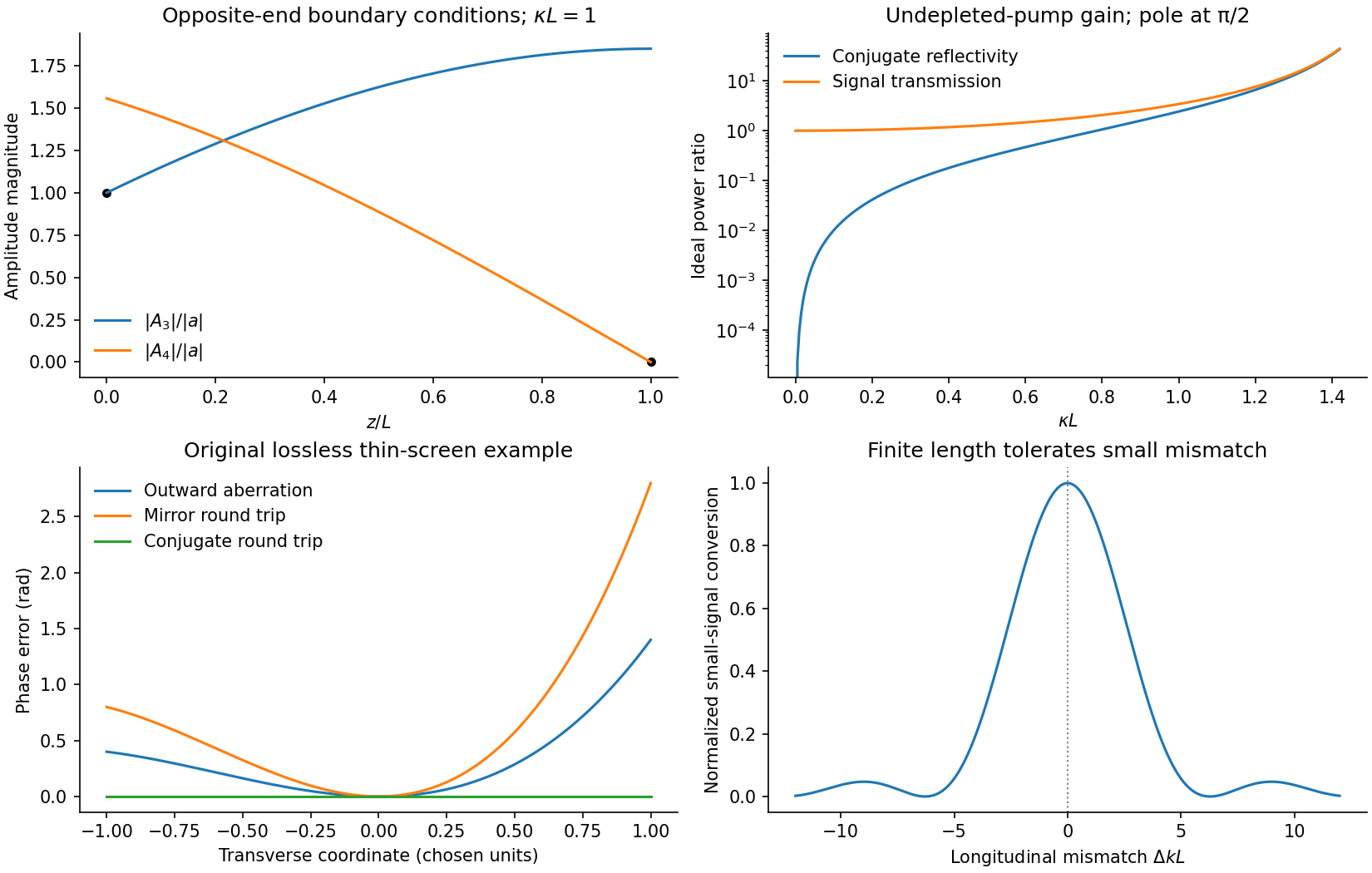

For the aberrating linear medium, assume its permittivity is real and stationary at this frequency. Taking the complex conjugate of the forward-envelope equation givesThis is the backward-envelope equation with carrier . Launching the conjugate boundary field therefore permits retracing of the distorted wave. In a transverse lossless phase screen model, let transmission be . A return proportional to acquires on its second passage and becomes . Thus the aberration phase cancels. A mirror instead gives , adding the aberration twice; merely reversing the central propagation direction does not reverse the wavefront phase.
The one-dimensional printed equation describes longitudinal variation; genuine transverse aberrations require the corresponding transverse Helmholtz equation or paraxial operator, for which the same real-coefficient conjugation argument applies. Exact reconstruction requires adequate aperture, the correct conjugate amplitude and polarization, uniform pump-product phase, and an unchanged reciprocal lossless medium. Absorption, missing scattered modes or a changed aberrator prevent a universal reconstruction. This is phase conjugation and thin phase-plate cancellation by phase conjugation under specified conditions, rather than reversal of every possible propagation loss.