
Marta Ferrero 2026-10-25
Past exam of the psychology and primary education course of the University of Oxford 2022 6 Solution 2026-10-25
Public understanding of neuroscience can be improved, and some neuromyth beliefs can be reduced, but better quiz performance does not itself establish better teaching or pupil attainment. The educational case depends on a chain from understanding to decisions, implementation and learning outcomes. Each link requires evidence. Brain-related language can inform a sound educational explanation, but its presence is not a substitute for a test of the proposed method.
A neuromyth is a misconception presented as following from knowledge about the brain. Examples include rigid learner types inferred from hemispheric labels or the claim that teaching should be matched to a learner's preferred sensory modality. Preferences and individual differences are real phenomena, but a preference for a format does not prove that learning is better in that format. Nor does a demonstration of neural involvement establish a unique classroom prescription: every learning activity has biological implementation.
Sanne Dekker and colleagues surveyed teachers about general brain knowledge and common neuromyth statements. Myth endorsement was frequent even in a sample interested in educational neuroscience, and greater general knowledge did not provide a simple guarantee against misconceptions. This is evidence about the co-occurrence of facts and beliefs in that sample, not a randomized test that neuroscience education makes teachers worse. Questionnaire wording and recruitment also affect prevalence estimates, so a headline percentage should not be generalized to every teacher.[ref]
Kelly Macdonald and colleagues compared respondents with different education and neuroscience backgrounds. Greater relevant training was associated with lower endorsement, yet misconceptions remained. Because training was not randomly assigned, the study cannot isolate its causal effect from selection, interests and other educational differences. Its value is to show that expertise and misinformation are not all-or-none categories. A useful public program needs more than exposure to additional terminology; it should support evaluating how a claim follows from evidence.[ref]
Dispelling the myth: training in education or neuroscience decreases but does not eliminate beliefs in neuromyths by Kelly Macdonald and others. 2017; cross-sectional training-background comparisons and persistent misconceptions
Deena Skolnick Weisberg and colleagues supplied a possible reason for undue credibility. Participants judged explanations that varied in quality and in whether they included neuroscience information irrelevant to the logic. Such information increased the apparent satisfaction of some explanations, particularly poor ones, among nonexperts; relevant expertise changed the pattern. This was a text-explanation experiment, not a demonstration that every brain image persuades a teacher or that all biological explanation is misleading. It suggests teaching people to ask whether the extra information actually improves the argument.[ref]
The seductive allure of neuroscience explanations by Deena Skolnick Weisberg and others. 2008; explanation-quality and irrelevant-neuroscience manipulations
The learning-style matching hypothesis makes the evidential requirement especially clear. Classify a preference before instruction, randomly allocate learners within each preference group to formats, and assess both with a fair common outcome. Matching predicts that the preferred format is better within each group. In notation, if is mean learning for preference and format , the visual/auditory version requiresA main effect in which one format helps everyone is not this pattern. Even a statistical interaction is insufficient if one format remains better in both groups. Preference reports or satisfaction ratings alone do not test the proposed learning advantage.
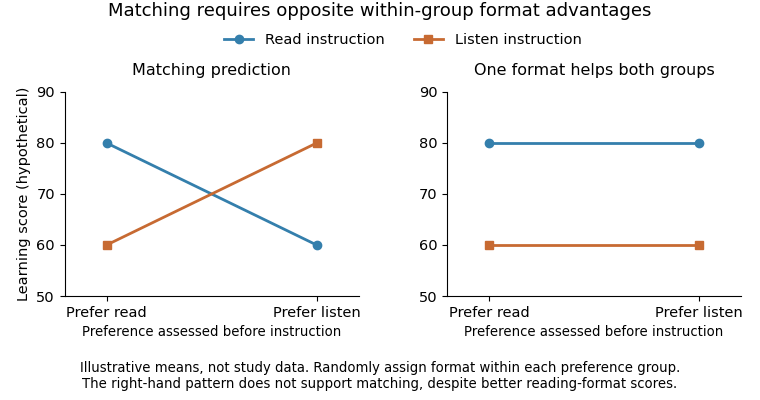
Original illustrative patterns for testing learning-style matching; hypothetical scores, not experimental data
. Details. 
Beth A. Rogowsky and colleagues tested preferences, instructional format and comprehension using audio and written materials with college-educated adults. The findings did not support the predicted matching benefit. That is a direct test of a specific meshing hypothesis, not proof that every individual difference is educationally irrelevant. Its adult sample also limits a claim about every primary-age child. A sensible response is to select representations for the content and learning goal, then evaluate their effect, rather than assign a permanent type from a preference questionnaire.[ref]
Matching learning style to instructional method: effects on comprehension by Beth A. Rogowsky and others. 2015; preference assessment, audio/e-text instruction and comprehension outcomes
Correction experiments provide a more direct answer about reducing myths. Marta Ferrero and colleagues exposed teacher-education students to refutation texts, variants adding origin information, and comparison conditions. Myth endorsement decreased immediately but the benefit was short-lived and intentions to use related educational methods did not show a corresponding improvement. This separates correcting a statement from changing an instructional decision. It also shows why an immediate post-course questionnaire is an incomplete evaluation of a neuroscience-literacy program.[ref]
An attempt to correct erroneous ideas among teacher education students: the effectiveness of refutation texts by Marta Ferrero and others. 2020; refutation conditions, delayed endorsement and intended teaching practices
The mechanism of a useful correction should therefore be considered rather than assumed. A refutation text can state what is wrong and supply a better explanation; repeated application to new examples could help learners use that explanation rather than merely remember the correct answer. Opportunities to compare claims, evaluate controls and identify an unjustified inference are plausible additions. Their effectiveness still needs testing, including retention and behavior, rather than being declared established because they sound scientifically sophisticated.
Educational benefit is possible through better decisions and reduced opportunity cost. Time and money spent diagnosing unsupported fixed learner types could be redirected to evaluating subject-specific instruction and formative assessment. A neuroscience account might also help explain genuine constraints without labeling them as immutable. Yet correcting a belief is not automatically equivalent to changing established classroom routines, and a teacher can use an effective practice while holding an inaccurate account of why it works. Evidence about beliefs should therefore not be used as a complete ranking of teaching quality.
A stronger evaluation would compare a neuroscience-literacy program with an equally credible program teaching general research literacy. It would measure immediate knowledge, delayed reasoning about unfamiliar claims, actual instructional choices and relevant pupil outcomes. Randomization and appropriate analysis of class or school clustering would help distinguish the effect from recruitment of unusually motivated teachers. Process measures could ask whether changed reasoning altered decisions, while implementation data show whether those decisions reached pupils. The benefit of a label such as “brain-based” should never be the outcome being optimized.
Reducing neuromyths is achievable to a degree, but durable understanding and positive educational effects must be demonstrated separately. The most promising aim is not collecting isolated brain facts; it is learning to connect a claim, its mechanism, a fair test and the outcome that matters. Neuroscience can contribute to that process alongside cognitive and educational psychology, with its practical value judged by evidence rather than prestige.