Two players independently choose venues or . Meeting at gives the ordered payoff pair ; meeting at gives ; choosing different venues gives . As throughout this article, the row player's payoff comes first:
| Row choice / column choice | ||
|---|---|---|
Against a column player choosing , the row player gets from and from , so is the unique best response. Against , the row player gets from and from , so is the unique best response. The column player likewise prefers to match the row choice. Thus and are pure strategy Nash equilibria, while each mismatched strategy profile has a profitable unilateral deviation.
For mixed strategies, let and be the row and column probabilities of choosing . The pure-choice expected payoffs areThe row player is indifferent when , giving . The column player is indifferent when , giving . The best responses are thereforeThese give exactly three Nash equilibria: . If either player uses both choices, their indifference condition places the other player's probability strictly between zero and one, so both conditions must hold; otherwise both choices are pure and must match. Notice whose equation determines whose probability: the row player's indifference fixes the column player's , and the column player's indifference fixes the row player's .
At the mixed Nash equilibrium, independence givesThus they meet with probability , and each receives expected payoff . Holding fixed, every row deviation gives ; holding fixed, every column deviation gives . This directly verifies the Nash equilibrium inequalities.
Both coordinated pure strategy outcomes strictly improve both players' expected payoffs over : and each do so. The mixed Nash equilibrium therefore fails Pareto efficiency, even though no unilateral deviation helps. Switching together can help when switching alone cannot. Neither coordinated outcome improves both players over the other, and both are Pareto efficient, even when a lottery over joint action profiles is allowed: any positive weight on another outcome reduces the payoff of the player receiving .
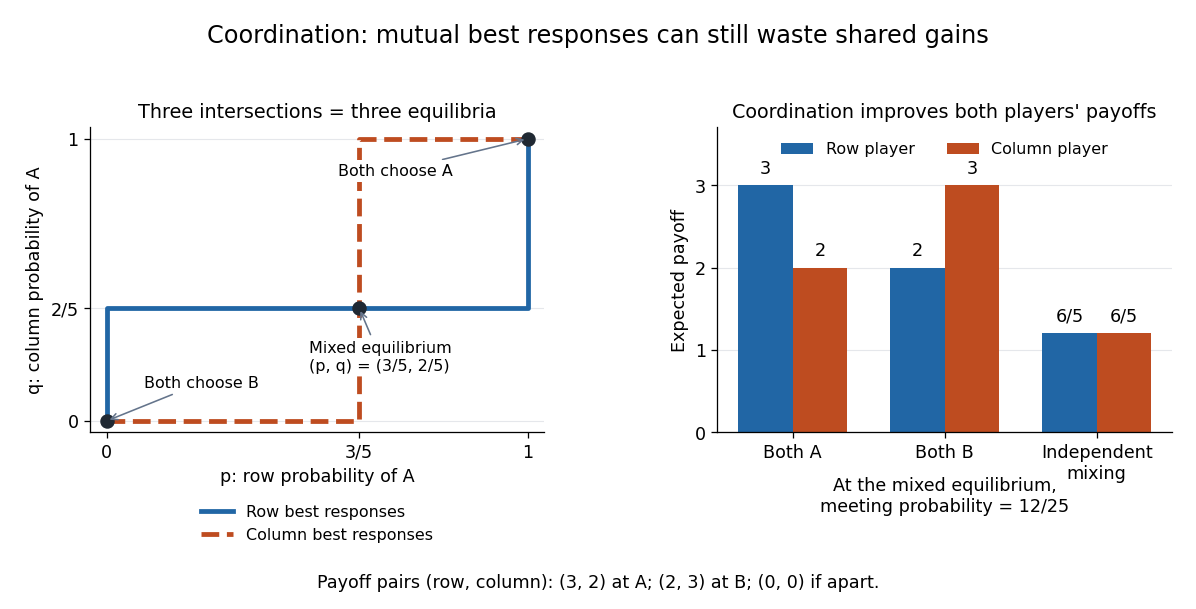
Asymmetric coordination: three best-response intersections and the cost of independent mixing
. Details. 
Articles by others on the same topic
There are currently no matching articles.