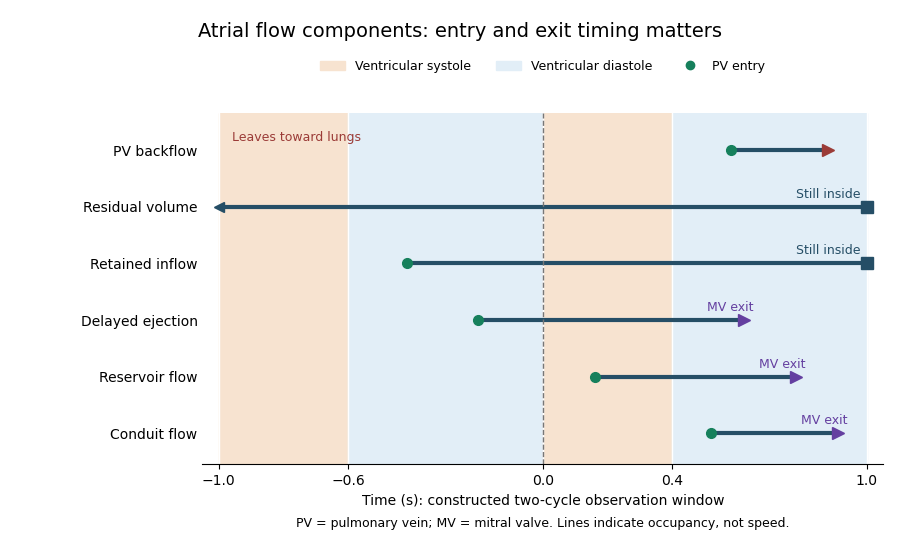
The atrial conduit flow component is blood entering the left atrium through the pulmonary veins during ventricular diastole and leaving through the mitral valve within that same ventricular diastole. The same-phase requirement distinguishes it from the atrial reservoir flow component and atrial delayed-ejection flow component.[ref]
An original two-history example shows why a volume curve alone cannot identify it. During a selected interval, suppose 20 mL enters the left atrium and 20 mL leaves through the mitral valve, leaving chamber volume unchanged. In history A, all 20 mL entering during that interval passes straight onward; it can qualify as atrial conduit flow component if the interval lies within one ventricular diastole. In history B, the 20 mL leaving is entirely older atrial blood, while the newly entering 20 mL stays behind. The same inflow, outflow and chamber volume change are compatible with different parcel identities.
The boundary balancecannot distinguish these histories. Here is net inward volumetric flow rate at the pulmonary veins and is net outward volumetric flow rate at the mitral valve. The additional information is the mapping between entry and exit, represented by pathlines.
This distinction also explains why atrial conduit function, a physiological role, and a particular volume-based proxy need not equal the atrial conduit flow component. A parcel volume collected over an interval need not be contained in the chamber simultaneously, so normalization requires an explicitly stated denominator rather than an assumed fraction of maximum atrial volume. The six histories below are constructed examples, not patient measurements.

Articles by others on the same topic
There are currently no matching articles.