An augmenting path in a matching is a nonempty alternating path in a matching with distinct endpoints that are both unmatched vertices in a matching. Its first and last edges lie outside . Thus it has unselected edges and selected edges, for some . Taking the symmetric differenceremoves the selected edges on and inserts its unselected edges. Each internal vertex exchanges one selected edge for another; each endpoint gains its first selected edge. All choices away from stay in place, so is a matching in a graph with .[ref]
Graph Theory by Reinhard Diestel. Matching, Covering and Packing, §2.1, printed p. 2: alternating paths, augmenting paths and symmetric difference
For an explicit repair, let the path graph have vertices in that order and start withThe endpoints and are initially unmatched vertices in a matching. Along the edges are outside, inside, outside, inside, outside . Remove and , then add together:This raises the cardinality from two to three and gives a perfect matching. Six vertices allow at most three disjoint pairs, so it is also a maximum cardinality matching. The initial is already a maximal matching: every unused edge touches a matched vertex. Augmentation succeeds because it can replace earlier choices instead of only adding to them.
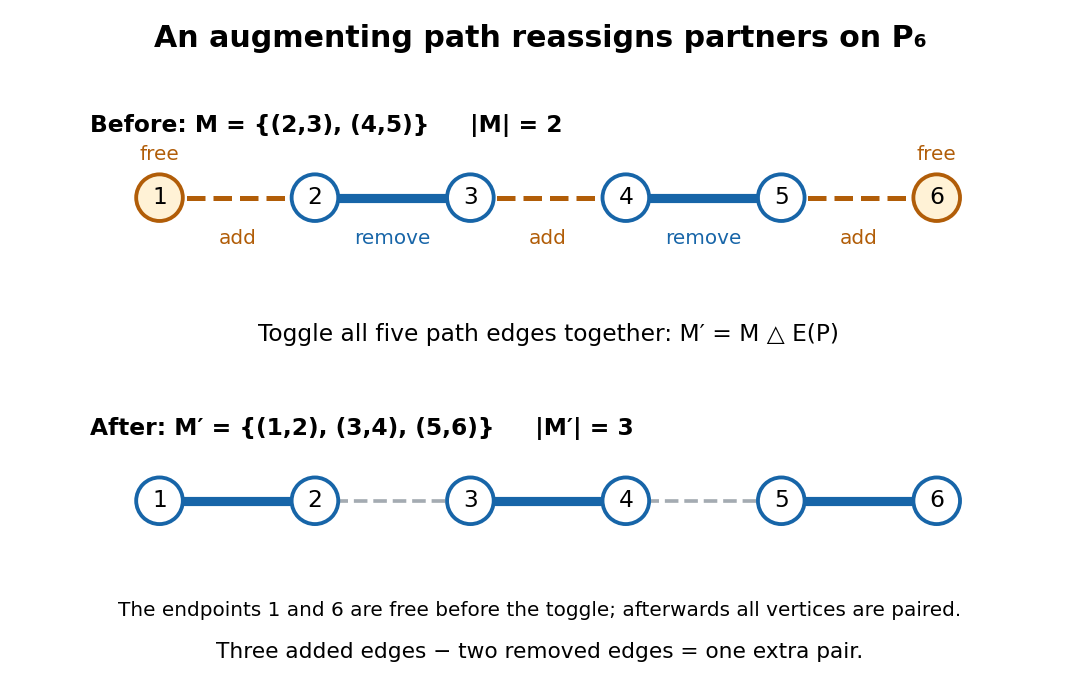
The augmenting path in a matching on P₆ replaces two selected edges by three using symmetric difference
. Details. 
One unused edge joining two unmatched vertices in a matching is the shortest possible augmenting path in a matching. Longer augmenting paths in a matching reassign several partners, explaining why a stalled greedy matching need not be optimal. For edge benefits , the change in total benefit iswhich need not be positive even though the cardinality increases. A maximum-weight matching therefore needs a different optimality test. In an assignment equality graph an augmenting path in a matching moves toward a perfect matching while preserving zero reduced costs on matched edges; this is the setting used by the Hungarian algorithm.
For a finite simple graph and a matching in a graph , is a maximum cardinality matching if and only if has no augmenting path in a matching relative to . The graph need not be a bipartite graph, and the assertion concerns cardinality, not edge benefits.[ref]
Two theorems in graph theory by Claude Berge. Claude Berge, Two theorems in graph theory, printed p. 842: finite unoriented graph and Problem 3; printed p. 843, Theorem 1: maximum matching and absence of an alternating chain between neutral points
The criterion turns a global comparison with every competing matching in a graph into a search for one repair. Starting from any matching in a graph, repeatedly find and toggle an augmenting path in a matching. Each step adds one selected edge, so finiteness gives termination after at most steps; absence of any further augmenting path in a matching certifies maximum cardinality. This is an optimality criterion, not by itself a bound on the work needed to find each graph path.
For a short proof outline, an augmenting path in a matching immediately contradicts maximum cardinality. Conversely, if another matching in a graph has , consider the subgraph whose set of edges is . Its vertices have degree of a vertex at most two; its nontrivial connected components are graph paths and even cycles in a graph, alternating between the two matchings in a graph. A cycle in a graph contributes equal numbers from each. Hence some graph path contributes one more edge from than from and starts and ends with edges from . Its endpoints are unmatched vertices in a matching relative to , yielding the required augmenting path in a matching.
The two sides have vertices each. Given a nonperfect matching in a graph, choose unmatched vertices on opposite sides. An unmatched neighbour of either supplies a one-edge augmenting path in a matching. Otherwise their neighbours are matched; the matched left vertices corresponding to and the set have total size greater than , so they intersect. This supplies the alternating path in a graph with in the matching in a graph. Repeated augmentation produces a perfect matching.
Choose such an augmentation deterministically. Its reverse is specified by at most four vertices, giving at most preimages for a matching in a graph of the next size. Thus the matching generating function coefficients satisfy .
Articles by others on the same topic
There are currently no matching articles.