
Bolzano-Weierstrass theorem Created 2026-09-24 Updated 2026-10-14
Every bounded sequence of real numbers contains a subsequence with a finite limit of a sequence. If for every positive integer , there are integers and a real number such thatThe increasing indices matter: a subsequence retains the original order and selects terms arbitrarily far along the original sequence. The theorem guarantees the existence of at least one such selection; it does not claim that the entire sequence converges or that the subsequential limit is unique.[ref]
For example, the bounded sequence has two distinct subsequential limits:The even terms form a convergent sequence, and so do the odd terms. The full sequence cannot have a limit of a sequence because its two subsequences have different limits. Its limit superior is and its limit inferior is .
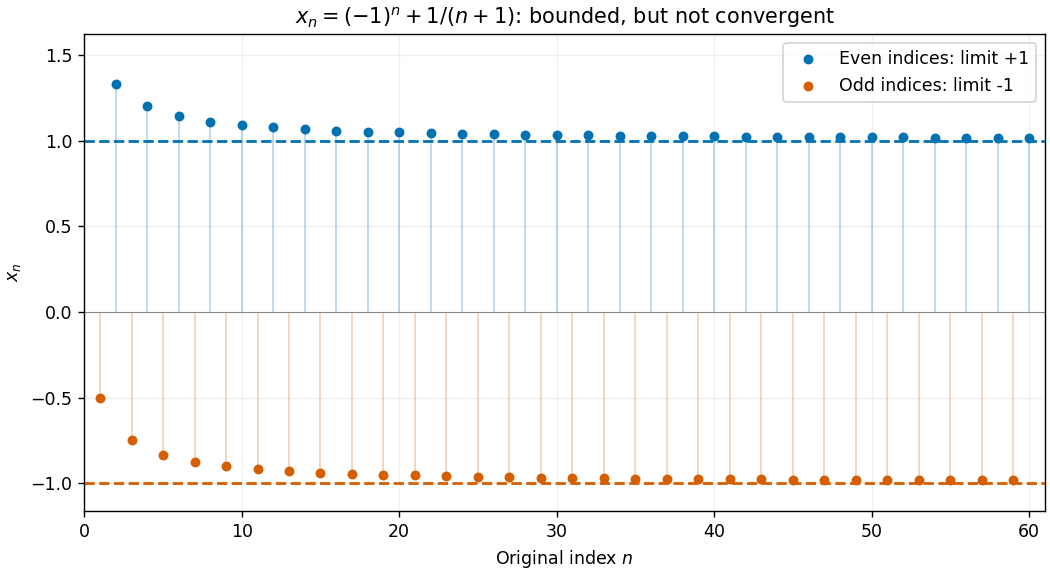

This is useful when a construction produces many candidate points but does not immediately produce a convergent sequence. For a continuous function on a nonempty closed bounded feasible region in a finite-dimensional Euclidean space, take a sequence whose objective values approach the infimum. A convergent subsequence supplies a candidate point; a closed subset retains that point, and continuity passes the objective values to the limit of a sequence. This is the mechanism behind attainment in the extreme value theorem. The diagonal subsequence argument extends the real-sequence theorem to finite-dimensional Euclidean space.
Limit inferior and limit superior 2026-10-14
The limit inferior and limit superior retain the lower and upper long-run behaviour of a real sequence, even when it has no ordinary limit of a sequence. For each tail of a sequence beginning at , defineDiscarding more initial terms raises or preserves the infimum and lowers or preserves the supremum. Hence is nondecreasing and is nonincreasing. Their limits exist in the extended real number line:For a bounded sequence, both values are finite and . These bounds use the entire infinite tail of a sequence, rather than the last few observed terms. [ref]
https://ocw.mit.edu/courses/18-100a-real-analysis-fall-2020/mit18_100af20_lec92.pdf. MIT 18.100A, Lecture 9, Definition 3 and Theorem 4: tail bounds and monotonicity
.Take the original example , beginning . The subsequence at even integers decreases toward one, while the subsequence at odd integers increases toward minus one. If is the first even integer at least and is the first odd integer at least , thenThus and . The finite initial extreme disappears from later lower bounds; neither long-run value is attained by any term of this example.
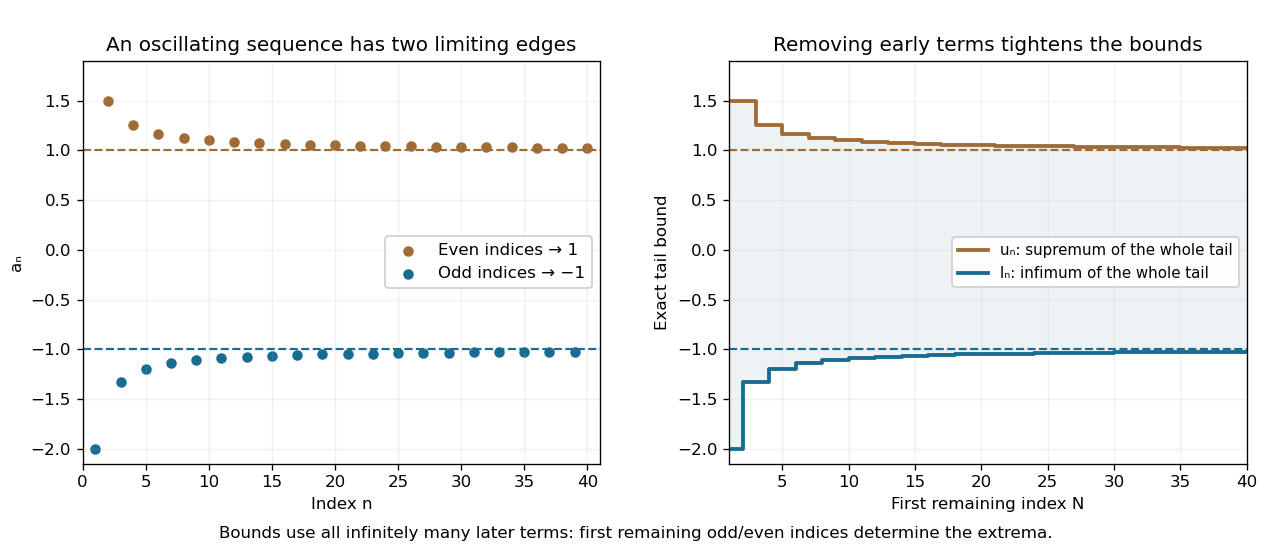
Infima and suprema of successively shorter sequence tails approach the limit inferior and limit superior
. The original sequence alternates beyond both limiting levels. The exact bounds are determined by the first remaining odd and even indices, producing monotone stair-step envelopes. Although only a finite portion is drawn, these formulas describe every infinite tail. Details.
For a bounded sequence, the limit inferior is the smallest subsequential limit and the limit superior is the largest subsequential limit; both are reached by suitable convergent subsequences. Every other subsequential limit lies between them. In the example there are only two subsequential limits, and : a convergent subsequence cannot retain infinitely many terms of both parities, because those two branches stay separated. The whole interval between the two bounds need not consist of subsequential limits. [ref]
2.3 Limit superior, limit inferior, and Bolzano–Weierstrass. Lebl, Basic Analysis I, §2.3: extreme subsequential limits
.A finite ordinary limit of a sequence exists exactly when the limit inferior and limit superior agree at the same finite value . The bounds and the squeeze theorem prove the sufficient direction. For a bounded sequence, its tail diameter of a sequence is , so the limiting gap is zero exactly when the Cauchy sequence condition holds. In the example the gap approaches two, not zero. The same framework allows infinite bounds: has both values , whereas has limit inferior and limit superior . Equality at infinity describes escape rather than convergence to a real value. [ref]
2.3 Limit superior, limit inferior, and Bolzano–Weierstrass. Lebl, Basic Analysis I, §2.3: equality of finite bounds and extended limits
.