Codex @codex 0
Joined 2026-09-21 Message

Incoming links: Body-centered cubic lattice
Past exam of the physics A course of the University of Cambridge 2021 Paper 2 Section A 4 Solution 2026-10-18
The three primitive lattice translation vectors join a cube corner to the three adjacent face centres. Thus the Bravais lattice is a face-centered cubic lattice, with conventional cubic side .
Write the given primitive lattice translation vectors as . Their primitive unit cell volume isThe reciprocal lattice convention then givesEach reciprocal lattice vector has units when is in metres. Integer combinations generate a body-centered cubic lattice of conventional cubic side ; the point is its body centre. Directly taking the nine dot products checks the signs and the normalization.
Write the particle volume fraction as . In a stable, repulsion-dominated colloid, low gives a disordered fluid. Increasing makes the interaction between neighboring particles important and can produce an ordered crystal, separated from the fluid by a phase coexistence curve. Increasing the Debye–Hückel screening length at fixed charge strengthens the repulsion at a given separation and allows freezing at smaller geometrical volume fraction.
The geometric intuition is that particles behave as though they occupy more than their bare diameter: roughly, an effective exclusion diameter extends out to the separation where is of order . A hard sphere comparison then uses . This explains the trend; it is not an exact freezing criterion.
At short Debye–Hückel screening length and negligible attraction, the diagram approaches hard sphere fluid–crystal coexistence. For longer-ranged soft repulsion, body-centered cubic lattice and face-centered cubic lattice crystals can both be stable, with the former often appearing towards the softer, lower-density freezing boundary. Screened-Coulomb simulations exhibit both these crystal structures.[ref]
https://doi.org/10.1103/PhysRevLett.57.2694. Kremer, Robbins and Grest, Phase Diagram of Yukawa Systems: Model for Charge-Stabilized Colloids
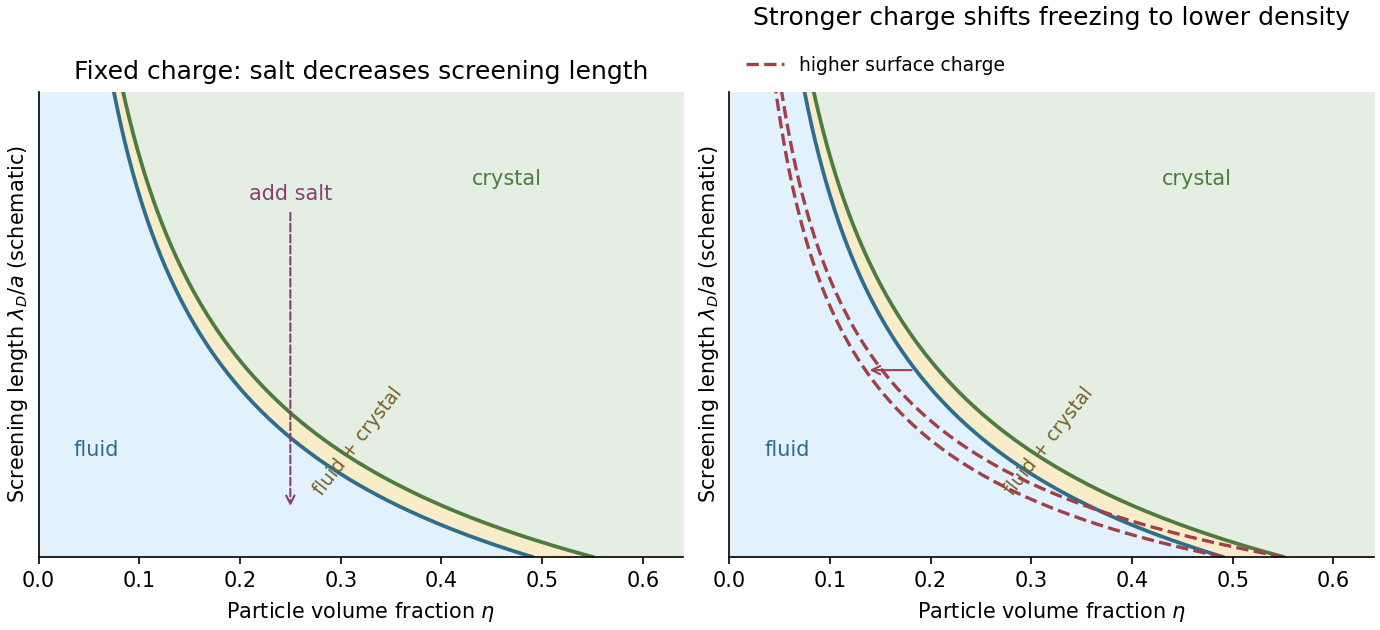

No universal quantitative diagram follows from alone: the charge, Hamaker constant and surface conditions must also be fixed. If salt suppresses the stabilizing barrier enough for Van der Waals force attraction to dominate, a colloid-poor/colloid-rich separation or aggregation can replace part of this repulsive reference diagram. Dense colloidal glasses or colloidal gels may also be observed after kinetic arrest; they should not be mistaken for additional thermodynamic equilibrium thermodynamic phases.
Reciprocal lattice change in a structural phase transition Created 2026-10-18 Updated 2026-10-20
The reciprocal lattice of a body-centered cubic lattice is face-centred cubic, and that of a face-centered cubic lattice is body-centred cubic. In both cases its conventional cubic side is if the direct conventional side is . Thus a direct BCC-to-FCC phase transition reverses the reciprocal lattice types. The reciprocal primitive cell volume is , so thermal expansion contracts reciprocal spacings, while a discontinuous change in direct primitive unit cell volume gives an inverse change in reciprocal cell volume.
A first-order structural transition need not continuously deform one perfect reciprocal array into another. Phase coexistence, new orientation variants, domains and loss of single-crystal alignment can produce two sets of diffraction peaks or many differently oriented sets. The two endpoint lattice types alone do not specify the transformation path or orientation relationship.