Knowing the radius of convergence does not settle convergence on its boundary. The three power seriesall have radius one, but behave differently on .
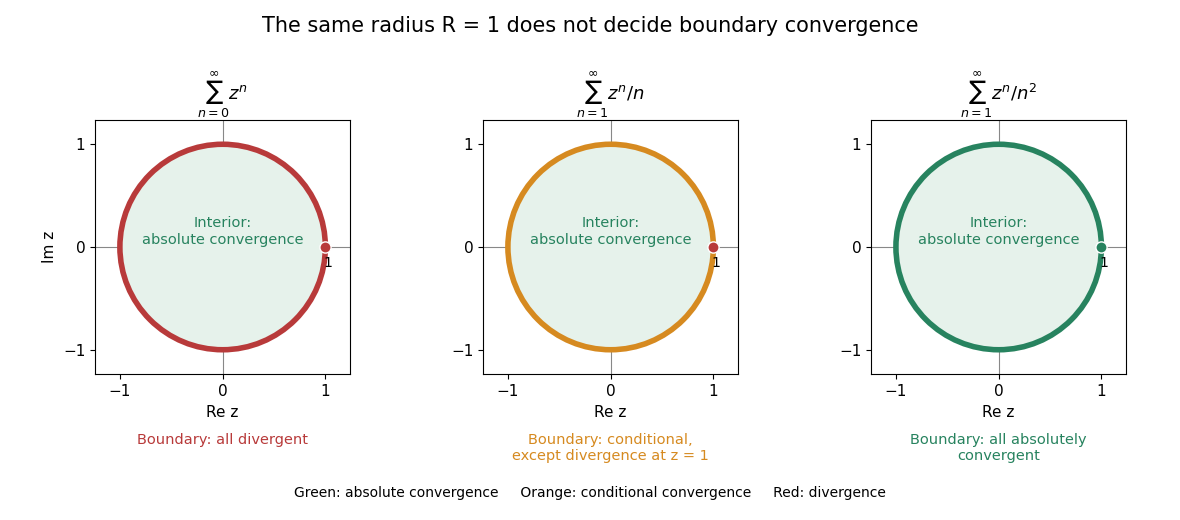
The same radius of convergence permits three different behaviours on the unit circle
. Green denotes absolute convergence, orange conditional convergence, and red divergence. All three series converge absolutely in the open unit disk. On its boundary, the geometric series diverges everywhere; the series converges conditionally except at ; the series converges absolutely everywhere. Details.
For the geometric series, boundary terms all have complex modulus one, violating the term test for divergence. For the second series, absolute values give the divergent harmonic series at every boundary point. At the series itself is harmonic and diverges. At any other point on the unit circle, its geometric partial sums obeyThe Dirichlet test with the decreasing sequence therefore gives conditional convergence. In particular, gives the negative of the alternating harmonic series, with sum . For the third series, the convergent p-series bounds the absolute values at every boundary point, giving absolute convergence by the comparison test for series.
At , the rational function is well defined and equals , yet its geometric series diverges there. A formula for a function and a particular series representation can have different domains. Likewise, applying termwise differentiation of a power series preserves the radius but need not preserve the boundary convergence.
Articles by others on the same topic
There are currently no matching articles.