Compare two rays scattered into parallel outgoing directions from neighboring lattice planes. In the diagram, lies on the upper plane and on the lower plane, directly beneath with . Draw through the incoming and outgoing equal-wave phase fronts, perpendicular to their respective rays. They meet the lower ray at and . Each right triangle gives , so the lower ray travels the extra distanceThe resulting phase difference is . Constructive interference requires , which proves Bragg's law in this ray construction. Comparing equal-wave phase fronts, rather than arbitrary ray endpoints, is what makes the distance comparison meaningful.
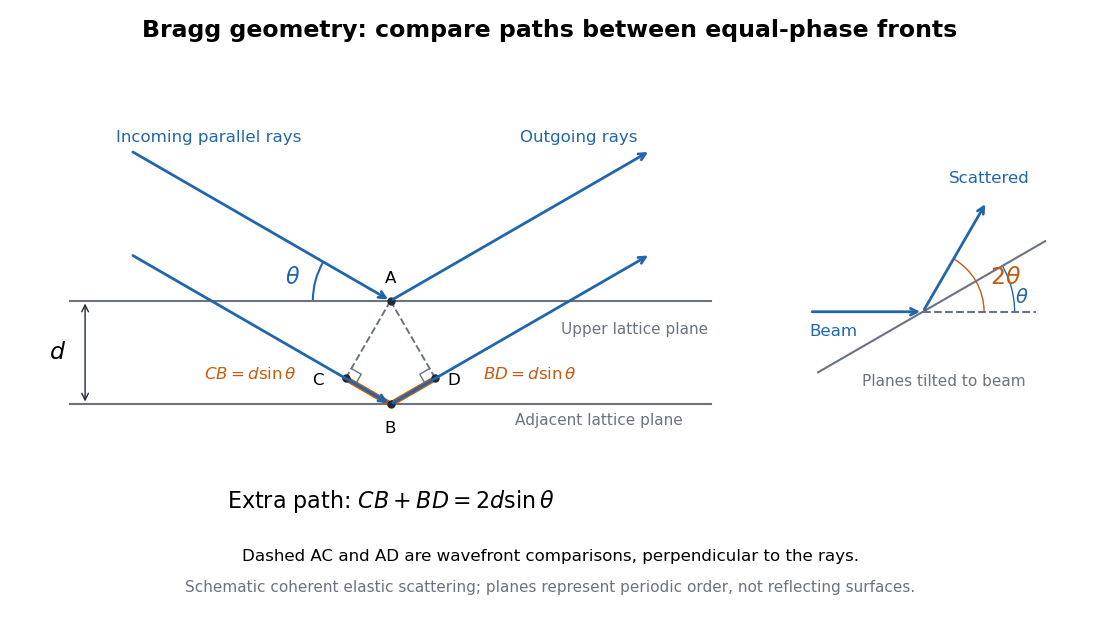
Bragg rays, extra path, and the distinction between the glancing angle and scattering deflection
. Original schematic of coherent elastic scattering. The orange segments give the extra path ; dashed segments compare equal-wave phase fronts. The separate angle sketch shows why the outgoing beam is deflected by when the Bragg angle is . The illustrated angle is schematic. Details.
The same geometry connects to the reciprocal lattice. With wavenumber , the elastic Bragg scattering condition gives a transfer magnitude . A reciprocal vector normal to these lattice planes has . Equating them again yields Bragg's law. The ray and reciprocal lattice descriptions therefore express the same wave phase matching.
Articles by others on the same topic
There are currently no matching articles.