A 2-core can contain bridges in a graph, and even vertices that lie on no cycle in a graph. Consider the dumbbell graph, also called a barbell in this example, made of two disjoint triangles in a graph joined by a graph path with two internal vertices:Here have degree of a vertex three, and every other vertex has degree of a vertex two. No deletion is possible, so the whole graph is its 2-core. Yet are bridges in a graph: deleting any one separates the two triangles. None belongs to a cycle in a graph, and belong to no cycle in a graph either. Keeping only edges on graph cycles would incorrectly discard the entire joining graph path.
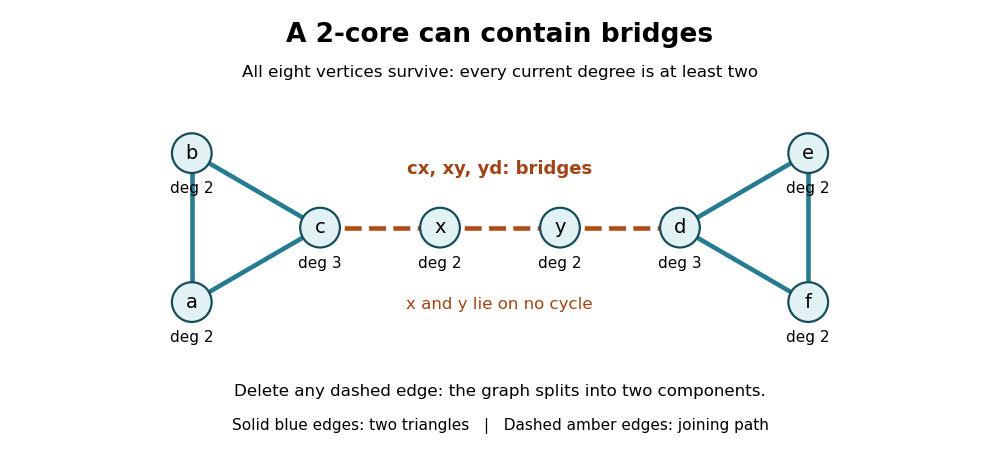
Every vertex of this dumbbell graph survives in the 2-core, including the joining graph path whose three edges are bridges in a graph
. Details. 
Every cycle in a graph does survive pruning, because each of its vertices keeps its two cycle graph neighbours. The barbell shows that the converse fails: the 2-core can be larger than the union of all graph cycles. Its condition is local minimum degree, not protection against a single connection failing.
A biconnected component is a different object: a maximal connected subgraph with no cut vertex of its own. Under the block convention used here, the barbell has five biconnected components: its two triangles and its three individual joining edges, each with its endpoints. Its cut vertices are . A 2-connected component with at least three vertices must remain connected after any single vertex is deleted; the whole barbell fails that test. An informal phrase such as "biconnected core" therefore needs its own definition and must not be substituted for 2-core. Even an isolated edge is a block under this convention, although its 2-core is empty.
The usefulness of the 2-core is this precise separation of local persistence from global robustness. In a connected graph with nonempty 2-core, the deleted vertices form a forest, with each of its connected components of a graph attached by exactly one edge to the 2-core. Otherwise a deleted graph cycle, or a graph path joining two surviving attachment points, would itself have survived. Stripping these attached trees exposes a smaller structure for studying graph cycles, graph excess and the graph kernel, while preserving the joining bridges in a graph that organize that structure.
Articles by others on the same topic
There are currently no matching articles.