A tree is a nonempty connected graph containing no graph cycle. Think of seven locations joined so that everyone can reach everyone else, but no connection supplies an alternative route. For a finite simple graph with vertices, three descriptions are equivalent: being a tree; having exactly one simple graph path between every pair of distinct vertices; and being a connected graph with exactly edges. Here a simple graph path repeats no vertex. Connectedness in the last description is essential. [ref]
https://www.maths.tcd.ie/~dwilkins/Courses/MA2C03/MA2C03Courseware_2014to15/MA2C03_S4_Yr1415.pdf. Trinity College Dublin, graph theory notes, Theorems 4.24–4.26 and Corollary 4.27
For a concrete tree, label the vertices and take the edgeswhere abbreviates the unordered pair . There are seven vertices and six edges. The unique graph path from to is , using five edges. The degree sequence in label order is : its sum is , as the degree-sum formula predicts. Each of is a leaf of a graph, having vertex degree one.
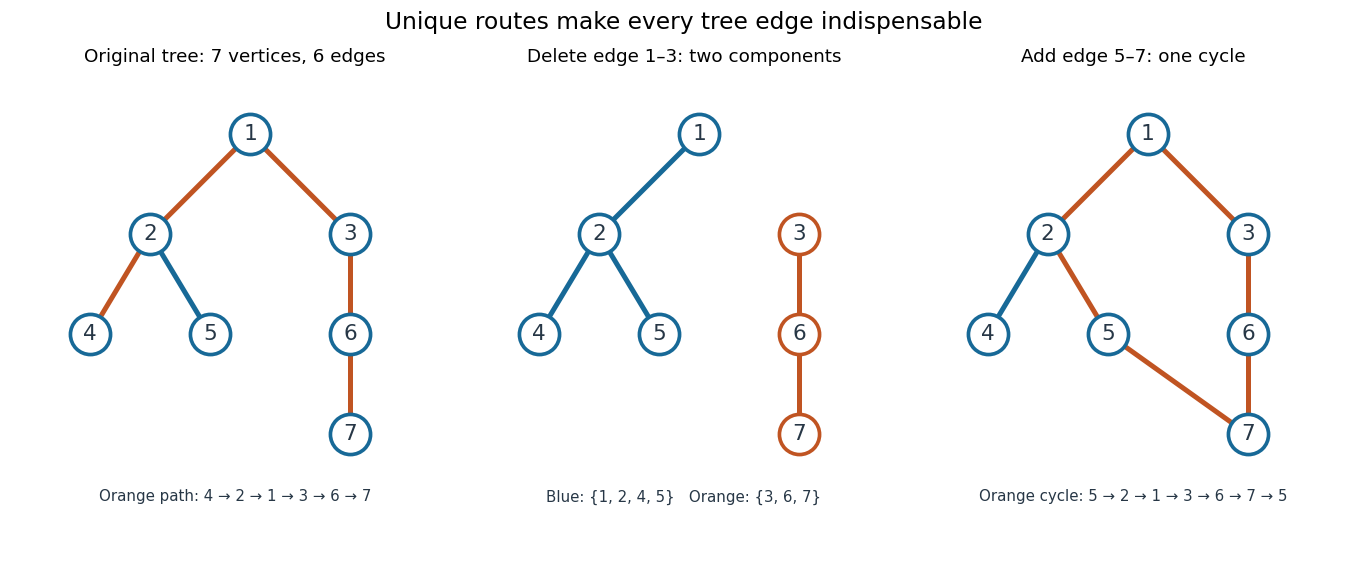
A seven-vertex tree: one graph path, two connected components of a graph after deletion, and one graph cycle after insertion
. Details. 
Deleting edge leaves precisely two connected components of a graph, on and . Every edge of a tree is a bridge in a graph. Instead add edge to the original tree: it closes the unique existing graph path into exactly one graph cycle. Thus a tree provides economical connections with no redundancy: a single failed link separates locations. Every finite tree with at least two vertices has at least two instances of a leaf of a graph; the endpoints of a longest graph path supply them. [ref]
https://www.mathstat.dal.ca/~janssen/2113/notes/class14/. Dalhousie University, Trees: leaves and indispensable edges
The number alone proves nothing about connectedness: a cycle graph on together with an isolated vertex has seven vertices and six edges, yet is disconnected. Briefly, two different simple graph paths between the same vertices would contain a graph cycle. Repeatedly removing a leaf of a graph and its incident edge proves the tree count by mathematical induction, starting with one vertex and no edges.
Articles by others on the same topic
There are currently no matching articles.