For , an end is a universal object with maps satisfying for every . Every other such family factors uniquely through . For small in a complete category, it is the equalizer of the two maps .
A categorical cone is a categorical limit precisely when is a bijection for every object . This is exactly the universal property expressed as a test on hom-sets. Consequently a functor preserves existing categorical limits if every composite with a covariant representable functor does.
With chosen -shaped categorical limits, the limit functor sends each diagram in a category to its limit object. A natural transformation induces the unique morphism compatible with the limit-cone projections. It is a right adjoint to the constant diagram functor, so it preserves existing categorical limits.
A finite limit is a categorical limit whose indexing category has finitely many objects and morphisms.
A terminal object and pullbacks in a category give binary products by pulling back the two terminal maps. The diagonal is the equalizer of the product projections; pulling it back along gives an equalizer of any parallel pair. A finite diagram then has a categorical limit as the equalizer of two maps from the product of its object values to the product of its arrow targets. The two maps encode source-image and target projections, so the equalizer enforces every cone equation.
In the finite-limit convention, a Cartesian category is a category with all finite limits, equivalently a terminal object and all pullbacks in a category. Some authors use the term for finite products alone, so the convention matters in constructions requiring equalizers.
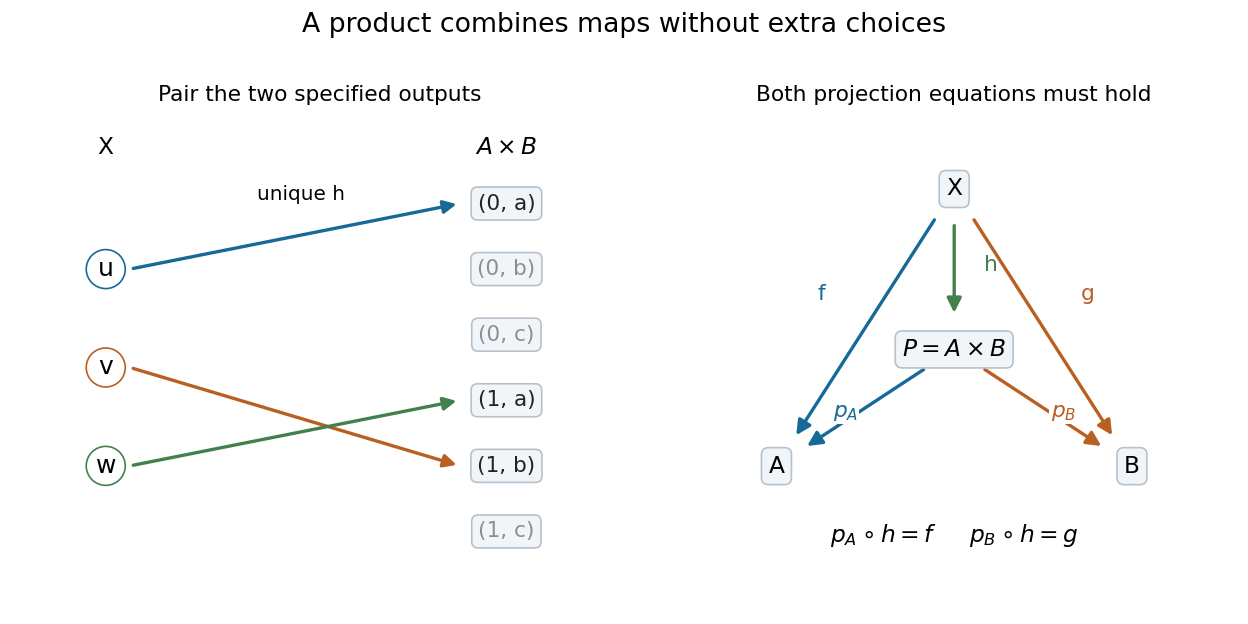
A binary categorical product of objects of a category is an object with categorical morphisms and . Its universal property is that, for every object and pair of arrows , , there is exactly one arrow satisfyingThe arrows are called the product projections. Existence lets us combine two maps; uniqueness means there is no extra unspecified information in the combined map.
In the Category of sets, take and . Their Cartesian product contains six ordered pairs, and the projection maps select the first and second coordinates. Let , , , , and , , . The unique required map is , , . Reading either coordinate recovers the corresponding input map.

In a partially ordered set viewed as a category, the projection arrows mean and . The universal property says that every common lower bound satisfies , so is the greatest lower bound. For subsets ordered by inclusion this is , the intersection; it is a different construction from the Cartesian product in the Category of sets because the allowed arrows have changed.
The universal property also compares any two proposed products: each supplies a unique map to the other compatible with the projections. The two composites have the same projections as the corresponding identity morphisms, so uniqueness makes them identities. Thus a categorical product is determined up to a unique projection-preserving isomorphism, which explains why we can use whichever concrete construction is convenient.
For a binary product in a category, the diagonal is the unique map whose two projection composites are . It is a split monomorphism, since either projection is a left inverse. The diagonal converts equality of two maps into a lifting problem: factors through exactly when .
A split equalizer consists of and with , together with maps , satisfying , , and . If , these identities give , so is its unique factorization through . Thus it is an equalizer, and every functor preserves it: all the defining identities survive application of the functor. Interchanging gives the other orientation of the same convention.
For a monad , the map is a split equalizer of with retraction and splitting . The map is a split equalizer of with retraction and splitting . Each assertion follows from the two unit laws and naturality of the unit or multiplication. No assumption that preserves arbitrary equalizers is needed.
The pullback of is a universal commutative square with an object mapping to and . In the Category of sets, it is the set of pairs with equal images in .
Given a pullback in a category and a morphism , assume the indicated pullbacks in a category exist. The four base-changed objects form a pullback in a category. A compatible pair of morphisms into and gives morphisms into and a common morphism into . The first two morphisms factor uniquely through , and their common image in permits unique factorization through . This proves the displayed canonical isomorphism without an assumption that the whole category is complete.
In a commutative diagram consisting of two horizontally adjacent squares, if both squares are pullbacks in a category, their outside rectangle is a pullback in a category. If the right square and the outside rectangle are pullbacks in a category, the left square is a pullback in a category. To prove the first assertion, factor a compatible pair of morphisms first through the right square and then through the left square. For the second assertion, factor through the rectangle and use uniqueness in the right square to recover the prescribed middle morphism. Each factorization is unique by the same universal properties.
The kernel pair of a morphism is the pullback in a category with its two projections to . It is the universal parallel pair equalized by .
Every epimorphism in an abelian category is the coequalizer of its kernel pair. Its kernel-pair square is a pullback in a category along an epimorphism and therefore also a pushout. A map equalizing the two projections supplies the same map on both pushout legs and so factors uniquely through the original epimorphism. In particular, all such epimorphisms are regular epimorphisms.
If all small products and equalizers exist, the limit of is the equalizer of the two mapswhose -coordinates are respectively after projection to and direct projection to .
A category is complete when it has every small limit. Small products and equalizers suffice to construct all small limits.
A functor is initial when every comma category is nonempty and connected. Restriction along an initial functor preserves limits:
A functor is initial if restriction preserves categorical limits for diagrams in a category with codomain . To test necessity, view as such a diagram. Its limit is a singleton, since the colimit of the corresponding representable presheaf is the connected-component set of the slice , which has a terminal object. The restricted colimit is the connected-component set of . Thus that comma category is nonempty and connected. Sufficiency follows from cone restriction along an initial functor.
For an initial functor , restriction gives an isomorphism between the category of cones over and that over . Given a cone over , choose and define its -leg as ; connectedness of makes the result independent of the choice.
Articles by others on the same topic
There are currently no matching articles.