A category specifies objects of a category, categorical morphisms between them, and composition in a category. An arrow can be followed by , giving . Every object has an identity morphism , and the rules satisfyAssociativity means that grouping a chain differently does not change its composite. It does not assert commutativity, and the sources and targets must match before a composite is defined.
In the Category of sets, arrows are functions. Take two functions on the real numbers, and . Then , whereas . At , the two orders give 8 and 7, respectively. Both orders are defined here because these maps share their source and target; for arbitrary arrows the reverse composite need not exist.
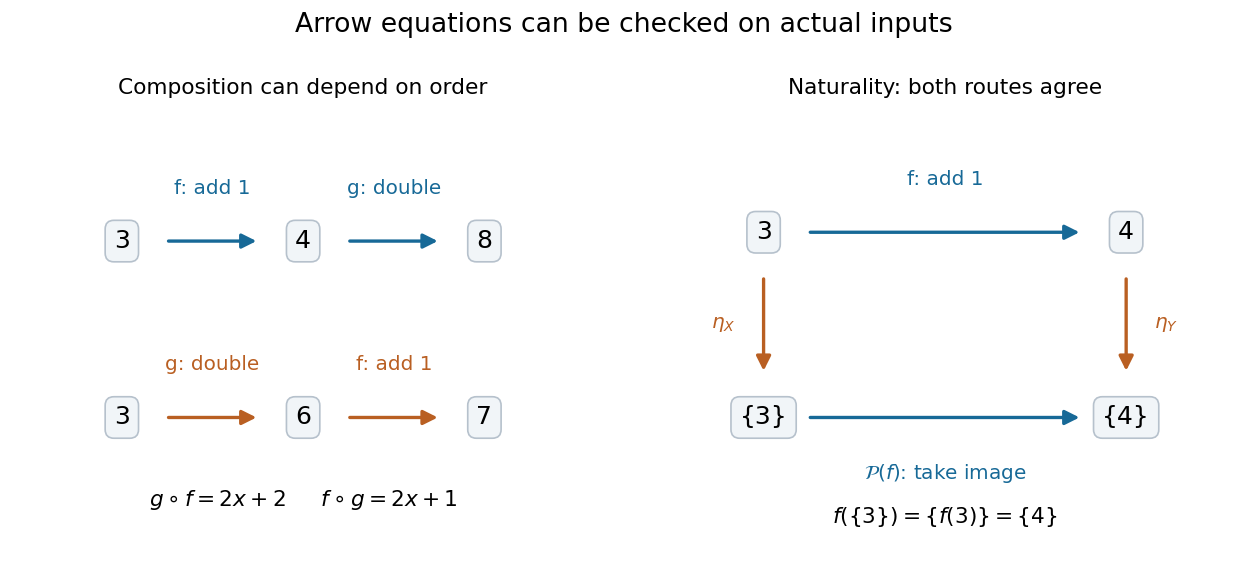
Function composition remembers order, while a naturality square gives equal results along both routes
. Details. 
A partially ordered set supplies a different example: its elements are the objects of a category, with exactly one arrow when , and none otherwise. Transitivity gives composition in a category, and reflexivity gives identity morphisms. For subsets ordered by inclusion, the two chains and have the same composite arrow. Thus arrows need not be maps of elements: they can record a relation.
Reversing the arrows in a categorical statement produces its dual statement. A theorem holding for all categories therefore has a dual theorem obtained by applying it to the opposite category; for example, categorical limits are exchanged with colimits.
A categorical morphism is an arrow with a specified source and target in a category. An arrow composes with to give . Composition is associative, and every object has an identity arrow acting as a unit. A functor preserves the sources, targets, identities and compositions of these arrows. In a locally small category, the arrows between fixed objects form a hom-set.
An object with the displayed property is called small projective; the term 0-presentable here uses this all-small-colimits convention. In a presheaf category, every representable presheaf has this property by the Yoneda lemma and pointwise computation of colimits. Conversely the canonical colimit presentation of a presheaf shows that the identity on such an object factors through one representable, making it a retract. If the indexing category has equalizers, a representable retract is again representable by the representable retract criterion.
Objects are small categories and morphisms are functors. Its products pair objects and arrows componentwise. Its exponential objects are functor categories, as shown by the currying adjunction for small categories.
The indiscrete category on a set has exactly one morphism between each ordered pair of objects. Every morphism is invertible. A functor into it is determined by its object assignment.
The discrete category on a set has that set as its objects and only identity morphisms. Functors from it are exactly assignments of objects in the target category.
Take two distinct objects and one nonidentity arrow for each element of , without arrows between different copies. A functor from this category to is exactly a choice of one arbitrary arrow of for each element of . Consequently this construction is left adjoint to the functor taking the set of all arrows of a small category. Its free object has three arrows per generator, including the two identity arrows.
A category is preadditive if every hom-set is an abelian group and composition is additive in each variable. Zero morphisms and differences of parallel morphisms are therefore defined. A zero object or finite biproducts need not exist; these are extra requirements in an additive category.
A full subcategory is coreflective when its inclusion has a right adjoint . The counit is universal for maps to from objects of the subcategory. The comonad is idempotent. For a finite-limit-closed coreflective subcategory of a topos, its coalgebra construction can prove that the subcategory is itself a topos.
A generating set is a set-indexed family such that unequal parallel morphisms are distinguished by some , with . It is dual to a cogenerating set.
Given morphisms and , their composite is . Composition is associative and has the identity morphisms as units.
The objects are the entities between which a category specifies morphisms. Each object has an identity morphism.
The category with one object and only its identity morphism. A functor from it selects an object of the target category.
An object of is a set with a finite list of partial unary operations. The first is total; the domain of each later operation consists exactly of the defined fixed points of the immediately preceding operation. Morphisms preserve every defined operation. Take to be the Category of sets. This tower gives examples of arbitrary finite monadic length even though its long free–forgetful composites induce the same first monad.
For an object of the nested partial unary operation category , adjoining the next operation freely gives one new value at each defined fixed point of the previous operation. Each new value starts an infinite free chain under the first unary operation; the other old operations are undefined on those new points. The new top operation consequently has no fixed points, so subsequent free extensions add no points. This gives a left adjoint to forgetting the last operation; extensions of maps along the chains are forced by the first target operation.
In the nested partial unary operation category, suppose the lower-operation diagram has a split coequalizer with , and . The section takes eligible fixed points to eligible fixed points, so the displayed next operation is defined on exactly the required domain. For eligible , the equations giveThus preserves the next operation. Every factored morphism preserves it by evaluating at , giving creation of the specified coequalizer. Together with reflection of isomorphisms, the Beck monadicity theorem proves one-step monadicity.
A coseparator in a category distinguishes parallel arrows by postcomposition: if , some satisfies . Equivalently, the contravariant functor is faithful. In a complete category that is a locally small category, the evaluation arrow is a monomorphism.
A cogenerating set is a set-indexed family such that whenever , there is a morphism with . It generalizes a single coseparator. In a locally small category with the needed products in a category, it gives an evaluation embedding into cogenerator products.
For a small cogenerating family in a locally small category, the evaluation arrow is a monomorphism whenever that small product in a category exists. Equality after all its projections is equality after every map to a cogenerator, hence equality of the original parallel morphisms.
In a complete category that is a locally small category with a coseparator , suppose every monomorphism is a regular monomorphism. The evaluation embedding , , is an equalizer of some pair into . Composing that pair with the evaluation embedding leaves the equalizer unchanged. Here powers mean products in a category indexed by sets, without assuming an exponential object exists.
The category of unital rings has identity-preserving ring homomorphisms as morphisms. The zero ring, allowing , is terminal, and is initial. Nonzero rings admit no maps from the zero ring. Monomorphisms are injective: maps from probe individual elements. It is a regular category, with surjective homomorphisms as regular epimorphisms; these are distinct from arbitrary categorical epimorphisms.
A skeletal category has no distinct isomorphic objects. A full and faithful functor with essential surjectivity between two skeletal categories is an isomorphism of categories: surjectivity on isomorphism classes becomes surjectivity on objects, and faithfulness and fullness reflect an equality of image objects to an isomorphism, hence an equality, of source objects.
A skeleton of is a full subcategory with exactly one object from each isomorphism class. The axiom of choice supplies skeletons of small categories. Conversely, if every small category has a skeletal equivalent, apply this to the groupoid on with exactly one morphism between objects in the same nonempty fibre. A quasi-inverse from the skeletal category selects one object per fibre, giving a choice function. This converse uses an equivalence of categories with specified quasi-inverse functors, not just the existence of a full essentially surjective functor in one direction.
A subcategory of a category specifies some objects and some morphisms between them, containing their identities and closed under composition. It is full if it contains every ambient morphism between its selected objects. A skeleton of a category is a full subcategory containing one object from each isomorphism class.
A replete subcategory contains every ambient object isomorphic to any of its objects. This closure is at the object level; fullness is a separate property.
A full subcategory contains all ambient morphisms between its chosen objects. Its inclusion is a fully faithful functor.
A groupoid is a category in which every morphism is invertible. A group is a groupoid with one object, while an equivalence relation defines a groupoid with exactly one arrow between any related pair of objects. Every functor sends invertible arrows to invertible arrows.
A functor assigns an object of a category to each object and a categorical morphism to each arrow . It preserves the rules for composing arrows:For example, the forgetful functor from the category of groups to the Category of sets keeps the underlying sets and maps of elements while forgetting the group operations. A group homomorphism remains a function, and composing the underlying functions gives the underlying map of the composite group homomorphism.
Another example sends a set to its power set . It sends a function to the function defined by , the image of the subset . For and , the subset goes to and then ; applying the composite directly also gives . The equality of these routes expresses preservation of composition in a category.
A bifunctor is a functor on the product of two categories. It assigns to each pair of objects and to a pair of morphisms, preserving identity morphisms and composition in a category. Equivalently, it is functorial separately in each argument, with the two actions commuting: whenever the expressions have the corresponding sources and targets. The product category has pairs as objects, pairs of morphisms as arrows, and componentwise composition in a category. A monoidal tensor product is a bifunctor from a category times itself.
A functor with a unique lift, from each specified object , of every arrow . The lifted arrow's target is part of the uniqueness requirement. This is dual to a discrete fibration. Lifting a cocone of a finite connected category gives a cocone upstairs: lifts of its legs have a common target because uniqueness identifies targets along every diagram arrow. Thus a discrete opfibration over a weakly filtered category has weakly filtered domain, including the possibility of an empty domain.
For discrete opfibrations with weakly filtered categories, the map taking a pair to its connected components of a category is a bijection. For surjectivity, send two base objects in the same component to a common target and lift both arrows. For injectivity, choose common targets upstairs for two representatives; a cocone over the resulting finite connected diagram downstairs makes their lifted composites agree. Hence the representatives have a common target in the pullback in a category. Over a filtered category, the component functor on the slice of discrete opfibrations preserves all finite categorical limits: it preserves pullbacks and takes the terminal object to a singleton.
A functor is full when each function is surjective. It is a faithful functor when each is injective. A full and faithful functor identifies its source, up to equivalence, with a full subcategory of the target. Fullness only concerns morphisms between image objects; it does not require every target object to lie in the image.
A covariant functor into a Grothendieck topos is flat when its tensor extension from presheaves preserves finite limits. For set values, its category of elements with arrows carrying source elements to target elements is cofiltered; equivalently the functor is a filtered colimit of covariant representables. If the indexing category has finite limits, flatness is equivalent to preservation of finite limits. For a site, cover-to-joint-epimorphism continuity adds the condition needed by the Diaconescu equivalence for geometric morphisms.
For a small category with finite limits, a set-valued functor preserving them has a category of elements with finite limits, so its opposite is a filtered category. The covariant density presentation is therefore a filtered colimit of representable functors. Conversely, representable functors preserve categorical limits, and filtered colimits commute with finite limits in sets, proving the criterion.
A left Kan extension is left adjoint to precomposition, when it exists; a Right Kan extension is right adjoint. For small indexing categories and set-valued functors, both exist by comma-category colimit and limit formulas. These two adjoints give the essential geometric morphism induced by a functor between presheaf indexing categories.
A finite-limit-preserving functor preserves a terminal object and pullbacks, equivalently all finite limits. It is also called left exact. Such functors from a Cartesian syntactic category to a finite-limit category correspond to models of the associated Cartesian theory.
A functor between regular categories is regular if it preserves finite limits and regular epimorphisms. It then preserves image factorizations, since finite-limit preservation preserves monomorphisms. A representable functor is regular exactly when is projective with respect to regular epimorphisms. Regularity of a functor does not alone imply faithfulness or reflection of isomorphisms.
A functor is conservative when it reflects isomorphisms: if is invertible then is invertible. It need not be full or faithful functor. The crude monadicity theorem uses this reflection property to lift invertibility of the comparison-adjunction counit from the base category.
For a specified diagram shape, a functor reflects categorical limits when a cone over a diagram is limiting whenever its image is limiting. This condition tests an existing categorical cone. It does not assert that every limiting categorical cone in the codomain has a lift.
A full and faithful functor reflects every existing shape of categorical limit. If the image of a cone is limiting, apply its universal property to the image of any competing cone. Fullness lifts the unique mediating morphism; faithfulness proves the cone equations and uniqueness of the lift. No essential-surjectivity hypothesis is needed.
A functor creates categorical limits of a specified shape when every given limiting categorical cone over an image diagram uniquely lifts to a categorical cone over the original diagram, and the lift is limiting. This is stronger than just being a limit-reflecting functor. Forgetting arrows from a functor category creates its pointwise limits in a functor category.
An equivalence-invariant lifting property permits the underlying cone of the lift to be identified with the chosen cone by an isomorphism, rather than requiring literal equality. Lifts are unique up to a unique isomorphism compatible with that identification. A monadic adjunction defined by equivalence of its comparison functor has this property by monad algebra forgetful functor creates limits. Literal creation follows if the comparison is an isomorphism over the base, or suitable strict transport of objects is part of the convention. An equivalence alone does not guarantee a literally prescribed underlying object lies in the image.
Relative to a specified class of diagram shapes, a functor preserves colimits when it takes each existing colimit cocone of those shapes to a colimit cocone. A left adjoint preserves all existing colimits, including large ones when their universal properties are meaningful. Small-colimit preservation alone does not imply preservation of a class-indexed colimit.
Relative to a specified class of diagram shapes, a functor preserves limits when it takes each existing categorical limit cone of those shapes to a categorical limit cone. The usual completeness and general adjoint functor theorem hypotheses refer to small shapes; a possibly large diagram requires an explicit preservation hypothesis covering its shape.
If has finite categorical limits, every functor preserving pullbacks in a category also preserves equalizers, even when it does not preserve a terminal object. Factor it through the slice category by sending to . This lifted functor preserves pullbacks because the slice forgetful functor reflects them; it also preserves the terminal object, so it preserves finite limits. The slice forgetful functor preserves equalizers, completing the proof.
A functor discarding some structure, for example an action on a module. It need not be full or faithful in general.
An endofunctor is a functor from a category to itself. A monad adds a unit and multiplication to an endofunctor, satisfying the unit and associativity laws.
A comonad is an endofunctor with natural transformations and satisfying and . It is the categorical dual of a monad. Its coalgebras for a comonad carry compatible maps into their image under .
In the finite-limit setting, a Cartesian comonad is a comonad whose underlying endofunctor preserves finite limits. Its category of coalgebras for a comonad has finite limits created by the forgetful functor. On an elementary topos, equalizer constructions of exponentials in a coalgebra topos and the subobject classifier of a coalgebra topos make that coalgebra category an elementary topos.
A comonad is idempotent when its comultiplication is invertible. Its coalgebra category identifies with the coreflective subcategory of objects on which the counit is invertible. A coreflective inclusion produces such a comonad.
For a comonad, a coalgebra is a map satisfying and . A morphism obeys . This is distinct from the tensor-based notion of a coalgebra in algebra.
The category consists of coalgebras for a comonad and their structure-preserving morphisms. Its forgetful functor has the cofree coalgebra as right adjoint. If is a topos and preserves finite limits, those limits are created by the forgetful functor, while exponentials in a coalgebra topos and the subobject classifier of a coalgebra topos can be constructed as equalizers inside cofree objects.
Let be a Cartesian comonad on a Cartesian category that is Cartesian closed. Its forgetful functor creates finite limits. For coalgebras and , set , . Transpose to , and put . Their cofree coalgebra transposes have a coalgebra equalizer. A map into this equalizer is exactly a map respecting coalgebra structures, so it is the required exponential object. No subobject classifier on the base category is needed.
Let classify . In the cofree coalgebra , equalize the identity and . A map classifies a subcoalgebra exactly when , since this says the subobject equals the inverse image of its image under . Transposition gives precisely the displayed equalizer condition.
For a finite-limit-preserving comonad on a topos, start with the cofree coalgebra on the ambient exponential . Its underlying evaluation is . Transpose the two expressions and first using the ambient exponential and then the cofree adjunction. Their coalgebra equalizer represents exactly the maps whose evaluations respect coalgebra structure. Thus coalgebra exponentials need not be the underlying ambient exponentials.
For a comonad, the cofree coalgebra on is . A map transposes to the coalgebra morphism . This gives the adjunction with the forgetful functor.
A functor is finite-limit-preserving if it carries each finite limit cone to a limiting cone. When is a small category with finite limits, this is equivalent to being a filtered colimit in a category of covariant representable functors, and to the opposite of its category of elements being a filtered category. It is also equivalent to every comma category having finite limits, for all sets .
An equivalence consists of functors and with natural transformation isomorphisms and . A full and faithful functor which is essentially surjective, meaning every target object is isomorphic to an image object, is part of an equivalence under the usual choice convention. An isomorphism of categories is stronger: it has a strictly inverse functor.
A functor is essentially surjective when every object of is isomorphic to for some . Together with full and faithful, this characterizes an equivalence of categories under the appropriate axiom of choice convention. For large categories, choosing a quasi-inverse on all objects requires a universe or a class-choice convention.
An isomorphism of categories is a functor with a strictly inverse functor. It is equivalently bijective on objects and on each hom-set. An equivalence of categories only requires inverse composites up to invertible natural transformations. For example, the category of partial functions and the category of pointed sets are equivalent but their actual object collections prevent an isomorphism: the former has one zero object, the empty set, while the latter has distinct singleton pointed set objects that are all zero objects.
A natural transformation between functors to the Category of sets is a monomorphism in the functor category exactly when every component is an injective function. Componentwise cancellation proves sufficiency. For necessity, the Yoneda lemma converts two elements with equal component images into two transformations from a covariant representable functor; monicity cancels these transformations, forcing the elements to coincide. The argument remains valid for a locally small category in an ambient universe where the functor category is formed.
For small diagrams with complete codomain, choose each objectwise categorical limit. For , its projections uniquely define the arrow through . The universal property proves identity and composition laws. The same projection calculation makes every categorical cone factorization a natural transformation. Hence these are genuine categorical limits in the functor category, and the objectwise forgetful functor is a limit-creating functor.
The constant diagram functor sends to the functor on with constant object value and identity arrow values; a morphism becomes the natural transformation with every component . When all -shaped categorical limits exist, it is a left adjoint to the limit functor.
For a topological space , let be the constant presheaf of sets on its open-set category, with identity restriction maps, including the value at the empty open set. A natural transformation is determined by its map ; its component at composes with . A transformation is determined by ; its component at restricts sections from . These two bijections prove the displayed adjunctions. This concerns presheaves, so no sheafification is involved.
For a nonempty topological space , the constant diagram functor on its open-set presheaf category lies in this five-term adjunction chain. The leftmost functor sends to the categorical presheaf equal to at the empty open set and empty elsewhere. The rightmost sends to the presheaf equal to at and a singleton elsewhere. A natural transformation from the former is determined by its empty-open component; a transformation into the latter is determined by its whole-space component. The middle adjunctions follow from restriction maps to the empty open set and from the whole space. Neither endpoint extends: the leftmost functor fails to preserve the terminal object, and the rightmost fails to preserve the initial object.
A presheaf on a category is a functor . A morphism induces the restriction map , reversing direction. The indexing category need not be small. For the category of open subsets of a topological space, this specializes to a presheaf of sets on a topological space.
The presheaf category on a small category is the functor category . Its limits and colimits are computed pointwise.
For a categorical presheaf on a small category, its category of elements has objects with and arrows satisfying . The canonical natural transformation sends to . These maps exhibit as the displayed colimit. At , a representative maps to , with inverse . The arrow identifies every representative with its canonical inverse image, proving the bijection and the colimit universal property.
For a small category , its presheaf category is the free enlargement under small colimits. Each categorical presheaf is the colimit of the diagram sending to the representable presheaf . The map at sends to . It is surjective at each because is the image of at . If two representatives have the same image , they are both identified with the representative at by arrows in the category of elements, proving injectivity. Thus . For a cocomplete target, a functor on extends by these colimits, uniquely up to natural isomorphism among colimit-preserving extensions.
A Grothendieck topology assigns covering sieves to each object. The maximal sieve covers; pulling back a covering sieve gives a covering sieve; and a sieve locally covering along all arrows of a covering sieve itself covers. It defines the sheaves on a site. Families of arrows generate sieves and can be used to generate the topology.
The dense sieves form the double-negation Grothendieck topology. Its sheaf topos is a Boolean topos: the union of a subobject with its pseudocomplement is dense and thus becomes the whole object after sheafification. This need not be the atomic topology, which requires every nonempty sieve to be dense.
Consider a site indexed by natural-number objects with arrows only downwards, the cancellation condition for equally typed , and the separation condition that arrows , admit with but . Its dense-sieve sheaf topos is a Boolean topos and a two-valued topos. The representables are separated. No nonempty partial map exists, by the separation condition and naturality. The associated sheaves consequently admit no maps . Each has nonzero support and maps epimorphically to one, but their product has an empty value at every stage , because its factor does.
On the opposite of the category of finitely presented unital commutative rings, a basic covering family is , where finitely many generate the unit ideal. Include the empty cover of the zero ring. Localization commutes with base change, so these families define a coverage on a category. Their sheaf topos classifies the coherent theory of local rings. This coverage is subcanonical: representable functors obey the usual localization gluing equations.
A coverage specifies covering families on a small category, stable under refinement along arrows: for a covering family into and , there is a covering family into whose composites with factor through the original family. Passing to generated sieves and imposing maximality and local transitivity gives its associated Grothendieck topology, with the same sheaves on a site. One can equivalently specify the saturated covering sieves directly. Rigidity refers to these covering sieves, so it is unchanged by replacing a family presentation by its generated topology.
A coverage on a category is rigid when each object is covered by the sieve generated by arrows from J-irreducible objects of a site. Restriction to their full subcategory identifies the sheaves on a site with its presheaf category. A presheaf on that subcategory extends by the right Kan extension : every covering sieve restricts to the full representable on , which proves the sheaf condition directly.
An object of a site is J-irreducible when its only covering sieve on a category is the maximal sieve. In particular the empty sieve cannot cover it. Every arrow from a J-irreducible object belongs to any covering sieve on its codomain: the pulled-back sieve must contain the identity. This makes the induced topology on the full subcategory of J-irreducible objects trivial.
A site is a category equipped with a Grothendieck topology, specifying which sieves are covering. The sheaves on a site satisfy unique amalgamation of matching families on those sieves. A small site presents a Grothendieck topos.
The atomic topology declares exactly the nonempty sieves covering. It exists precisely when arrows with a common codomain admit a common refinement. On nonempty finite sets and surjections this follows from the fiber product. Its J-closed sieves are only the empty and maximal sieves.
Use a small skeleton of nonempty finite sets and surjections, with every nonempty sieve covering. Fiber-product projections are surjections, so the atomic coverage exists. Surjections are effective quotients of their kernel pairs, making the site subcanonical. Its sheaves admit the primitive decomposition of an atomic finite-surjection sheaf.
An element is primitive if it does not descend along any surjection . All elements at cardinality one are primitive. Repeated descent reaches a primitive ancestor in finitely many steps, and the primitive-element kernel rigidity lemma makes the ancestor unique up to bijection.
Partition the elements of a sheaf by their primitive-ancestor equivalence classes under bijection. Each class gives a sheaf subfunctor, because its membership is preserved and reflected along covering surjections. A representative primitive element names an epic representable map onto its class component. Thus every sheaf is the coproduct of these components, each an atom in a topos.
If primitive elements have equal restrictions along and , then these surjections have equal kernels. To rule out with unequal images, identify those two images by . The set of pairs equal under and maps surjectively both to by projection and to the kernel pair of by applying . Injective restrictions force the kernel-pair matching condition on the primitive element, contradicting descent along .
For any sheaf and surjection , is an equalizer. In particular every is injective. These follow from the sheaf condition on the sieve generated by the covering arrow and control primitive elements.
For each pair , , require for some arrows , . This is necessary and sufficient for stability of nonempty sieves under pullback; the other topology axioms then follow. Nonempty finite sets with arbitrary functions fail it at distinct singleton-to-two-point maps.
A Grothendieck topology is subcanonical when every representable functor is a sheaf on a site. It is also called standard in some topos-theory terminology. A nontrivial covering quotient can fail this condition by identifying distinct sections of a representable.
A categorical presheaf is a sheaf for if every matching family on a covering sieve has a unique amalgamation. Equivalently restriction is bijective for each covering sieve . Sheaves on a small site form a Grothendieck topos.
A sieve on is a subfunctor of the representable functor , equivalently a family of arrows into closed under precomposition. For , the pullback sieve consists of arrows into for which belongs to the original sieve.
A sieve on is dense when every arrow has a further composite in . Equivalently, every pullback sieve is nonempty. This condition is stable under pullback and transitive refinement and defines the double-negation topology.
A sieve is J-closed when membership is local with respect to the Grothendieck topology . Pullback preserves J-closedness. Their presheaf is the subobject classifier of the sheaf topos: a section of a sheaf is sent to the sieve of arrows on which it belongs to the chosen subsheaf.
Every presheaf category is a topos. Finite limits are pointwise; the exponential isand the subobject classifier assigns to the set of sieves on .
If every slice category is essentially small, the displayed exponential object and the set of sieves on a category at each are small even when is large. Together with pointwise finite limits, they give the elementary-topos constructions in a universe admitting the large diagrams. This does not force the entire functor category to be locally small in the original universe: a large discrete category has terminal slices, but maps between its constant-one and constant-two presheaves are arbitrary class-indexed binary families.
For categorical presheaves on a small category, restrictions in the displayed exponential object act by precomposition with . Evaluation sends at to . The currying of sends to the natural transformation whose value on is . Evaluation and currying are inverse and natural, proving the Cartesian closed category structure.
The arrow category of has morphisms of as objects and commutative squares as morphisms. It is the functor category , where is the category with one nonidentity arrow.
It is also the comma category .
Write a presheaf on as an arrow . Evaluation has the displayed chain, where , , and . The Hom-set bijections follow by solving the commuting-square equation. The functor has no right adjoint because it fails to preserve the initial object: is not .
The category of injective functions is the full subcategory of whose objects are injective functions. It is cartesian closed: products are computed pointwise, and exponentiating an injection by any arrow again gives an injection.
A covariant functor is representable when it is naturally isomorphic to for some object ; a contravariant functor is representable when it is naturally isomorphic to .
Suppose a small category has equalizers. If a categorical presheaf is a retract , with , then equalizes and . The Yoneda lemma writes for an endomorphism . An equalizer of and gives the same presheaf equalizer, since the Yoneda embedding preserves categorical limits. Uniqueness of equalizers gives .
On a complete category that is locally small, a set-valued functor is representable exactly when it preserves small categorical limits and its category of elements has a weakly initial set. Categorical limit preservation makes that comma category complete. The initial-object lemma for complete categories with a weakly initial set then supplies a universal element, hence a representation of a functor.
If has small coproducts in a category and , then is a left adjoint to . Maps from this coproduct to are families of maps , naturally equivalent to functions . Conversely, a set-valued right adjoint is represented by , because maps from a singleton evaluate to elements.
Articles were limited to the first 100 out of 373 total.
Articles by others on the same topic
There are currently no matching articles.