Category theory studies mathematical structures through the morphisms between them. A category specifies which objects of a category and arrows are allowed; a functor translates these objects and arrows into another category; a natural transformation compares two such translations coherently. For example, the category of groups records both groups and group homomorphisms, so it remembers which maps respect multiplication.
The usefulness appears in constructions we already know. A Cartesian product combines two sets, while a direct product of groups combines two groups. Both satisfy the same universal property of a categorical product: any pair of maps into the factors comes from exactly one map into the product. This gives a reusable way to construct maps and establish isomorphisms, without depending on a particular choice of coordinates or element labels. In a partially ordered set regarded as a category, the corresponding categorical product is a greatest lower bound. The shared definition exposes a connection between pairing data and finding the best common bound.
Start with the computed examples under category, functor, natural transformation, and product in a category. Their arrow equations are practical tests: do both routes in a commutative diagram produce the same result? Later, the same language organizes tensor products, adjunctions, and the fundamental group of a topological space. Emily Riehl's textbook develops these basic notions before using them to compare constructions across different subjects. [ref]
In their 1945 paper, Samuel Eilenberg and Saunders Mac Lane set out the notions of category, functor, and natural transformation. The introduction uses the relation between a vector space and its dual space to ask which comparisons are natural, setting up a precise language for compatibility with maps. [ref]
https://people.math.osu.edu/cogdell.1/6112-Eilenberg&MacLane-www.pdf. Eilenberg and Mac Lane, General Theory of Natural Equivalences, introduction and sections 1–3

Saunders Mac Lane at left and Samuel Eilenberg at right at a 1992 category theory meeting; photograph by SixWingedSeraph, CC BY-SA 4.0
. Source. A bicategory has objects, hom-categories, composition functors and identity 1-cells. Associativity and unit laws hold through coherent invertible 2-cells, satisfying pentagon and triangle identities. A monoidal category is exactly a bicategory with a single object: its objects are the 1-cells, its morphisms the 2-cells, and its tensor product the horizontal composition.
A coreflexive pair has a common retraction with . It is the dual of a reflexive pair. Both and are split monomorphisms.
A coherent category has finite limits, pullback-stable regular-epi/mono image factorizations, and finite unions of subobjects stable under pullback. Each subobject lattice is distributive. These structures interpret all constructors of coherent logic.
A functor between coherent categories is coherent when it preserves finite limits, image factorizations and finite unions of subobjects, including the empty union. It consequently preserves the interpretation of every coherent formula. A coherent functor from a coherent syntactic category to a topos is equivalent to a model of the corresponding coherent theory; natural transformations correspond to ordinary model homomorphisms.
The coherent topology on a small coherent category is generated by finite families of arrows whose image subobjects have union equal to the whole target. Pullback stability of images and unions and closure under composition make these a coverage. On a coherent syntactic category, this is the site topology used to construct the classifying topos of its coherent theory.
In a coherent category, maps and agreeing on the intersection define a relation from to by taking the union of their graphs. It is total because the two subobjects cover their union, and single-valued because the maps agree on overlap. Total functional relations define morphisms, giving a unique glued map. This is the pushout universal property without assuming a general supply of pushouts.
A map has the right lifting property against when every commutative square with on the left and on the right has a diagonal making both triangles commute. Lifting against a family of maps gives a class of right-injective maps.
A complete and cocomplete category with designated model weak equivalences, model fibrations and model cofibrations, closed under retracts. Weak equivalences satisfy two-out-of-three; maps admit the two cofibration/fibration factorizations, and either acyclic class has the required lifting property against the opposite class. These axioms organize homotopy-theoretic calculations abstractly.
Attach cells for all lifting squares at each successive stage, then take a suitable colimit. Smallness of the generating domains makes every eventual lifting square occur at an earlier stage. This factors a map into a relative cell complex followed by a map with the prescribed right lifting property.
A composite built by successive pushouts of coproducts of prescribed generating maps. In nonnegative chain complexes, attaching a sphere-to-disk generator adds a free element with a specified existing cycle as boundary. The resulting inclusion has a degreewise free cokernel.
Mapping out of the object preserves sequential colimits. A map factors through a finite stage, and two finite-stage maps agreeing in the colimit agree at a later stage. Relative sequential smallness restricts the diagrams to a stated class of morphisms.
The model category of nonnegative complexes of left modules has quasi-isomorphisms as model weak equivalences, positive-degree surjections as model fibrations, and degreewise injections with projective cokernel as model cofibrations. All objects are fibrant; cofibrant objects are degreewise projective.
The sphere chain complex inclusions into disk chain complexes, together with the separate degree-zero cell, generate the model cofibrations by cell attachment and retracts. Their right-injective class is exactly the acyclic fibration in the projective chain-complex model structure.
The right lifting property for each sphere-to-disk map fills a prescribed cycle and a compatible target element. The degree-zero generator supplies initial surjectivity; all other fillers force an acyclic kernel and the remaining degreewise surjections.
A map that is both a model fibration and a quasi-isomorphism. The homology isomorphism together with degree-one surjectivity forces surjectivity in degree zero. Equivalently it has the right lifting property against the generating cofibrations for nonnegative chain complexes.
A morphism in the chosen cofibration class of a model category. In the projective model structure on nonnegative chain complexes it is a degreewise split injection with degreewise projective cokernel. This usage is distinguished from the topological cofibration.
A morphism in the chosen fibration class of a model category. In the projective model structure on nonnegative chain complexes, it is surjective in strictly positive degrees; degree zero is not required.
A morphism in the chosen weak-equivalence class of a model category. In the projective model structure on nonnegative chain complexes these are quasi-isomorphisms.
A category equipped with a monoidal tensor product, a monoidal unit object, and natural associators and unitors satisfying the pentagon and triangle axioms.
Cartesian product with singleton unit and disjoint union with empty unit each make the Category of sets monoidal. Associators and unitors simply retag or rebracket the same elements, so the pentagon and triangle identities hold elementwise. These structures differ even up to monoidal equivalence: any category equivalence preserves initial and terminal objects, so it cannot identify the empty unit with the singleton unit.
The associator and unitors of a monoidal category satisfyThus the two ways to remove a unit between two tensor factors agree. Together with the pentagon identity for a monoidal category this implies all unit identities derived from the monoidal pentagon and triangle and the monoidal coherence theorem.
For an associator in a monoidal category, the two paths from to agree:This five-vertex diagram is the basic compatibility for reassociating four tensor factors. The monoidal coherence theorem extends it to arbitrary finite tensor expressions.
The associator and unitors of a monoidal category satisfyFor the first identity, postcompose the pentagon on by , then use the triangle twice and cancel . This gives the first equality after tensoring with ; set and cancel using the natural invertible right unitor. Reversing tensor order proves the second identity. Naturality of the left unitor at gives ; comparing the second identity with the triangle on gives and hence the last identity. These are consequences of the axioms, not extra axioms imported from the monoidal coherence theorem.
An invertible morphism satisfying with coherent parentheses. It produces representations of the braid groups; a self-braiding is an example.
Objects with an evaluation morphism and a coevaluation morphism satisfying both snake identities. These are categorical duality data, distinct from the locally convex dual pair.
Closing an identity strand using compatible evaluation morphisms and coevaluation morphisms gives the categorical dimension in a pivotal or ribbon setting. For the standard two-dimensional quantum enveloping algebra of sl2 module, the weighted contraction has diagonal coefficients , giving quantum dimension . The chosen duality and framing conventions matter.
The two triangular identities and , with canonical associators and unitors inserted, for a dual pair in a monoidal category.
The unit-valued duality map of a dual pair in a monoidal category, constrained together with evaluation by both snake identities.
For a dual pair in a monoidal category, the contraction . In a left closed monoidal category, evaluation also denotes the adjunction map .
Using the convention , every tensoring-on-the-right functor has a right adjoint functor. Evaluation is . Naming left and right closure varies in the literature, so the adjunction fixes the convention.
The categorical dual of a monoid object: an object with coassociative comultiplication and a counit, with the ambient constraints included.
The structure map of a comonoid, with and equal to the inverse unitors. This is distinct from the counit of an adjunction.
An object with multiplication and unit satisfying associativity and unit diagrams using the ambient associators and unitors.
A monoid object with a morphism such that and a suitable coevaluation make a dual pair in a monoidal category. In a category of vector spaces this is a Frobenius algebra. This condition alone is not the usual separability condition.
An object that is both a monoid object and a comonoid in a braided monoidal category, with preserving multiplication and unit. The product on its tensor square uses the ambient braiding.
In a symmetric monoidal category, a convolution-invertible scalar pairing on a bimonoid inducing the comodule braiding . Its multiplicativity, normalization and commutation axioms express the hexagon, unit and colinearity conditions. The notation abbreviates morphisms and ambient symmetries, not a requirement for elements.
A monoidal category with natural invertible braidings satisfying the two hexagon axioms. The equation is an additional symmetric condition, not a braided axiom.
The braided monoidal category generated by one object: objects are parenthesized tensor expressions in that object and the unit, and morphisms are structural isomorphisms and crossings subject to precisely the monoidal category and braiding axioms.
The braided monoidal category with objects , endomorphism groups , no arrows between unequal objects, tensor given by juxtaposition, and block-crossing braiding. Its tensor is strict.
The natural tensor interchange isomorphism in a braided monoidal category, constrained by the two hexagon axioms.
A functor with natural maps and satisfying the reversed monoidal functor associativity and unit diagrams. No invertibility is required.
Here the unqualified term allows lax comparison maps and , natural and compatible with associators and unitors. Invertible comparison maps give a strong monoidal functor. The opposite direction gives an opmonoidal functor.
A lax monoidal functor and opmonoidal functor on the same underlying functor, satisfying and in coherent notation. It transports dual pairs in a monoidal category and Frobenius monoids.
A strong monoidal functor whose comparison maps are identities. It preserves the tensor, unit and structural constraints exactly; its source need not be a strict monoidal category.
A monoidal category whose associators and unitors are identities; the tensor and unit laws are then equalities of objects and morphisms.
Every diagram formed solely from the canonical associators, unitors and their inverses commutes. Consequently structural reparenthesizations can be suppressed in calculations; this statement does not make distinct braidings equal.
Orient associativity towards right association and unit maps towards deletion of unit symbols. A lexicographic measure consisting of the number of leaves and the sum of the sizes of left subtrees decreases at every step. All overlapping reductions have commuting completions: the essential cases are the pentagon identity for a monoidal category, the triangle identity for a monoidal category, and the derived left and right unit identities. Induction on the decreasing measure makes every normalization arrow equal, proving that every structural arrow is determined by its endpoints.
Associate to a finite ordered word the right-associated tensor , retaining a terminal unit: and . Define concatenation maps recursively byThe unit identities derived from the monoidal pentagon and triangle give . Induction on , using the pentagon in the induction step and left-unitor compatibility in the base case, givesNormalize a letter by , a formal unit by , and a tensor expression recursively using . The displayed identities show that normalization commutes with each generating associator or unitor, and therefore also with inverses, tensor products and composites of them. Every structural arrow from expression to expression is consequently , proving monoidal coherence without presupposing it.
The natural isomorphisms and in a monoidal category. Together with the associator they satisfy the triangle axiom.
The bifunctor in a monoidal category. Its associativity is expressed by the associator, rather than equality in general.
The category of groups has groups as objects and group homomorphisms as morphisms. Its product is the direct product of groups, and its coproduct is the free product, as expressed by the universal property of a free product.
An object is injective when every morphism extends across every monomorphism to a morphism . This is the categorical extension property of an injective module or an injective sheaf; it is dual to the lifting property of a projective object in a category.
A universal property characterizes an object by a prescribed family of morphisms and a unique factorization of every competing family. It determines that object up to a unique compatible isomorphism. Examples include the pushout in a category and the universal property of the tensor product of modules.
A category specifies objects of a category, categorical morphisms between them, and composition in a category. An arrow can be followed by , giving . Every object has an identity morphism , and the rules satisfyAssociativity means that grouping a chain differently does not change its composite. It does not assert commutativity, and the sources and targets must match before a composite is defined.
In the Category of sets, arrows are functions. Take two functions on the real numbers, and . Then , whereas . At , the two orders give 8 and 7, respectively. Both orders are defined here because these maps share their source and target; for arbitrary arrows the reverse composite need not exist.
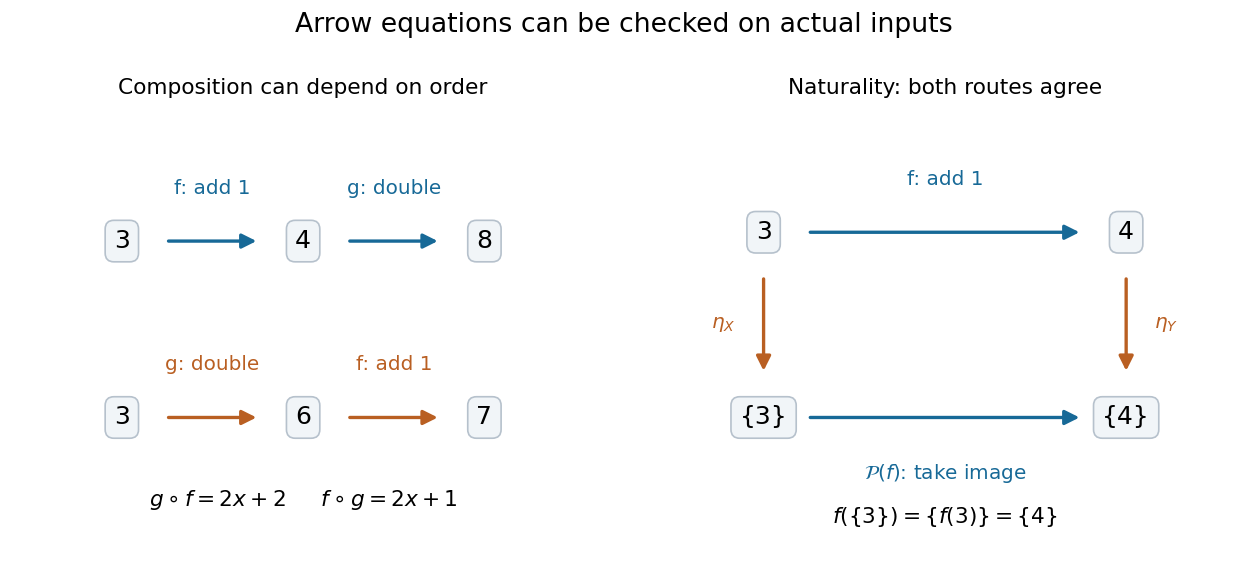
Function composition remembers order, while a naturality square gives equal results along both routes
. Details. A partially ordered set supplies a different example: its elements are the objects of a category, with exactly one arrow when , and none otherwise. Transitivity gives composition in a category, and reflexivity gives identity morphisms. For subsets ordered by inclusion, the two chains and have the same composite arrow. Thus arrows need not be maps of elements: they can record a relation.
Reversing the arrows in a categorical statement produces its dual statement. A theorem holding for all categories therefore has a dual theorem obtained by applying it to the opposite category; for example, categorical limits are exchanged with colimits.
A categorical morphism is an arrow with a specified source and target in a category. An arrow composes with to give . Composition is associative, and every object has an identity arrow acting as a unit. A functor preserves the sources, targets, identities and compositions of these arrows. In a locally small category, the arrows between fixed objects form a hom-set.
An object with the displayed property is called small projective; the term 0-presentable here uses this all-small-colimits convention. In a presheaf category, every representable presheaf has this property by the Yoneda lemma and pointwise computation of colimits. Conversely the canonical colimit presentation of a presheaf shows that the identity on such an object factors through one representable, making it a retract. If the indexing category has equalizers, a representable retract is again representable by the representable retract criterion.
Objects are small categories and morphisms are functors. Its products pair objects and arrows componentwise. Its exponential objects are functor categories, as shown by the currying adjunction for small categories.
The indiscrete category on a set has exactly one morphism between each ordered pair of objects. Every morphism is invertible. A functor into it is determined by its object assignment.
The discrete category on a set has that set as its objects and only identity morphisms. Functors from it are exactly assignments of objects in the target category.
Take two distinct objects and one nonidentity arrow for each element of , without arrows between different copies. A functor from this category to is exactly a choice of one arbitrary arrow of for each element of . Consequently this construction is left adjoint to the functor taking the set of all arrows of a small category. Its free object has three arrows per generator, including the two identity arrows.
A category is preadditive if every hom-set is an abelian group and composition is additive in each variable. Zero morphisms and differences of parallel morphisms are therefore defined. A zero object or finite biproducts need not exist; these are extra requirements in an additive category.
A full subcategory is coreflective when its inclusion has a right adjoint . The counit is universal for maps to from objects of the subcategory. The comonad is idempotent. For a finite-limit-closed coreflective subcategory of a topos, its coalgebra construction can prove that the subcategory is itself a topos.
A generating set is a set-indexed family such that unequal parallel morphisms are distinguished by some , with . It is dual to a cogenerating set.
Given morphisms and , their composite is . Composition is associative and has the identity morphisms as units.
The objects are the entities between which a category specifies morphisms. Each object has an identity morphism.
The category with one object and only its identity morphism. A functor from it selects an object of the target category.
An object of is a set with a finite list of partial unary operations. The first is total; the domain of each later operation consists exactly of the defined fixed points of the immediately preceding operation. Morphisms preserve every defined operation. Take to be the Category of sets. This tower gives examples of arbitrary finite monadic length even though its long free–forgetful composites induce the same first monad.
For an object of the nested partial unary operation category , adjoining the next operation freely gives one new value at each defined fixed point of the previous operation. Each new value starts an infinite free chain under the first unary operation; the other old operations are undefined on those new points. The new top operation consequently has no fixed points, so subsequent free extensions add no points. This gives a left adjoint to forgetting the last operation; extensions of maps along the chains are forced by the first target operation.
In the nested partial unary operation category, suppose the lower-operation diagram has a split coequalizer with , and . The section takes eligible fixed points to eligible fixed points, so the displayed next operation is defined on exactly the required domain. For eligible , the equations giveThus preserves the next operation. Every factored morphism preserves it by evaluating at , giving creation of the specified coequalizer. Together with reflection of isomorphisms, the Beck monadicity theorem proves one-step monadicity.
A coseparator in a category distinguishes parallel arrows by postcomposition: if , some satisfies . Equivalently, the contravariant functor is faithful. In a complete category that is a locally small category, the evaluation arrow is a monomorphism.
A cogenerating set is a set-indexed family such that whenever , there is a morphism with . It generalizes a single coseparator. In a locally small category with the needed products in a category, it gives an evaluation embedding into cogenerator products.
For a small cogenerating family in a locally small category, the evaluation arrow is a monomorphism whenever that small product in a category exists. Equality after all its projections is equality after every map to a cogenerator, hence equality of the original parallel morphisms.
In a complete category that is a locally small category with a coseparator , suppose every monomorphism is a regular monomorphism. The evaluation embedding , , is an equalizer of some pair into . Composing that pair with the evaluation embedding leaves the equalizer unchanged. Here powers mean products in a category indexed by sets, without assuming an exponential object exists.
The category of unital rings has identity-preserving ring homomorphisms as morphisms. The zero ring, allowing , is terminal, and is initial. Nonzero rings admit no maps from the zero ring. Monomorphisms are injective: maps from probe individual elements. It is a regular category, with surjective homomorphisms as regular epimorphisms; these are distinct from arbitrary categorical epimorphisms.
A skeletal category has no distinct isomorphic objects. A full and faithful functor with essential surjectivity between two skeletal categories is an isomorphism of categories: surjectivity on isomorphism classes becomes surjectivity on objects, and faithfulness and fullness reflect an equality of image objects to an isomorphism, hence an equality, of source objects.
A skeleton of is a full subcategory with exactly one object from each isomorphism class. The axiom of choice supplies skeletons of small categories. Conversely, if every small category has a skeletal equivalent, apply this to the groupoid on with exactly one morphism between objects in the same nonempty fibre. A quasi-inverse from the skeletal category selects one object per fibre, giving a choice function. This converse uses an equivalence of categories with specified quasi-inverse functors, not just the existence of a full essentially surjective functor in one direction.
A subcategory of a category specifies some objects and some morphisms between them, containing their identities and closed under composition. It is full if it contains every ambient morphism between its selected objects. A skeleton of a category is a full subcategory containing one object from each isomorphism class.
A replete subcategory contains every ambient object isomorphic to any of its objects. This closure is at the object level; fullness is a separate property.
A full subcategory contains all ambient morphisms between its chosen objects. Its inclusion is a fully faithful functor.
A groupoid is a category in which every morphism is invertible. A group is a groupoid with one object, while an equivalence relation defines a groupoid with exactly one arrow between any related pair of objects. Every functor sends invertible arrows to invertible arrows.
A functor assigns an object of a category to each object and a categorical morphism to each arrow . It preserves the rules for composing arrows:For example, the forgetful functor from the category of groups to the Category of sets keeps the underlying sets and maps of elements while forgetting the group operations. A group homomorphism remains a function, and composing the underlying functions gives the underlying map of the composite group homomorphism.
Another example sends a set to its power set . It sends a function to the function defined by , the image of the subset . For and , the subset goes to and then ; applying the composite directly also gives . The equality of these routes expresses preservation of composition in a category.
A bifunctor is a functor on the product of two categories. It assigns to each pair of objects and to a pair of morphisms, preserving identity morphisms and composition in a category. Equivalently, it is functorial separately in each argument, with the two actions commuting: whenever the expressions have the corresponding sources and targets. The product category has pairs as objects, pairs of morphisms as arrows, and componentwise composition in a category. A monoidal tensor product is a bifunctor from a category times itself.
A functor with a unique lift, from each specified object , of every arrow . The lifted arrow's target is part of the uniqueness requirement. This is dual to a discrete fibration. Lifting a cocone of a finite connected category gives a cocone upstairs: lifts of its legs have a common target because uniqueness identifies targets along every diagram arrow. Thus a discrete opfibration over a weakly filtered category has weakly filtered domain, including the possibility of an empty domain.
For discrete opfibrations with weakly filtered categories, the map taking a pair to its connected components of a category is a bijection. For surjectivity, send two base objects in the same component to a common target and lift both arrows. For injectivity, choose common targets upstairs for two representatives; a cocone over the resulting finite connected diagram downstairs makes their lifted composites agree. Hence the representatives have a common target in the pullback in a category. Over a filtered category, the component functor on the slice of discrete opfibrations preserves all finite categorical limits: it preserves pullbacks and takes the terminal object to a singleton.
A functor is full when each function is surjective. It is a faithful functor when each is injective. A full and faithful functor identifies its source, up to equivalence, with a full subcategory of the target. Fullness only concerns morphisms between image objects; it does not require every target object to lie in the image.
A covariant functor into a Grothendieck topos is flat when its tensor extension from presheaves preserves finite limits. For set values, its category of elements with arrows carrying source elements to target elements is cofiltered; equivalently the functor is a filtered colimit of covariant representables. If the indexing category has finite limits, flatness is equivalent to preservation of finite limits. For a site, cover-to-joint-epimorphism continuity adds the condition needed by the Diaconescu equivalence for geometric morphisms.
For a small category with finite limits, a set-valued functor preserving them has a category of elements with finite limits, so its opposite is a filtered category. The covariant density presentation is therefore a filtered colimit of representable functors. Conversely, representable functors preserve categorical limits, and filtered colimits commute with finite limits in sets, proving the criterion.
A left Kan extension is left adjoint to precomposition, when it exists; a Right Kan extension is right adjoint. For small indexing categories and set-valued functors, both exist by comma-category colimit and limit formulas. These two adjoints give the essential geometric morphism induced by a functor between presheaf indexing categories.
A finite-limit-preserving functor preserves a terminal object and pullbacks, equivalently all finite limits. It is also called left exact. Such functors from a Cartesian syntactic category to a finite-limit category correspond to models of the associated Cartesian theory.
A functor between regular categories is regular if it preserves finite limits and regular epimorphisms. It then preserves image factorizations, since finite-limit preservation preserves monomorphisms. A representable functor is regular exactly when is projective with respect to regular epimorphisms. Regularity of a functor does not alone imply faithfulness or reflection of isomorphisms.
A functor is conservative when it reflects isomorphisms: if is invertible then is invertible. It need not be full or faithful functor. The crude monadicity theorem uses this reflection property to lift invertibility of the comparison-adjunction counit from the base category.
Articles were limited to the first 100 out of 641 total.
Articles by others on the same topic



Category theory is a branch of mathematics that focuses on the abstract study of mathematical structures and relationships between them. It provides a unifying framework to understand various mathematical concepts across different fields by focusing on the relationships (morphisms) between objects rather than the objects themselves. Here are some key concepts in category theory: 1. **Categories**: A category consists of objects and morphisms (arrows) that map between these objects. Each morphism has a source object and a target object.