The following original model isolates the conversion mechanism. Use a periodic image window, unit illumination, ideal unit magnification, and a phase plate that changes only the zero spatial frequency. Write for the spatial mean. Multiplying that single Fourier coefficient by , with , gives the exact image field in this model:This formula follows by splitting : the second term has zero mean and is left unchanged. A real annular, partly coherent instrument alters a finite band of directions, so this calculation is a mechanism model rather than its full image-formation law.
For a weak phase object with , one has and henceThe cross term is . Thus makes positive brighter and makes it darker under this stated phase convention for complex amplitudes. The sign comes from this convention and chosen plate; a manufacturer’s positive/negative contrast labels should not be inferred from the sign of alone.
For example, choose and a zero-mean periodic pattern whose peak phase is . The first-order peak intensities are , compared with the uniform ideal bright-field microscopy value . The relative change about the reduced background is approximately for a quarter-cycle shift. Attenuating the reference increases relative contrast while reducing the background photon count; it is not light amplification or a universal improvement of signal-to-noise ratio.
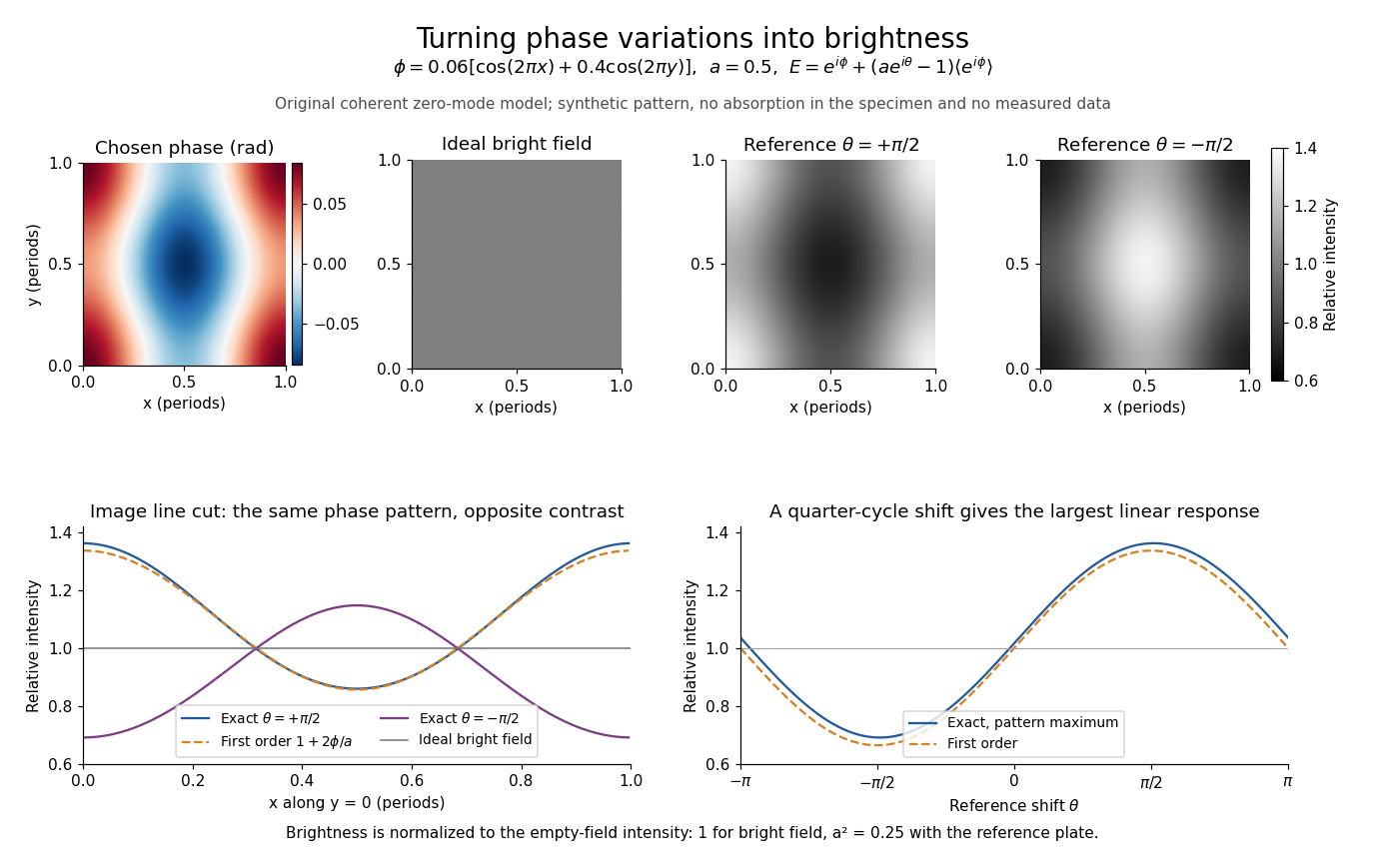

Two checks expose what the model can and cannot measure. A spatially constant phase gives and , so no absolute phase is recovered. Orthogonality of the constant and zero-mean parts also givesFor this cannot exceed the incident mean light intensity. The image redistributes brightness and loses some reference light rather than creating energy.
Articles by others on the same topic
There are currently no matching articles.