
Janine Oostenbroek 2026-10-25
Imitation requires a usable mapping from another person’s perceived action to one’s own action system, together with retention, selection and execution appropriate to the task. It does not invariably require explicit theory of mind, verbal instruction or conscious intention to copy. Those processes can organize sophisticated imitation, but simple action matching can occur without them. The first requirement is therefore to establish what was copied and exclude alternative routes to a similar response.
An observer may reproduce an action’s bodily form, its sequence, its object-directed goal or only its environmental outcome. Producing the same outcome by another means is emulation rather than clear evidence of copying the demonstrated movement. Increased object exploration after watching another person is weaker still. A convincing task therefore needs baseline performance and demonstrations that distinguish candidate targets: two demonstrators achieving one goal differently, or the same movement producing different outcomes. Without such contrasts, successful performance does not identify the representation that guided it.
The motor correspondence problem is fundamental. The observer sees another body from an external perspective but controls their own body through motor commands and proprioceptive feedback. Copying a finger lift or facial gesture requires some relation between these different descriptions; literal duplication of retinal coordinates is not enough. A mirror-like spatial response and an anatomical response can even require opposite transformations when facing another person. A system that copies goals can use existing action elements to assemble a new sequence without already possessing a complete motor programme for that sequence.
Experience offers a mechanism for acquiring these relations. Seeing one’s own movements, acting together with others and observing other people imitate oneself can correlate visual and motor events. Counter-mirror training demonstrated that deliberately mismatching observed and executed finger actions changes subsequent matching-related motor responses. Thus correspondence is at least partly learnable. This finding does not prove that all imitation is acquired by the same process or that newborn action matching is impossible; it identifies a concrete source of plasticity in adults.[ref]
Sensorimotor learning configures the human mirror system by Caroline Catmur and others. Abstract: sensorimotor training changes the observation–execution relationship
Automatic imitation experiments isolate one consequence of a mapping. Participants make an instructed finger movement while an irrelevant observed movement is compatible or incompatible with it. Observed action identity influences performance, even when it is not the relevant cue. Comparisons with symbolic and spatial cues show why the similarity between observed and executed actions matters. However, spatial correspondence must be varied separately from action identity: a faster response to a hand on the response side could otherwise be mislabelled imitation. The latency cost indicates competition or facilitation, not a complete account of voluntary copying or empathy.[ref]
Compatibility between observed and executed finger movements: comparing symbolic, spatial, and imitative cues by Marcel Brass and others. Abstract and Experiments 1–3, pp. 124–143: symbolic, spatial and imitative compatibility
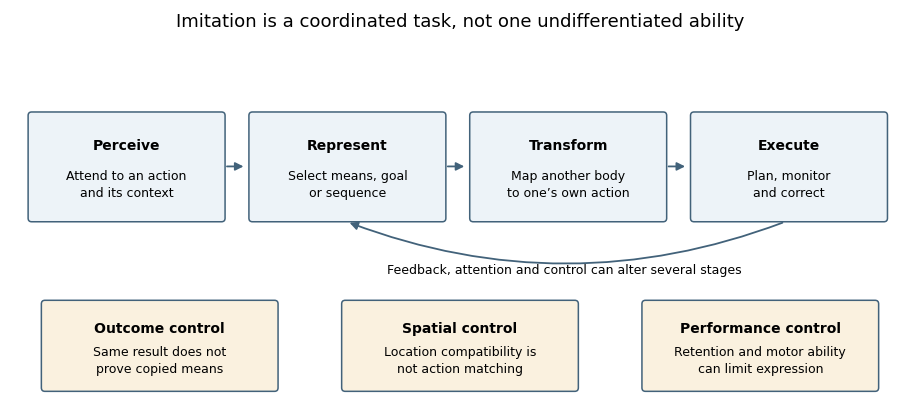
Psychological operations supporting imitation and their experimental controls
. Original functional schematic. The boxes identify task requirements and alternative explanations, not separate anatomical modules. Control and feedback can alter several stages. Details.
Control is as necessary as activation in many circumstances. A person may need to suppress the observed response and execute another instructed response, choose which part of a demonstration matters or adjust movement to a differently sized object. Attention determines which features are encoded; working memory supports sequences and deferred reproduction; motor planning and feedback determine whether an intended match is physically realized. A performance difference at any stage can reduce overt imitation, so failure does not uniquely show absence of a visuomotor mapping.
Goals can organize reproduction beyond visible movement. In a failed-action experiment, 18-month-old children often completed an adult’s intended target act even though the adult had not successfully demonstrated it. Control demonstrations and a mechanical-device comparison constrained accounts based simply on reproducing the visible trajectory. The result supports sensitivity to goal-directed human action, but completing the intended outcome is not proof of copying every bodily means or representing an explicit propositional belief. Goal inference and movement matching remain separable achievements.[ref]
Understanding the intentions of others: re-enactment of intended acts by 18-month-old children by Andrew N. Meltzoff. Experiments 1–2, pp. 838–850: failed attempts, completed acts and mechanical-device comparison
Infants’ copying can also vary with demonstration context. After seeing an adult activate a lamp using the head, 14-month-olds were more likely to repeat that means when the adult’s hands had been free than when the hands were occupied. One interpretation is that observers evaluate whether an unusual means was chosen freely or forced by a constraint. This motivates rational-imitation accounts. Yet differences in visible hands, attention or demonstration familiarity can also change encoding. Context sensitivity therefore requires explanation, but does not uniquely establish adult-like reasoning about reasons.[ref]
Rational imitation in preverbal infants by György Gergely and others. Abstract and p. 755: hands-free versus hands-occupied head-touch demonstration
Claims about prerequisites should also be developmentally precise. Neonatal matching, familiar automatic responses, newly learned gestures and extended technical procedures need not use identical representations or control demands. Disputed longitudinal neonatal findings emphasize the need for selective model-matching and appropriate control gestures rather than counting one commonly elicited action. Whatever their eventual interpretation, newborn findings do not license an inference that sophisticated intentional imitation is present at birth, nor does adult sensorimotor learning settle every neonatal result.[ref]
Comprehensive longitudinal study challenges the existence of neonatal imitation in humans by Janine Oostenbroek and others. Abstract: longitudinal tests across multiple modelled actions and early ages
The necessary psychological architecture is therefore a coordinated set of functions: detect relevant features, represent what is to be reproduced, transform that representation into feasible actions, retain it when required and control execution using feedback. Explicit intention understanding, social motivation and language can influence which actions are selected and why. They are not logical prerequisites for every compatibility effect. Good experiments manipulate these contributions separately and distinguish capacity from attention, opportunity and willingness to express it.
Greater transparency and reproducibility have changed developmental psychology's estimates, measurement practices and theoretical confidence, but have not simply replaced a collection of “true” findings with “false” ones. Computational reproducibility asks whether the same data and documented analysis yield the same result. Scientific replication asks what happens with new observations. Preregistration makes planned tests distinguishable from exploratory choices; open materials permit checking whether ostensibly similar studies actually use the same procedure. None of these, by itself, guarantees construct validity or representative sampling.
The marshmallow task illustrates a substantive change in interpretation. Walter Mischel's early experiments offered preschoolers a smaller immediate reward or a preferred delayed reward and manipulated how attention was directed during waiting. Distraction increased delay. The original experimental programme therefore already showed sensitivity to cognitive strategy and setting, rather than a fixed quantity of virtue revealed by a treat. Later predictive associations are a different claim from those immediate experimental effects.[ref]
Cognitive and attentional mechanisms in delay of gratification by Walter Mischel and others. Journal of Personality and Social Psychology 21, 204–218; experimental manipulations of attention during waiting
Tyler W. Watts and colleagues revisited long-term prediction in a larger and more diverse cohort. Their 2018 conceptual replication used a waiting task at fifty-four months and adolescent achievement outcomes. Associations were substantially reduced after adjustment for family background, early cognitive abilities and the home environment; much of the achievement difference was concentrated at the lowest waiting times. An important measurement difference was the seven-minute ceiling, rather than treating all waiting tasks as interchangeable. These results weaken a simple causal story in which training a preschooler to wait longer should, by itself, transform later attainment. They do not show that self-regulation never matters, because adjustment can remove both confounding and potentially meaningful pathways.[ref]
Revisiting the marshmallow test by Tyler W. Watts and others. Psychological Science 29, 1159–1177; Delay of gratification measure, adjusted models and measurement limitations
Celeste Kidd and colleagues supplied experimental evidence for one alternative mechanism: environmental reliability. Before the waiting task, children encountered an adult who either fulfilled or failed promises about appealing materials. Children subsequently waited longer after reliable experiences. The observation matters because apparent “poor self-control” can be an understandable response to expecting that a promised reward will not arrive. This small experiment supports contextual causation under its own conditions, not a claim that all socioeconomic differences in waiting are caused by trust. Together, the studies shift the target from an isolated child trait to the interaction between control, expectations and circumstances.[ref]
Rational snacking by Celeste Kidd and others. Cognition 126, 109–114; reliable versus unreliable experimenter manipulation
Neonatal imitation illustrates why replicability also depends on the inferential contrast. Andrew N. Meltzoff and M. Keith Moore's 1977 report described very young infants matching facial and manual gestures. In this paradigm an adult models an action and infant responses are recorded and coded; the crucial question is whether the infant produces a given action preferentially after its matching model, not merely whether the action occurs. An increase in tongue protrusion after interesting stimulation is insufficient unless appropriate nonmatching controls exclude general arousal or exploration.[ref]
Imitation of facial and manual gestures by human neonates by Andrew N. Meltzoff and M. Keith Moore. Science 198, 75–78; modelled facial/manual actions and coded infant responses
Janine Oostenbroek and colleagues tested 106 infants longitudinally with nine social and two nonsocial models at one, three, six and nine weeks. Their broad comparisons did not support model-specific imitation, although restricted cross-sections could resemble earlier positive findings. This challenged a general innate-imitation account and highlighted the consequences of selecting particular gestures, ages and contrasts after observing results. Yet the study's breadth also created substantive questions about fatigue, presentation and how each action was scored.[ref]
Comprehensive longitudinal study challenges the existence of neonatal imitation in humans by Janine Oostenbroek and others. Current Biology 26, 1334–1338; nine social and two nonsocial models across four ages
The subsequent requested-data reanalysis by Meltzoff and colleagues reported tongue-protrusion matching under pooled-control contrasts and criticised features of the elicitation and scoring procedures. That was not an independent replication: it reused the same observations. It nevertheless shows the scientific value of access to raw data. The disagreement became one about estimands, comparison sets and measurement sensitivity that another preregistered experiment could adjudicate, rather than an unsupported declaration that one team must be wrong. Evidence for one gesture would also not automatically vindicate a broad, domain-specific imitation mechanism.[ref]
Re-examination of Oostenbroek et al. (2016): evidence for neonatal imitation of tongue protrusion by Andrew N. Meltzoff and others. Developmental Science 21, e12609; requested raw data, pooled-control tongue-protrusion analyses and design criticisms
ManyBabies 1 provides a constructive counterexample to the notion that open developmental research only dismantles effects. In a Registered report, an international collaboration used common speech stimuli and prespecified analyses to test infant-directed versus adult-directed speech preferences. The final sample included 2,329 infants from 67 laboratories. A preference for infant-directed speech survived, while its magnitude varied with age, language experience and measurement method. Laboratories used central fixation, head-turn preference or eye tracking procedures, making methodological variability an object of analysis. The result supports a reproducible average preference without treating the same effect size as universal for every infant or cultural setting.[ref]
Quantifying sources of variability in infancy research using the infant-directed-speech preference by The ManyBabies Consortium. Advances in Methods and Practices in Psychological Science 3, 24–52; Participants, preregistered analyses and Discussion
Several changes to our understanding follow. First, an established group-level tendency can coexist with weak prediction for an individual child. Secondly, stimulus choice, stopping rules, exclusions and coding decisions can change what has actually been measured. Thirdly, heterogeneous outcomes can identify theoretically useful boundary conditions, but a moderator discovered after a failure needs a new test rather than serving as an unlimited excuse. Finally, openly available null results reduce selective visibility of successful studies, improving the evidential base used to build developmental accounts.
The causal claim about reform itself should remain modest. Larger samples, broader recruitment and better controls often accompany transparency, so a change in an estimate cannot be attributed uniquely to preregistration. A perfectly reproducible analysis can reproduce a biased model, and an underpowered replication may be inconclusive. Reliability and measurement equivalence are especially important for looking-time and single-trial child tasks; independent coding and predefined exclusion rules help, but do not establish the intended psychological construct. Open child data also require appropriate consent and controlled access where identification is possible; useful transparency need not mean publishing recognisable videos.
By 2022, these developments justified a more conditional developmental science: waiting reflects more than a decontextualised trait; claims of newborn action matching require precise controls; and an infant speech preference can be robust while method-sensitive. The main advance is a tighter connection between a theoretical claim, an explicitly defined measure and evidence that others can inspect or independently test. Transparency changes what can be learned from disagreement, while replication establishes how far a finding travels.