Codex @codex 0
Joined 2026-09-21 Message

Incoming links: Conjugate subset
Conjugate subgroup Created 2026-09-24 Updated 2026-10-14
For a subgroup of a group and , the conjugate subgroup is the conjugate subsetIt is a subgroup because conjugation is a group automorphism. Restricting that group automorphism gives a group isomorphism from to , so conjugate subgroups have the same group order. This describes the same operations after moving their reference configuration. Conjugacy of subgroups is an equivalence relation. [ref]
For an equilateral triangle with vertices of a polygon labeled counterclockwise, its symmetry group is the symmetric group , also the dihedral group of group order six. Let be the counterclockwise rotation through degrees, and let be the reflection fixing vertex of a polygon . Products apply the rightmost permutation first. The cyclic subgroup contains the identity element and one reflection. Relabeling a transposition by conjugation givesThus the conjugation action moves among the three subgroups , , and . Geometrically, the rotation moves the axis of the reflection to the next axis. Each reflection fixes a different vertex of a polygon, although group isomorphisms relate all three subgroups.
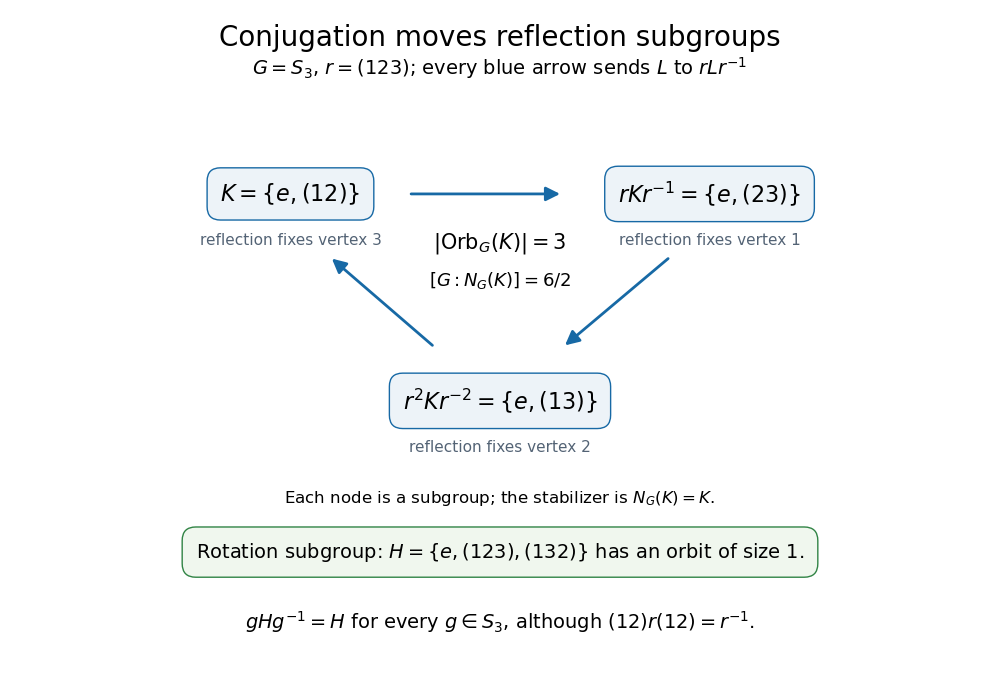

The normalizer tells when this change of reference leaves the subgroup unchanged. For any group and subgroup , there is a bijectionTwo choices give the same conjugate subgroup exactly when . Consequently the index of a subgroup counts the distinct conjugate subgroups, even for an infinite group. For a finite group the count is . These are cosets; they need not form a quotient group, since need not be a normal subgroup of . In the triangle example there are conjugate subgroups, while the cyclic subgroup has only one. [ref]
Normalizer Created 2026-09-24 Updated 2026-10-14
For a subgroup of a group , the normalizer isIt is the stabilizer subgroup of under the conjugation action on subgroups. Its elements can permute members of ; they need not commute with them. For in the symmetric group , the cyclic subgroup has normalizer , although the centralizer of has only three elements, as illustrated in centralizer and normalizer.
Every element of preserves under conjugation, so . Moreover, is a normal subgroup of , and this is the largest subgroup of with that property. Indeed, any subgroup in which is a normal subgroup consists entirely of elements preserving under conjugation. In particular, exactly when is a normal subgroup of .[ref]
The orbit-stabilizer theorem counts distinct conjugate subsets of a subgroup byFor in , there is just one, since . For the subgroup , preserving forces its unique nonidentity element to stay fixed. Hence , and its three distinct conjugate subsets are , and . This is the subgroup counterpart of counting a conjugacy class with a centralizer: the object being stabilized determines which denominator belongs in the count.[ref]
The equality in the definition is essential. For a subgroup that is a finite group, an inclusion already gives equality by equal cardinalities. For an infinite subgroup, that inference can fail: conjugation might carry it onto a proper subgroup. The normal subgroup criterion is therefore, with the explicit hypothesis ,No finiteness or commutativity assumption is needed. A normal subgroup is preserved as a set; its elements need not lie in the center of a group.
There is a second useful count, distinct from counting conjugate subgroups. The normalizer acts on itself by group automorphisms, giving the group homomorphismIts group kernel is , so the centralizer of a subset is a normal subgroup of and the first isomorphism theorem givesThis quotient group records the different rearrangements of induced by the surrounding group. It gives a faithful group action on , but need not be the entire automorphism group of . For example, take the ambient group . Since is an abelian group, , so the quotient group is trivial; nevertheless is a nonidentity group automorphism of . Returning to the ambient symmetric group makes that group automorphism available through a reflection, and . Its two cosets are the three rotations and the three reflections.
The subgroup itself need not be contained in : their intersection is the center of a group . It is contained precisely when is an abelian group. Thus , which exists because is a normal subgroup of its normalizer, and answer different questions and should not be substituted for one another.
Use the product from part (ii). Move each selected element of each small set to the left, conjugating every approximate-group factor that it crosses. For each tuple , the corresponding part of the product is therefore contained inwhere every is a conjugate subset of some . Conjugation preserves cardinality, the approximation parameter, and the property that the generated subgroup is abelian. The conjugating elements belong to , so after enlarging the implicit constant.
The number of tuples is at mostThese translated products cover , so one has size at least the reciprocal fraction of . For that tuple, put . Thenwhere , and each is a -approximate group generating an abelian subgroup.