The centralizer of an element of a group consists of all elements that commute with :It is the stabilizer subgroup of under the conjugation action, hence a subgroup of . In conjugacy classes of the symmetric group on three letters, the three representative computations areFor the transposition , a commuting permutation must preserve the exchanged pair and fix ; only and do so. For , a commuting permutation is determined by where it sends : the equation forces the images of and , leaving exactly . For , every permutation commutes. These centralizer sizes give conjugacy class sizes .
The centralizer is useful because it measures how much freedom remains after fixing one operation. Its index of a subgroup counts the distinct results of conjugation, and the intersection of all element centralizers is the center of a group. A centralizer need not be an abelian group: even when is a nonabelian group. In an abelian group, all element centralizers equal . These observations also explain why the surrounding group matters: the centralizer of inside the alternating group is the whole , whereas its centralizer inside is a proper subgroup. See McKernan, the centralizer definition preceding lemma 23.6.
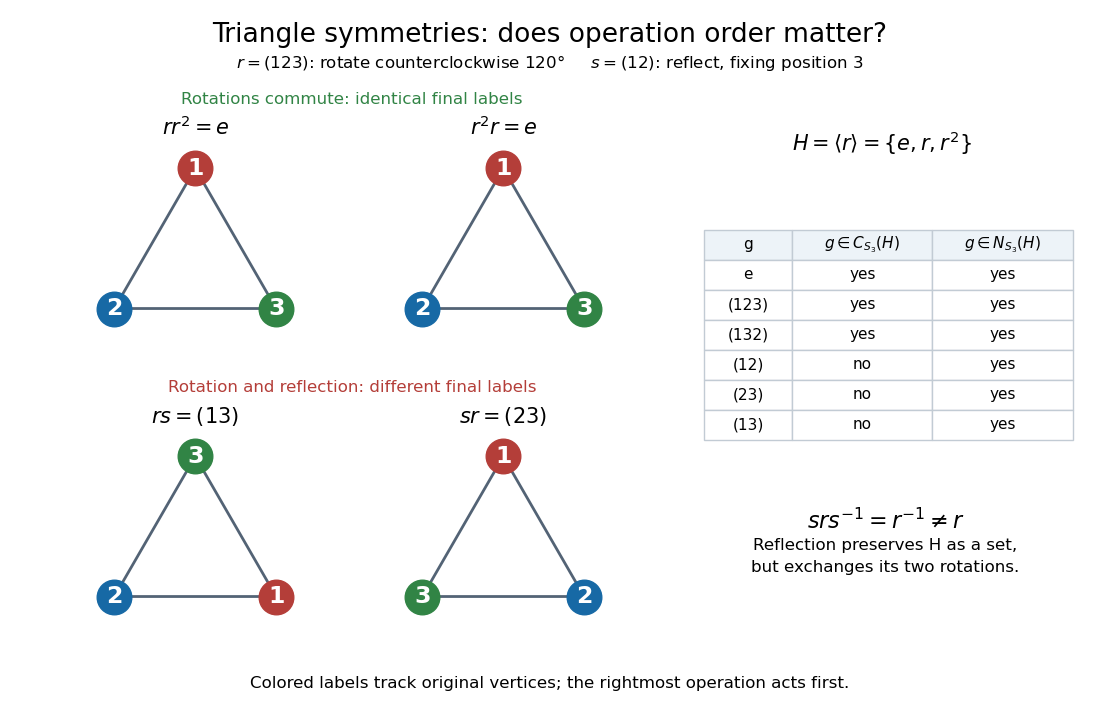
For an arbitrary subset , the centralizer of a subset fixes every element of individually under the conjugation action:This is a pointwise stabilizer of the elements of , not of the vertices of a polygon in a geometric realization. In particular, belongs to although its rotation moves every vertex of a polygon of the equilateral triangle. If generates a subgroup , commuting with every element of implies commuting with every product of those elements and their inverse elements; hence . For the triangle rotation subgroup , this gives .
To see the commutation test directly on the equilateral triangle, compare a rotation with the reflection . Their permutations satisfyThe two orders send vertex of a polygon to different places: , but . Thus . By contrast and commute, with . The reflection reverses the chosen rotation while preserving the subgroup of all triangle rotations, so . The distinction is visible before any counting: commuting preserves an operation itself; membership in the normalizer permits exchanging it with another operation in the same subgroup.

The centralizer of a subset of a group consists of the elements commuting with every member of . It is the intersection of the element centralizers, hence a subgroup. Directly, identity commutes with every element, products of two elements that each commute with every member of still have that property, and the same is true of inverses. For this is the centre of a group. For an empty subset the commutation condition is vacuous and the centralizer is all of .
Commutation with a fixed-point-free involution preserves its partner relation. A commuting permutation can permute the pairs and independently swap each pair. This gives the permutation wreath product with order .
A permutation commutes with a transposition exactly when it preserves its two-element support as a set. It may swap those two points and independently permute the remaining points. Thus this centraliser has order .
Articles by others on the same topic
There are currently no matching articles.