For a group action of any group on a set , the cardinality of the orbit of a group action through is the index of a subgroup of its stabilizer subgroup:In particular, if is a finite group,For a fixed finite group, a larger stabilizer subgroup means a smaller group orbit: more transformations repeat the same image of . The set itself need not be finite.
The underlying bijection uses left cosets, without requiring to be a normal subgroup:To check it briefly, replacing by with preserves , so is well-defined. Every member of the group orbit has this form. Finally, implies , hence , proving the bijection. This is the construction in MIT's group-action notes, lemma 23.5. For infinite groups, the bijection and the cardinality statement still hold; division of infinite cardinalities does not supply the finite formula.
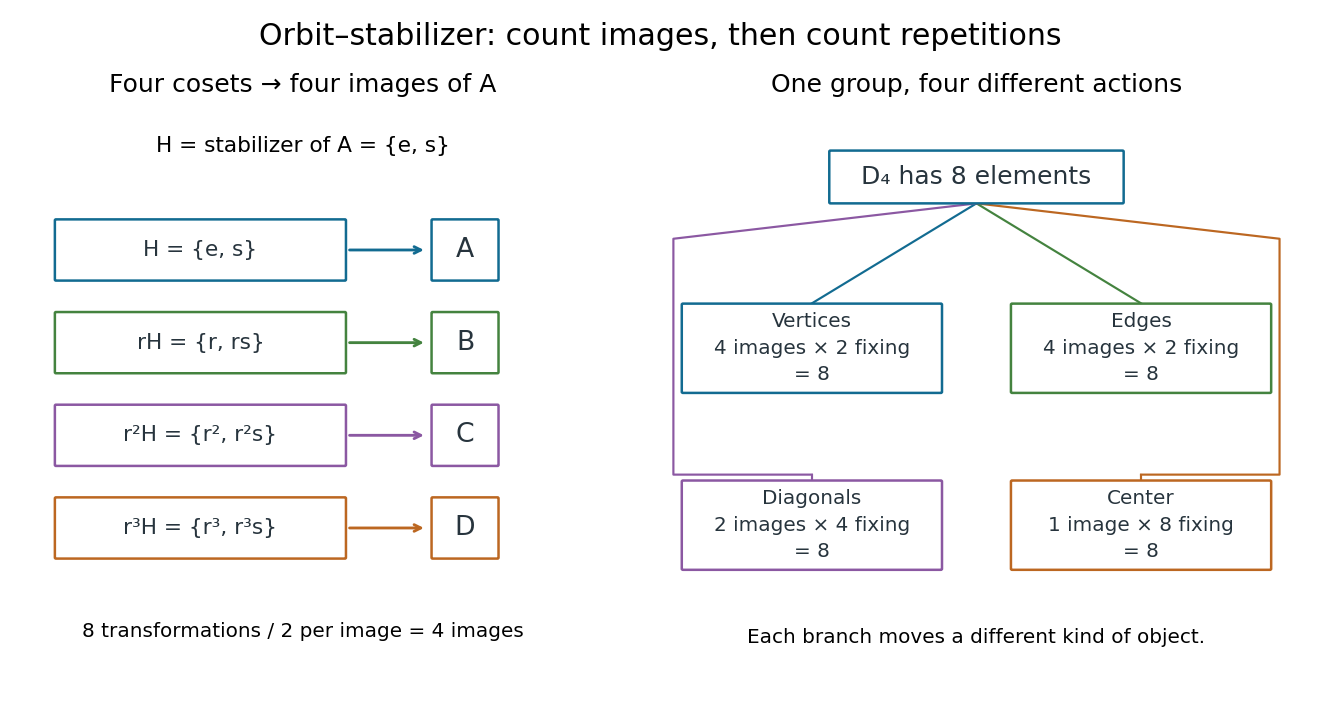
For the eight-element dihedral group acting on the square described under group action, moving a marked vertex of a polygon gives . Moving a marked side of a polygon also gives ; moving one unoriented diagonal of a polygon gives ; moving the centroid gives . These are four different group actions, each with one group orbit. In the first group action, the four left cosets of areThey correspond respectively to . Counting all eight transformations would count each position of the marked vertex of a polygon twice.

For a second computed example, let the symmetric group act on the Cartesian product by . There are two orbits of a group action:andThe first stabilizer subgroup can exchange and while fixing ; the second must fix both and , so also fixes . The orbit-stabilizer theorem gives and , and the two group orbit sizes account for all nine ordered pairs. The general reason for exactly these two group orbits is equality-pattern orbits of ordered pairs.
For an algebraic group action, a group orbit has dimensionwhere is the stabilizer subgroup. The orbit map has fibres that are cosets of , so the fiber dimension theorem gives the formula.
For the base change action on quiver representations, the stabilizer subgroup is the automorphism group of a quiver representation. It is a Zariski-open set in the endomorphism ring of that quiver representation, so their dimensions agree. The Ringel form then identifies orbit codimension with the dimension of the self-extension group. This open-unit-group argument applies to this representation-classification setting; a general vector stabilizer subgroup need not have that form.
Articles by others on the same topic
There are currently no matching articles.