For sorting records with integer sort keys in , where , let count the input occurrences of sort key . Define two prefix sums:The empty sum gives . Here are counts of sorting records. Exactly sorting records have smaller sort keys, so the output positions for sort key form the half-open integer intervalIts right endpoint is excluded: the last occupied array index is when .[ref]
11.2 Counting Sort and Radix Sort. Open Data Structures: An Introduction by Pat Morin; §11.2.1 Counting Sort, paragraphs after Figure 11.7: running sums count keys at most k and determine the output block
For the seven-sorting record example, the frequency array, inclusive cumulative count array, and start array areThus sort keys zero, one, two and three occupy the integer intervals , , and , respectively. In particular, the three sorting records with sort key two belong at array indices three, four and five. The inclusive cumulative count counts all six sorting records with sort keys at most two; six is the exclusive endpoint, not the final position of a sorting record with sort key two.
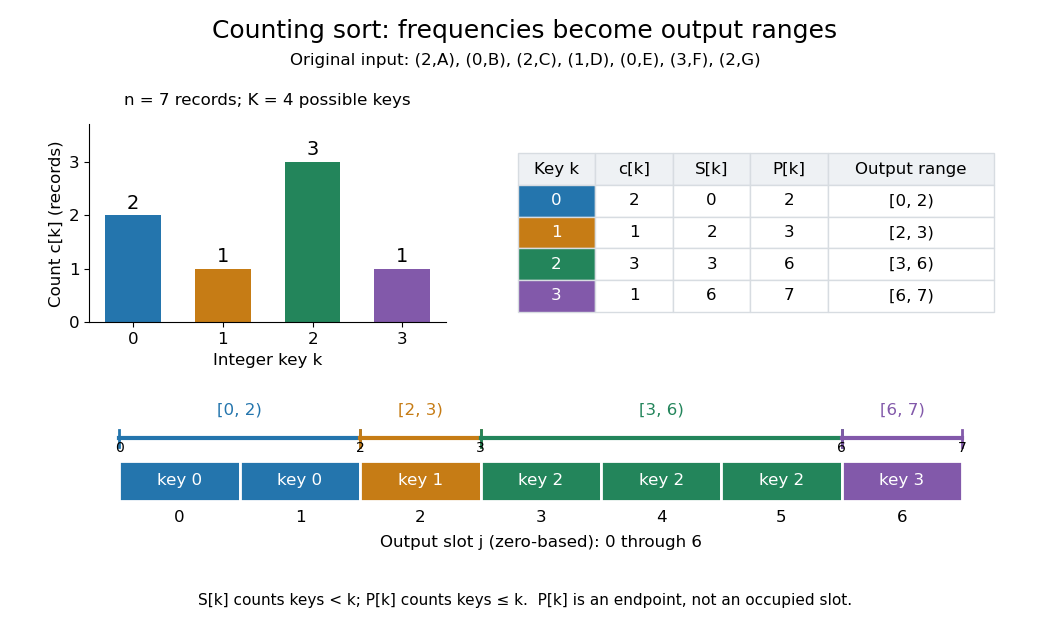

These integer intervals fit together because for , and . Their lengths add to , so they partition all output positions without overlaps or gaps. An absent sort key contributes an empty integer interval: with frequencies , the endpoints are and sort key two has range . For empty input, every count and endpoint is zero; every reserved integer interval is empty. This makes the same formulas cover missing sort keys and the empty case.
Articles by others on the same topic
There are currently no matching articles.