A prefix sum stores the accumulated sum through a specified position in a finite sequence or array. For inputs , include the empty sum and setFor the original input , the prefix array including is . A negative entry makes the accumulated sum decrease; a prefix sum does not have to be monotone. Conversely, the original entry is recovered by subtraction: .
The useful cancellation is that any contiguous block has sumBoth prefixes include the entries before ; subtracting cancels those entries. In the example, the sum from positions two through four is , recovered as . The arithmetic mean of that block is , obtained by dividing its sum by its length. Prefix sums therefore make many repeated questions about an unchanged array cheap: reuse accumulated totals instead of resumming every block.
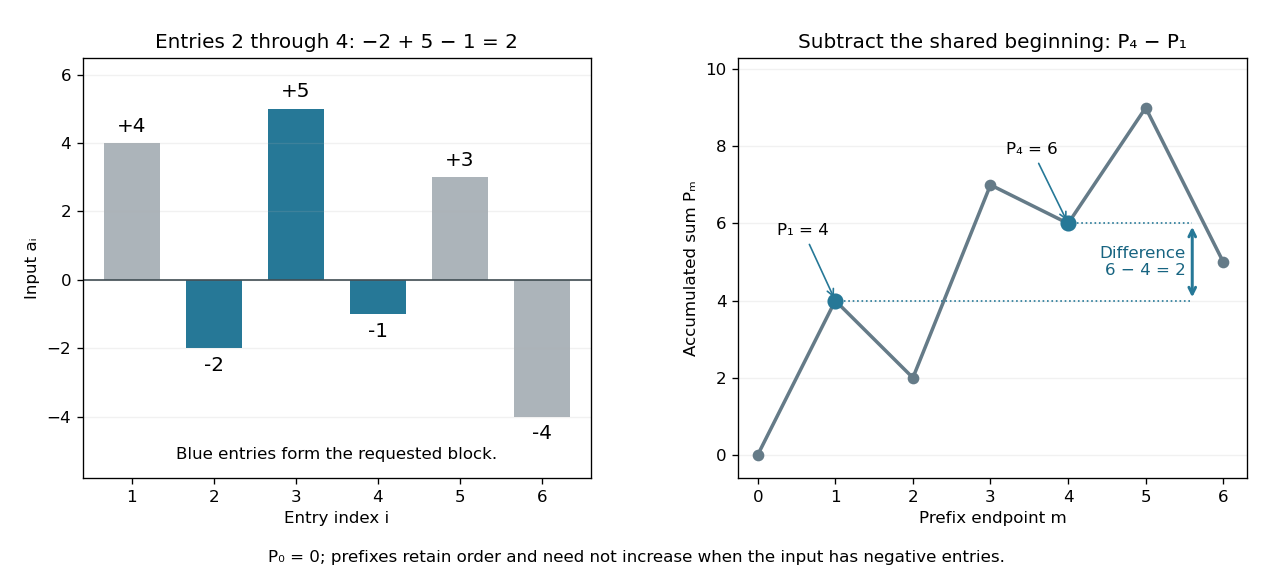
The sequential recurrence builds all prefixes in time complexity and storage; each block query needs two reads and one subtraction, hence time complexity. These counts assume constant-cost arithmetic and access to array entries. If one input changes, all later stored prefixes change, so this simple representation is most useful when queries outnumber updates. For integer inputs, sufficient numeric capacity must be retained; with floating-point arithmetic, subtracting large nearby prefixes can lose relative accuracy for a small block total. The exact mathematical identity does not eliminate representation error.
The apparently sequential recurrence also motivates a prefix scan: associativity permits a tree of partial calculations that yields all accumulated results in parallel. Guy E. Blelloch's 1990 technical report systematically develops this operation and its applications; its authored chapter version explains the two tree sweeps used to obtain all prefixes. [ref]
https://www.cs.cmu.edu/afs/cs.cmu.edu/project/scandal/public/papers/CMU-CS-90-190.html. Blelloch, Prefix Sums and Their Applications, CMU-CS-90-190, November 1990
. [ref]https://www.cs.cmu.edu/~guyb/papers/Ble93.pdf. Blelloch, authored chapter version, §§1.1–1.2: sequential scans and parallel tree sweeps
.A prefix scan computes successive accumulated results for an associative operation while keeping input order fixed. A scan based on addition produces prefix sums; one based on matrix multiplication produces successive ordered matrix products. Associativity allows regrouping, while commutativity is unnecessary because the order stays fixed. If an initial empty prefix is included, its value is the identity element for the chosen operation.
The ability to compute accumulated results does not by itself allow subtraction of two prefixes. For example, two accumulated minima cannot reveal a block minimum: the lists and both have successive minima , but the minimum of positions two through three is seven for one and two for the other. Prefix sums support block recovery because addition has additive inverses; an arbitrary associative operation need not have that property.
Articles by others on the same topic


A **prefix sum** is a concept used in computer science and mathematics, particularly in the context of array manipulation and analysis. The prefix sum of an array is a new array where each element at index \(i\) represents the sum of the elements in the original array from the start up to index \(i\).