Beam optics 2026-10-24
The transverse transport of a charged-particle beam relative to a reference trajectory. Linear focusing gives betatron oscillations, described by Hill's equation and Courant-Snyder parameters; the beam envelope depends on its geometric emittance.
Geometric emittance 2026-10-25
For a centered beam, the displayed rms area in coordinates. A matched beam has , where is one of the Courant-Snyder parameters. Under ideal acceleration, adiabatic damping of geometric emittance decreases this area even when the canonical phase-space area is preserved.
Write , with and . Differentiating twice gives
The coefficients must vanish for arbitrary initial phase . The sine coefficient gives
The conventional Courant-Snyder parameters normalize the phase so that ; any positive constant can be absorbed into the scale assigned to and . Explicitly, and preserve the orbit while making . With this convention,
The second expression is the Ermakov-Pinney equation for the beam envelope. It follows by substituting into the cosine coefficient.
The printed equation omits the factor multiplying . For a concrete counterexample, take the constant periodic focusing strength and the constant envelope . Then and solve . The correct envelope equation is , whereas the printed equation gives .
The associated invariant is
Thus fixes the phase-space ellipse of a trajectory; a beam's rms geometric emittance uses the corresponding second-moment convention. Factors of depend on whether emittance means ellipse area or area divided by and do not alter the envelope equation.
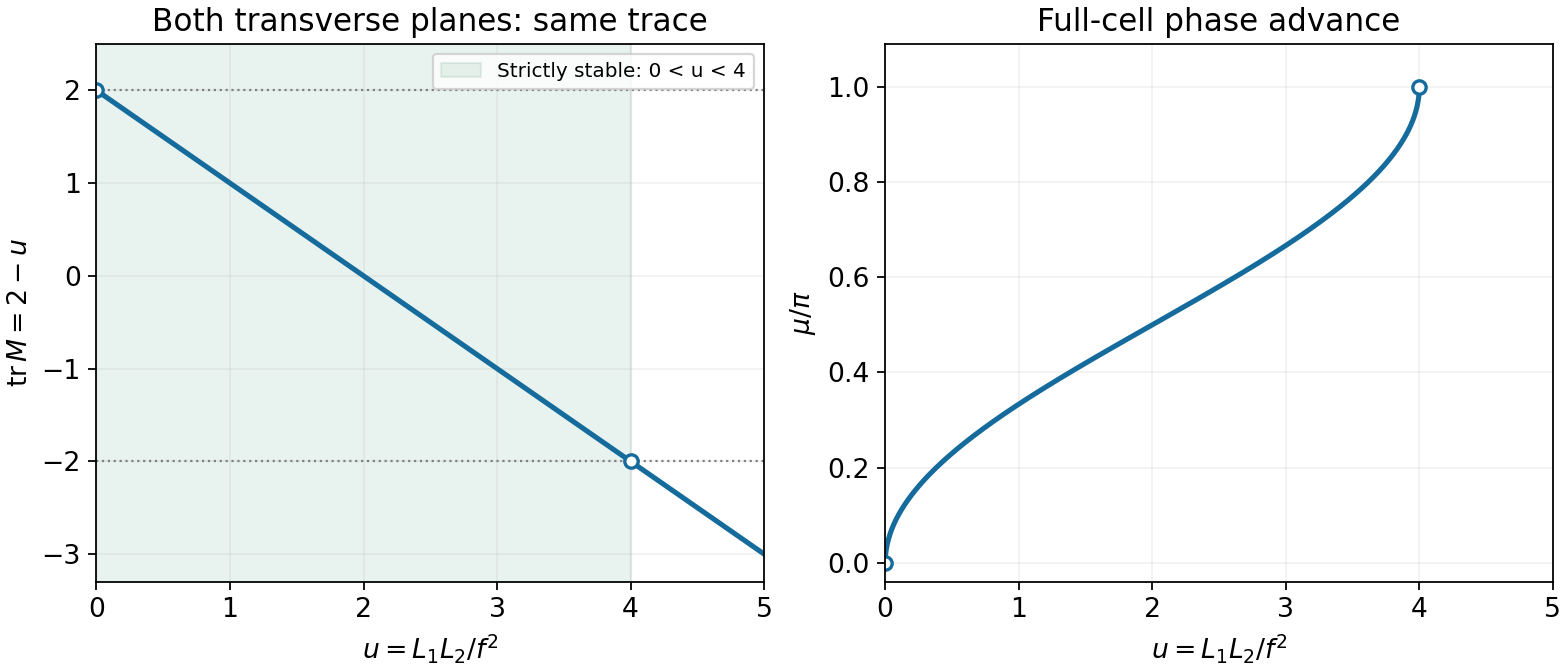
For a real determinant-one map, bounded generic repeated transport requires eigenvalues , equivalently . Here both planes have , so
For positive drift lengths and , this means . The equalities are marginal and generally produce a Jordan-block growth rather than stable motion. Moving the reference point changes the map by a similarity transformation, , so the eigenvalues and full-cell phase advance are unchanged.
Write the stable map using the Courant-Snyder parameters, also called Twiss parameters:
At the chosen reference point , , and . Repeated traversal gives
If the full ring contains identical cells, its one-turn phase is modulo ; ring turns use . The displayed is for repetitions of the specified cell.
Figure 1.
Stability and phase advance of the equal-strength quadrupole cell
. Both transverse planes have trace 2 minus L_1 L_2/f squared. The strict stable interval excludes the two marginal boundaries. Details.
At fixed gradient and magnet length, . If is total energy,
Here , not one of the Courant-Snyder parameters. For ultrarelativistic electrons this becomes , or : higher-energy particles are bent and focused less strongly. If the symbol instead denotes kinetic energy , the coefficient is , approaching in the nonrelativistic limit. Stating the energy convention avoids applying the ultrarelativistic result to a slow beam.
For a real uncoupled, lossless transverse map, . Bounded nondegenerate oscillatory motion requires complex-conjugate eigenvalues , equivalently
Its Courant-Snyder parameters give
The positive quadratic form is invariant, so repeating the cell cannot produce secular growth. At trace a nontrivial Jordan block instead produces linear growth; only the exceptional maps remain bounded at those exact boundaries. The criterion must hold in both transverse planes. For the symmetric FODO cell, both traces are , giving
