Similarity transformation
ID: similarity-transformation

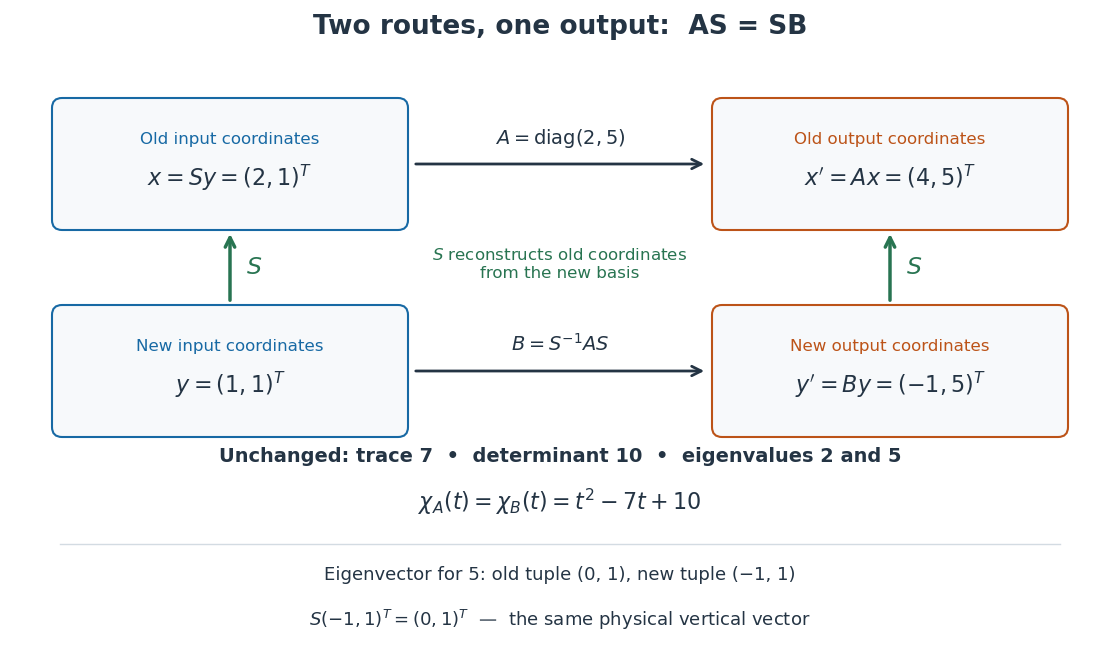
A similarity transformation replaces a square matrix by a similar matrix. With the change-of-basis matrix convention , it sends to : reconstruct the input in old coordinates, apply , then extract the output's new coordinates. These three operations explain the order of the factors.
The equivalent formula uses as the conversion from old to new coordinates, reversing the role assigned to above. For the opening example's numerical , this opposite conversion gives . If the old basis is , the new basis vectors in that convention are the columns of , namely and . Both formulas are similarity transformations; the direction of the coordinate conversion decides which one describes a specified basis.
An especially useful form is the intertwining operator equationIt says that applying before reconstruction by gives the same physical output as reconstructing first and applying . Given an invertible matrix , multiplying this equation by proves matrix similarity. Without invertibility, the equation alone does not prove matrix similarity.

New to topics? Read the docs here!