A standard positive-total form of the Dvoretzky-Motzkin cycle lemma uses a nonempty sequence of integers satisfyingExactly starting positions have every nonempty partial sum strictly positive, using the same rotation convention as the sum-one cycle lemma. Negative entries can be arbitrarily large in magnitude, and zero entries are allowed. Addario-Berry's proposition 2.2.1 gives an equivalent form with increments at least and negative total; reversing the sequence and changing all signs gives the form here. [ref]
https://problab.ca/louigi/notes/ssprob2021.pdf#page=39. Addario-Berry, Lecture notes: 2021 CRM-PIMS Probability Summer School, proposition 2.2.1, p. 39
Four starts, two successes. For , the sum is . Starts and give partial sums and , respectively. Start gives and touches zero; start gives and begins below zero. Thus exactly two starts are good. The rotated sequence has the same positive total, but its first start is bad: a positive final lead alone does not control earlier partial sums.
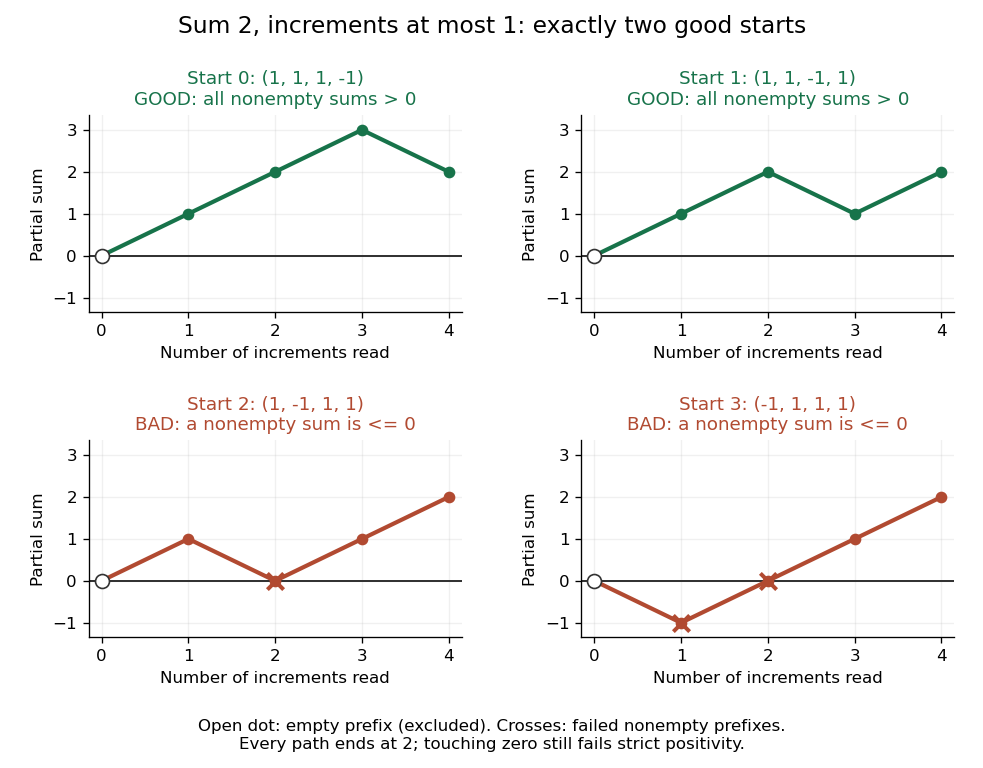
All four starts of : the cycle lemma with increments at most one counts precisely the two paths whose nonempty partial sums stay strictly above zero
. Details. 
Positions can give identical words. The sequence repeats a block of length three and has sum two. Its good starts are and , both giving the same word with partial sums . Starts and touch zero; starts and begin negatively. The cycle lemma with increments at most one counts two starting positions even though there is only one distinct good rotated word. Counting distinct words would lose the multiplicity that makes the statement true.
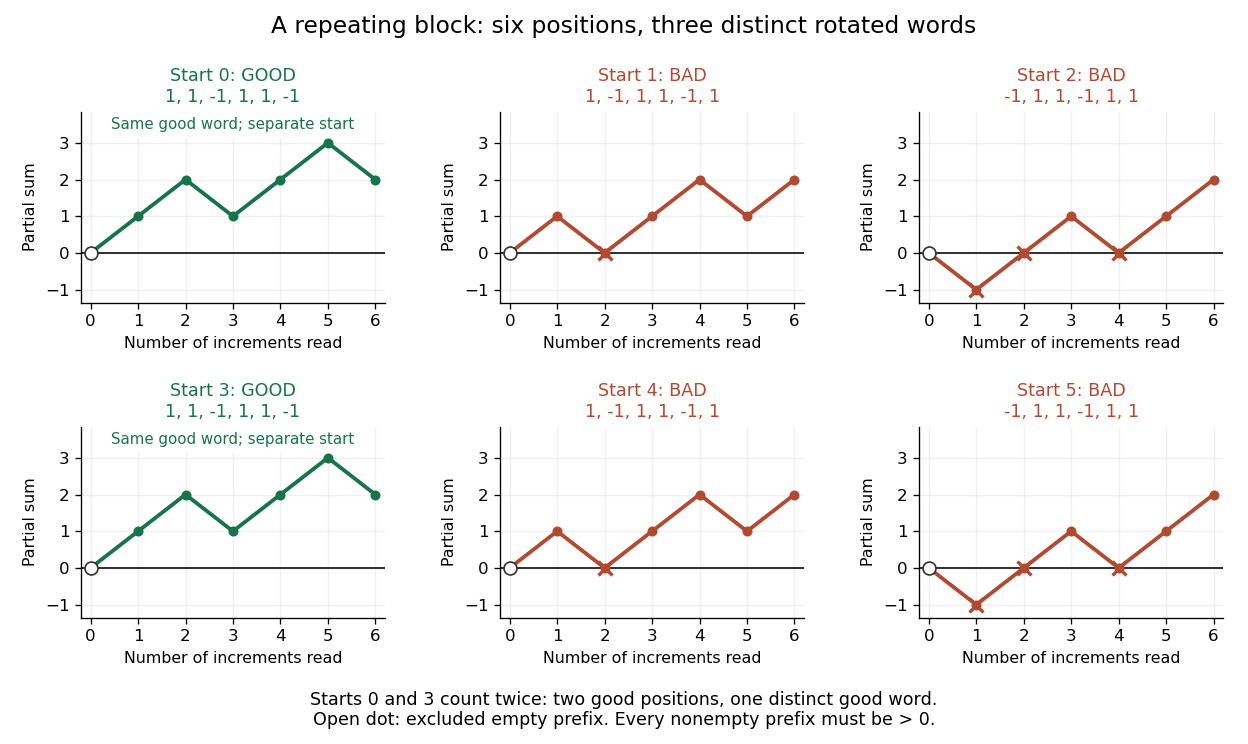
Six starting positions of the repeating sequence : starts and produce identical good words and count twice
. Details. 
The upper bound matters. The one-entry sequence has positive integer sum two, but only one starting position. Thus the sum- conclusion fails for arbitrary positive increments when . The sum-one cycle lemma above needs no such upper bound. Strict positivity also matters: counting paths that merely stay at or above zero would include additional starts in both diagrams.
From rotation to enumeration. For a fixed admissible sequence, a start chosen from a uniform distribution on a finite set of its positions is good with probability . More generally, let be any finite set of length- sequences satisfying the increment bound and total , closed under rotation. Double counting pairs consisting of a sequence and a good starting position givesFor each good output sequence and each of the positions, inverse rotation gives one such pair, even when several rotated words coincide. For example, the four sequences containing three votes and one vote have exactly vote orders with a strictly positive running lead: and . This is how the cycle lemma with increments at most one converts many prefix inequalities into a simple counting factor.
Articles by others on the same topic
There are currently no matching articles.