A discrete uniform distribution gives every element of a nonempty finite set the same probability. Write for its cardinality. A random variable with this law has support of a probability distribution and probability mass functionThe masses sum to . Conversely, if all masses equal , their sum is , so necessarily . Thus equal chances determine the whole law.[ref]
Counting now computes an event's probability: for any set of possible values,In particular, when , the answer is . The intersection matters: values outside the support of a probability distribution contribute zero. This turns a probability question into a combinatorics question, provided that equal chances are justified by the model.
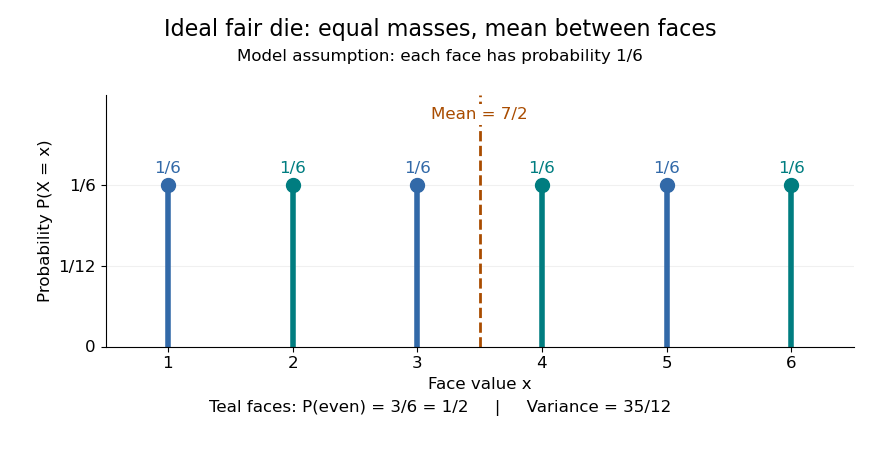
For an ideal fair six-sided die, and each face has probability . The event of an even integer is , so its probability is ; the event has probability . Direct summation gives the expected value and the variance . The mean is a balance point between possible outcomes. These are exact consequences of stipulated fairness, rather than measured frequencies from physical dice.

Uniformity describes probabilities, not distances between values. For a second constructed model, stipulate equal-chance selection from . Every value has probability , despite the unequal gaps . Here , while the expected value and variance areNeither the midpoint of the extreme values, , nor a formula using only the cardinality gives these moments. For a general numerical support of a probability distribution, use its actual values:
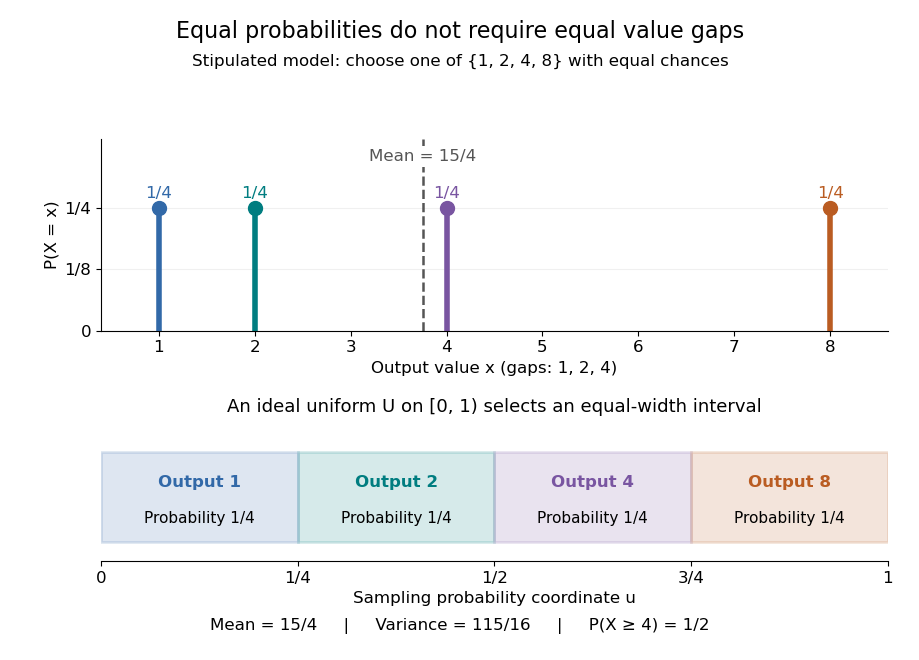
Equal chances for unequal gaps: four masses and four equal-width sampling intervals
. Details. 
Choosing an item from a finite list with equal chances is a basic building block of simple random sampling. A bijection that relabels the items preserves equal probabilities, although changing numerical labels can change the expected value and variance. A function that merges labels can destroy uniformity: for the fair-die model, has masses at , since four faces map to three. Always count the original equally likely outcomes.
An indicator random variable for membership in a set has a Bernoulli distribution with parameter ; counting that event over independent repetitions gives a binomial distribution with parameters and . Equal chances among individual values need not produce equal chances among aggregated counts.[ref]
Introduction to Probability, Statistics, and Random Processes by Hossein Pishro-Nik. §3.1.5, indicator random variables and binomial variables as sums of independent Bernoulli variables
Suppose the support of a probability distribution consists of all consecutive integers from to , including both endpoints, with . Its cardinality is , and a discrete uniform distribution on it satisfiesFor a short derivation, set , whose possible values are . The finite sums giveand henceAdding shifts the expected value by and leaves the variance unchanged. For completeness, the first sum follows by pairing with . For the second, sum from to : the left side is , so inserting the first sum gives the stated result.
The edge case has : with probability one, expected value , and variance zero. On an arithmetic progression with , the same argument instead gives expected value and variance . Equal spacing is the extra hypothesis behind these formulas; the discrete uniform distribution on requires the general sums above.
Let the numerical support of a probability distribution be . Its cumulative distribution function counts how many values have been passed:It is zero below , equals on for , and is one at and above . Every jump is , even when the horizontal gaps differ.
For inverse transform sampling, take an ideal continuous uniform distribution for on . Partition that interval into intervals of width and outputEach interval has probability , proving the desired discrete uniform distribution. Using the floor function, the index is ; for consecutive integer values the output is . With the usual quantile function convention , one instead writes for , using the ceiling function. The endpoint conventions differ only at a finite set of points with probability zero under the ideal continuous uniform distribution.
For , the four intervals , , , and select , respectively. Thus selects , while selects . The upper half of the interval selects values at least four, recovering probability . Equal widths refer to the sampling probability coordinate, not to distances between output values. This is an exact mathematical construction assuming an ideal continuous uniform distribution; a finite computer random-number source needs its own justification of equal output chances.
An ordered sample from equally likely values is nondecreasing exactly when it is the unique sorted representative of its multiplicities. Stars and bars counts the nonnegative multiplicities summing to ; repeated values are included automatically.
Articles by others on the same topic
There are currently no matching articles.