A dermatologist is a physician specializing in the diagnosis and treatment of diseases affecting the skin, hair and the nail. The field combines visible patterns with information about symptoms, timing, exposures and the rest of the body. The American Academy of Dermatology describes this scope and distinguishes additional specialization in dermatopathology.[ref]
What is a dermatologist? by the American Academy of Dermatology. Opening definition; dermatopathologist subsection
The surface is informative but does not directly reveal every cause. Similar redness or scaling can occur through different biological processes, while one process can look different at different sites or stages. A skin biopsy supplies a selected piece of tissue for microscopic examination; a dermatopathologist relates its cellular and structural findings to the clinical question.[ref]
What is a dermatologist? by the American Academy of Dermatology. Dermatopathologist description, microscopic examination of removed tissue
Sampling location and the question asked determine what that specimen can represent.An original diagnostic-reasoning example shows why appearance and diagnosis are not identical. Suppose a hypothetical classification signal is positive in of affected cases and of unaffected cases, in a population where have the specified condition. Bayes' theorem givesThus even a signal associated with the condition can have many other explanations among positive results. These are chosen probabilities, not performance data for a skin examination, biopsy or particular diagnostic instrument.
The scientific work is to connect observations at different scales: lesion distribution, tissue architecture, cellular changes and a plausible disease mechanism. An observation that supports one mechanism need not uniquely establish it. Repeated examination can additionally reveal change over time that a single photograph cannot encode.
The profession's scope is biological and clinical, while training pathways and certification rules depend on jurisdiction. The distinction matters when interpreting an institutional role description: a particular board-certification route does not define the universal scientific meaning of dermatology.
A dermatopathologist is a medical specialist who interprets sampled skin, hair or nail tissue to investigate disease. The role combines microscopic observation with clinicopathological correlation and communicates the interpretation in a pathology report.[ref]
What is a dermatologist? by the American Academy of Dermatology. Dermatopathologist subsection, microscopy and report
It differs from simply acquiring a magnified image.The specialist asks whether the specimen represents the relevant lesion, which tissue structures are present and how the observed pattern bears on the proposed diagnosis. A histological section is a selected two-dimensional view. Clinical information can help determine whether the section addresses the intended question, while the microscopic findings can support or challenge the initial clinical impression.
Diagnostic reproducibility is an empirical property of a classification procedure. The primary study by Joann G. Elmore and colleagues compared repeated interpretations of melanocytic lesions and agreement with a consensus reference.[ref]
Pathologists' diagnosis of invasive melanoma and melanocytic proliferations: observer accuracy and reproducibility study by Joann G. Elmore and others. Abstract and Methods, repeat interpretation and reference diagnosis
The same observer agreeing with an earlier label, two observers agreeing with each other, and an observer agreeing with the reference are separate comparisons.In an original illustration, two observers agree on 12 of 20 classifications, giving observed agreement . That fraction does not by itself specify which categories were confused or how either observer compared with an independent reference. Conversely, two observers could agree on every case while sharing the same systematic error relative to that reference.
A useful report therefore distinguishes the observation from its interpretation and states meaningful limitations. Additional sections, clinical clarification or other appropriately selected evidence can address particular uncertainties, but no single type of extra information resolves every diagnostic ambiguity. Training and certification arrangements depend on jurisdiction; the scientific core is disciplined interpretation and communication of biological evidence.
Martin Leverkus coauthored the 2016 crystal violet assay protocol with Maria Feoktistova and Peter Geserick. The paper's affiliations connect the collaboration with molecular dermatology at Mannheim and dermatology at Aachen.[ref]
Crystal Violet Assay for Determining Viability of Cultured Cells by Maria Feoktistova and others. Byline and affiliations
Its scientific value includes making an assay's biological interpretation explicit: less retained stain does not, by itself, identify a particular mechanism of cell death.A useful distinction is between reduced cell proliferation and increased cell death. An original constant-rate model giveswhere and are per-cell proliferation and death rates. Parameter pairs and give the same net growth rate. Starting from 10000 cells, both predict approximately 14918 after ten hours, although only the first model includes ongoing deaths.
A staining endpoint proportional to retained cell number would not distinguish those two histories. Time-resolved counting or a measurement specific to a death process supplies additional information. Moreover, altered attachment or staining can invalidate the assumed proportionality before that biological comparison even begins. This is why the protocol's requirement for additional characterization matters.[ref]
Crystal Violet Assay for Determining Viability of Cultured Cells by Maria Feoktistova and others. Abstract, requirement to characterize the cause of reduced staining
The calculation is an original identifiability example, not a reconstruction of Leverkus's data.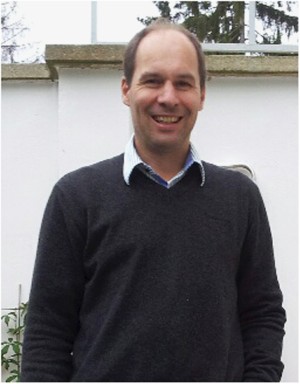
Martin Leverkus, portrait accompanying the Cell Death Discovery memorial
. External portrait from the memorial to Martin Leverkus. Articles by others on the same topic
There are currently no matching articles.