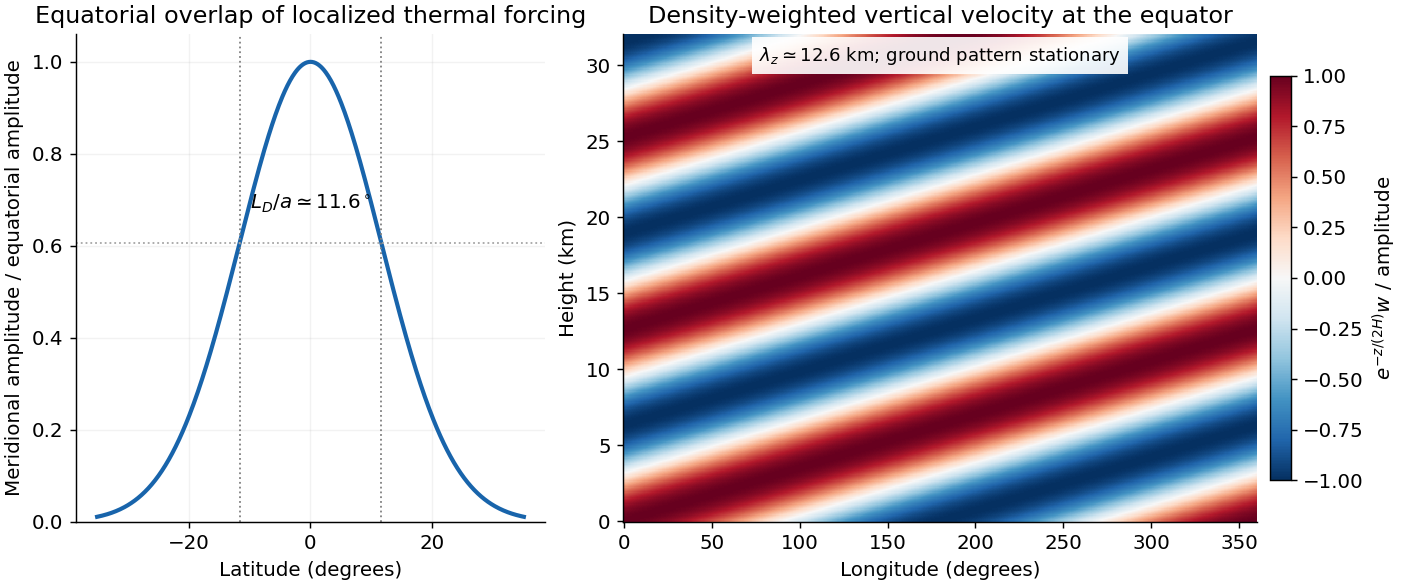
Apply the intended, corrected dispersion relation in c. A uniform mean zonal wind gives ωground=ω+kU. Stationarity with U=−20ms−1 therefore requires eastward intrinsic phase speedω/k=−U=20ms−1. With k=1/a,
Astorm within roughly 12∘ of the equator has substantial projection on the Gaussian mode. There is no sharp latitude cutoff: ∣y∣=LD gives amplitude e−1/2 and the 1/eamplitude latitude is about 16.4∘. Forcing outside that core has progressively weaker overlap.
The intrinsic wave is eastward even though its observed ground pattern is stationary; westward advection cancels its phase propagation. Its intrinsic period is about 12.4Earthdays. The inferred ∣m∣≫1/(2H) puts it in the short-vertical-wavelength branch, well below the long-wavespeed 2NH=200ms−1. For upward energyradiation, ∂ω/∂m must be positive, which selects m<0 for positive k,ω: vertical phase propagation is then downward. Dust absorption supplies thermal forcing with a zonally asymmetric component; the response does not imply that dust itself moves eastward at the intrinsic phase speed.
Heating over land often favours a deeper cyclonic thermal low, while cooling favours a shallower anticyclonic thermal high. Diabatic heating and surfacefriction violate the assumptions of simple parcel PV conservation; a vertical profile is needed for a quantitative statement.