Let be interior to a parameter interval. Suppose is a measurable function for each , is a Lebesgue integrable function, and is differentiable near for almost everywhere. If one integrable nonnegative function satisfies throughout that neighbourhood off one fixed null set, then is defined there and satisfies the displayed derivative formula at .
The mean value theorem gives , proving local integrability. It also bounds the difference quotient by . That quotient converges almost everywhere to , so the dominated convergence theorem permits passing the limit through the Lebesgue integral.
Suppose and its partial derivative are jointly continuous on a compact rectangle . Then is continuously differentiable in the interior of , and the displayed formula holds, with one-sided derivatives at parameter endpoints where the corresponding partial derivative is given.
To prove it, the extreme value theorem bounds by . For each fixed , the mean value theorem bounds the difference quotient by . It converges pointwise to , and the constant is integrable over . Dominated convergence gives the derivative formula. Apply continuity of parameter integrals on compact rectangles to to obtain continuity of . The proof works locally on unbounded parameter intervals as well.
For every real , the mean value theorem bounds on . Hence the apparent singularity at zero cancels, and the remaining bound is Lebesgue integrable. On a bounded parameter interval , every positive-order parameter derivative of the integrand is bounded in absolute value by . Repeated dominated differentiation under the integral sign therefore proves that is a smooth function, withIn particular, , , and . Thus is strictly convex, lies above its tangent at zero, and satisfies for and for . The inequalities follow directly as well by comparing to one. The substitution removes the square-root endpoint singularity for numerical integration:
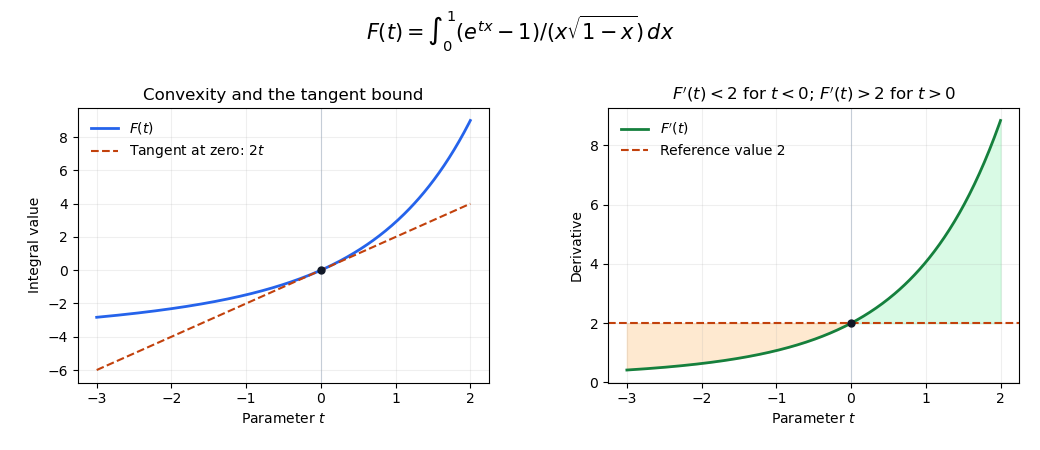
Convexity and derivative bounds for the exponential endpoint integral
. The derivative is below two for negative parameters and above two for positive parameters. The integral lies above its tangent at zero. Substitution removes the endpoint singularity before numerical quadrature. Details.
Articles by others on the same topic
There are currently no matching articles.