Evolution is descent with inherited modification. Within a population, changes in allele frequencies provide a precise genetic description; over longer histories, branching descent connects populations through common descent. An individual growing larger is biological development, whereas an inherited variant becoming more frequent across generations is evolution. See UC Museum of Paleontology: the definition of evolution.
Mutation supplies new alleles, genetic recombination reshuffles inherited material, natural selection favors variants with greater reproductive contribution in a specified environment, and genetic drift changes frequencies through chance. Gene flow moves variants between populations. Consequently, an increasing allele frequency alone does not identify natural selection. See Clark, Douglas and Choi, Biology 2e: population genetics.
Evidence includes ordered fossils, shared inherited structures and similarities in DNA; phylogenetics uses such observations to infer relationships. A phylogenetic tree is an inferred historical account, with uncertainty about particular branches. See Clark, Douglas and Choi, Biology 2e: evidence of evolution. Evidence also comes from experiments: Blount, Borland and Lenski reported an Escherichia coli lineage able to use citrate with oxygen present by 31,500 generations, and tested historical dependence by replaying evolution from stored ancestors. See Blount, Borland and Lenski, 2008: original experimental report. Such observations constrain explanations; no single frequency equation captures every evolutionary process.
evolution in which different anatomical or developmental components change on different schedules. A fossil can combine derived states in one system with retained ancestral states in another.
A change returning a character to a state resembling an earlier ancestral state. Similar terminal appearances do not by themselves identify the developmental route of the change.
Loss of an inherited anatomical or molecular feature. Its inference requires distinguishing genuine absence from incomplete observation and reconstructing the ancestral state.
A family of hypotheses concerning continuing adaptation in response to other evolving organisms. In explanations of sex, changing host-parasite associations can favour production of less familiar host genotypes; the advantage is conditional.
Differential expansion or persistence of lineages under a specified environment. Increased survival can confer an advantage even without a higher instantaneous division rate.
A transition in which previously reproducing entities become integrated into a new higher-level reproductive unit. cooperation and control of lower-level conflict are complementary issues.
Change among cell lineages within an organism through mutation, drift and selection. Success of a cell lineage can conflict with the reproductive success of the organism.
Reproductive contribution measured relative to a specified population, environment and timescale. Survival or task performance is a component or proxy, not automatically total reproductive success.
Resemblance between organisms that influences a receiver’s animal behaviour and thereby changes fitness. Similarity alone does not establish the receiver-mediated evolutionary process.
A set of co-occurring organisms sharing a mimetic signal. Membership should be tested against the relevant receiver’s perception and behaviour rather than human resemblance alone.
Resemblance of a relatively undefended organism to a defended model that reduces attack through the receiver’s response to the model. Protection depends on model abundance and predator experience.
Shared warning signals among defended organisms, potentially reducing each participant’s cost of educating predators through predator learning. Benefits depend on encounter rates, defence and generalization.
Recovery of a declining biological population through inherited adaptive change. Immediate survival enabled by phenotypic plasticity can provide time for rescue, but is not itself evidence that inherited rescue occurred.
An evolutionary role for acquired adjustments, including learning, in allowing persistence and changing the natural selection experienced by inherited variants. It does not require direct inheritance of learned contents.
Assignment of a fitness or experimental performance measure to genotypes, together with a specified relation between neighbouring genotypes. Context and epistasis affect accessible improvement paths.
Evolutionary feedback between inherited genetic differences and culturally transmitted practices. Dairying and lactase persistence illustrate why the timing of the practice and allele rise should be tested separately.
Patterns and processes at and above the species level, including lineage origination, diversification and extinction. Its timescale does not make it independent of population processes.
A rate describing lineage accumulation, often expressed as speciation rate minus extinction rate under a branching model.
Diversification of a lineage into ecologically differentiated descendants. Colonization, ecological opportunity and reproductive barriers are distinct contributing processes.
Evolutionary change within populations, including changes in allele frequencies and inherited quantitative traits.
Reciprocal heritable evolutionary responses in interacting lineages, each altering selection on the other. Functional matching, co-occurrence and immediate plastic responses are insufficient by themselves to demonstrate coevolution.
Reciprocal evolutionary change driven by opposed fitness effects, including some host–parasite and sexual interactions. Correlated traits or temporal change alone do not establish reciprocal selection.
Evolutionary biologist whose marine research includes species delimitation and divergence of snapping shrimp lineages.


Portrait of August Weismann
. Unknown photographer; reproduced with Edwin G. Conklin’s 1915 memorial in Proceedings of the American Philosophical Society 54(220), iii–xii. Public domain in the United States; Commons cites expired copyright for the historical publication. Source usage terms, via Wikimedia Commons. Source.
Portrait of Jean-Baptiste Lamarck
. Ambroise Tardieu, engraving drawn from life in Paris, 1824; reproduction recorded in the National Library of Medicine historical-image collection. Commons claims public domain in the country of origin and jurisdictions with life-plus-70 terms or shorter. Source usage terms, via Wikimedia Commons. Source.
Portrait of Alfred Russel Wallace
. Wellcome Library, London / Wellcome Images, L0025210; reproduced in James Marchant’s Alfred Russel Wallace: Letters and Reminiscences (1916). Original photographer unspecified. Creative Commons Attribution 4.0 International., via Wikimedia Commons. Source.Evolutionary biologist whose explanation of natural selection linked inherited genetic variation to differential reproduction.
A historical process involving sustained relationships with humans and inherited population change. Individual tameness, management and species transport alone are not sufficient definitions.
Study of the distribution of organisms through space and time and the historical processes producing it. Present distribution alone does not identify an evolutionary birthplace.
Geographic coexistence at a stated scale. fossils from one deposit may still represent different times or habitats.
Human-mediated movement of organisms between places. It includes movements within a historical native range as well as introductions beyond it.
Study of the geographic distribution of genealogical lineages. Modern distributions can reflect old structure, recent introductions and lineage loss.
Division of an ancestral distribution by a newly formed barrier. It must be distinguished from dispersal across an existing barrier using chronological as well as geographic evidence.
Correspondence of structures or other characters through shared evolutionary ancestry. Shared function alone does not establish it; comparative position, biological development and phylogenetics help distinguish it from convergent evolution.
Evolution of expression of a formerly induced phenotype in the absence of the original inducing condition. It is a particular outcome of genetic accommodation, not direct copying of acquired bodily modifications into DNA.
Evolutionary modification of an environmentally responsive phenotypic trait or its regulation. It can change a response threshold, magnitude or specificity and need not reduce phenotypic plasticity.
A sequence in which an environmental change induces a phenotype through phenotypic plasticity, followed by inherited refinement through natural selection. Evidence requires separating initial induction from subsequent inherited change.
Independent evolution of similar outcomes in different lineages. Similar phenotypes can arise through the same gene, different genes in a shared pathway, or distinct mechanisms; independence of the evolutionary events must first be established.
Observation of evolutionary change in controlled, replicated biological populations. Known ancestors, archived samples, DNA sequencing and reconstruction of candidate mutations help connect genetic changes to measured genotype fitness.
Recruitment of an existing character for a function different from its previous role. It is a claim about functional history; gene co-option can supply a developmental mechanism for such recruitment.
An inherited feature shaped by natural selection for its contribution to genotype fitness, or the evolutionary process producing such improvement. An immediately helpful response within a lifetime need not itself constitute evolutionary change.
Speciation is the formation of distinct species through evolution. Detecting a difference between biological populations is a starting observation; its interpretation depends on the stated species concept and the evidence for lasting separation. Reproductive isolation is one important route to limiting gene flow in sexual reproduction.
Divergence of adjacent populations into distinct species while some gene flow persists across their contact region. Spatially varying natural selection and the development of reproductive isolation can maintain differences despite exchange. It is a geographical mode distinct from complete separation in allopatric speciation and initial coexistence without such a barrier in sympatric speciation.
Origin of a reproductively distinct lineage through hybridization. A surviving hybrid individual alone is not a new species.
Evolution of increased premating isolation because interpopulation mating has fitness costs. Ecological divergence without such selection is not sufficient evidence.
Origin of distinct species without initial geographic separation at the relevant scale. Current sympatry alone does not establish this historical route.
Evolution of distinct species during geographic separation. Persistence of isolation after renewed contact is a further test.
Evolution of reproductive isolation as a consequence of divergent ecological natural selection. Ecological differences or distinct reaction norms alone are insufficient unless they reduce gene flow.
Divergence of sensory systems and signals associated with the physical or ecological environment, potentially generating mating barriers.
A trait affected by divergent ecological selection that also contributes to assortative mating. Distinguish one pleiotropic trait from tightly linked separate loci.
Reproductive isolation consists of barriers that reduce gene flow through sexual reproduction. Distinguish premating isolation from barriers after mating. Barriers before fertilization also include incompatible gametes; barriers after fertilization can reduce offspring survival or fertility. [ref]
Biology 2e by Mary Ann Clark and others. §18.2, “Reproductive Isolation”, opening paragraphs, gametic barriers and hybrid inviability/sterility
An assay should state which step it measures. Observing fewer cross-group matings does not measure offspring fertility; observing fertilization does not demonstrate that the offspring will reproduce. These distinctions make a partial barrier informative without declaring completed speciation.
Barriers to gene exchange acting before a zygote forms. Habitat separation, differing breeding times, behavioral discrimination and mechanical mismatch can reduce mating or gamete transfer; gametic incompatibility can act after mating while still preventing fertilization. Thus prezygotic isolation is broader than premating isolation and distinct from postzygotic isolation. The time and biological stage measured by an assay determine which category it tests.
Reproductive incompatibility associated with an inherited cytoplasmic factor, including some bacterial symbionts. Reciprocal crosses, microbial manipulations and host-background controls identify its cause.
Greater divergence of mating signals or preferences in sympatry than outside contact. The pattern can follow reinforcement, but also ecological differences, sorting or interference without reduced hybrid fitness.
When one sex of first-generation hybrids is absent, rare or sterile, it tends to be the heterogametic sex. This predicts a sex bias within crosses, rather than a universal difference in isolation between birds and mammals.[ref]
Sex ratio and unisexual sterility in hybrid animals by J. B. S. Haldane. Journal of Genetics 12, pp. 101–109
A harmful interaction between alleles that evolved in separate lineages and are compatible with their own genetic backgrounds. For example, substitutions yielding and can each be tolerated, while the combination is harmful in a hybrid. This is a form of epistasis.
Premating isolation reduces mating between biological populations. The dietary divergence and mating isolation in Drosophila pseudoobscura assay measures this stage using observed pairings.
Postmating reproductive isolation acts after mating. Specify whether the test concerns fertilization, offspring survival, or the offspring's own reproduction; those outcomes are not interchangeable.
Reduced survival or fertility appearing in later-generation or backcross descendants of hybrids, even when first-generation offspring are fertile. genetic recombination can expose harmful combinations previously masked in the first generation.
A barrier to gene flow acting after fertilization, through reduced survival or fertility of hybrids. Test both sexes and later generations: survival of first-generation offspring does not establish their fertility.
Reduced or absent fertility of hybrid offspring. It must be distinguished from failure to mate or reduced viability before reproductive maturity.
The 1989 experiment used eight Drosophila pseudoobscura biological populations from one Bryce Canyon population: four maintained on starch medium, four on maltose, in cages at . Testing began about a year after establishment. [ref]
Reproductive Isolation as a Consequence of Adaptive Divergence in Drosophila pseudoobscura by Diane M. B. Dodd. p. 1308, population origin, media and cage conditions
Before testing, flies spent one generation on cornmeal–molasses–agar. Virgins aged 3–6 days entered multiple-choice chambers: twelve females from each population, followed by males from both populations introduced nearly simultaneously without anesthesia. Observers scored matings for 60–90 minutes under bright indirect lighting. One group's right wing tips were clipped for identification, with clipping reversed between replicates. [ref]
Reproductive Isolation as a Consequence of Adaptive Divergence in Drosophila pseudoobscura by Diane M. B. Dodd. p. 1308, mating-preference procedure and wing-marking control
All sixteen cross-diet comparisons had positive mating assortment contrasts; eleven departed significantly from random mating. Same-diet comparisons did not show significant departures. Common-medium rearing addressed immediate diet conditioning; same-diet controls addressed separation and establishment population bottlenecks. Mate choice was not the selection target; the biological populations were maintained separately. The result supports partial premating isolation accompanying dietary divergence, not completed speciation. [ref]
Reproductive Isolation as a Consequence of Adaptive Divergence in Drosophila pseudoobscura by Diane M. B. Dodd. pp. 1309–1310, Tables 1–2 and discussion of conditioning and physical isolation
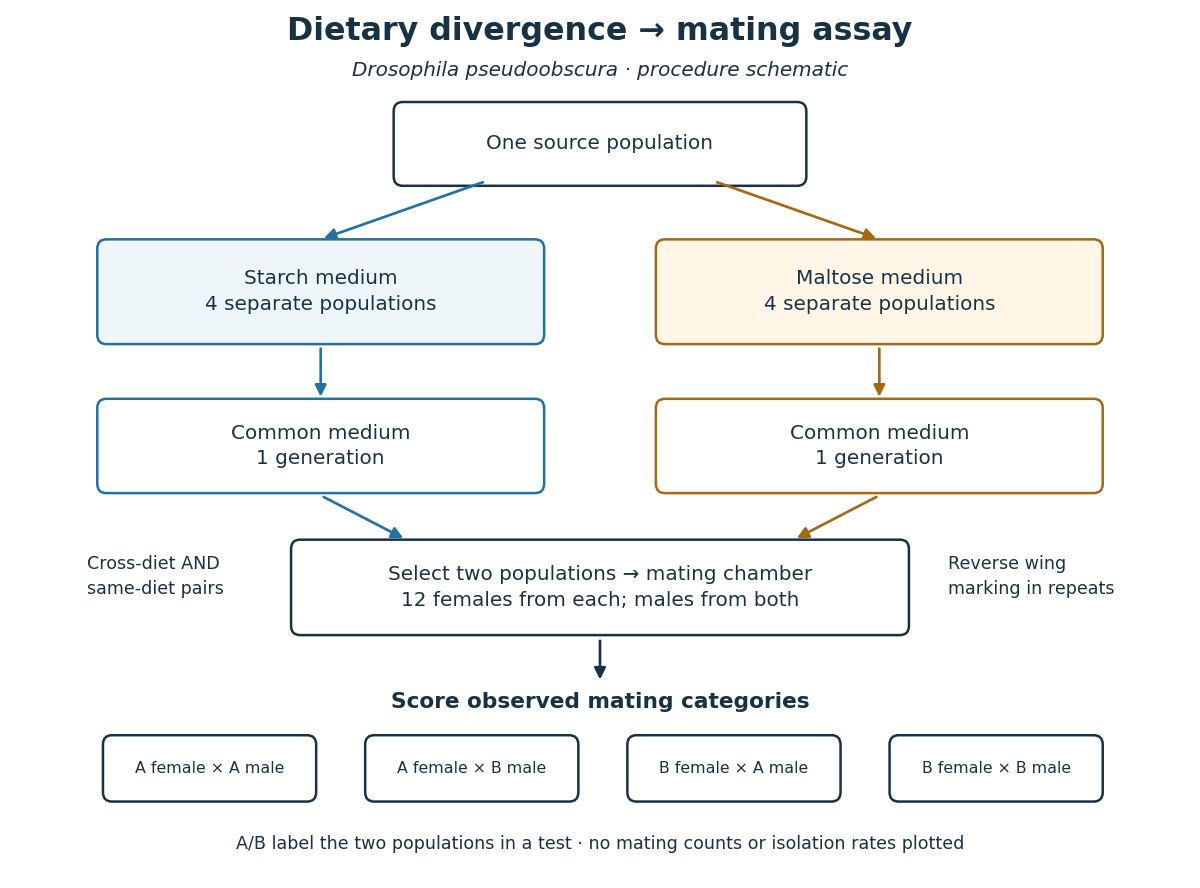
Design of the dietary divergence and mating isolation in Drosophila pseudoobscura assay
. Original design schematic. Arrows indicate procedure, not a measured reproductive isolation rate. The four mating categories are possible outcomes; no invented counts are shown. Details.The causal inference remains limited. A negative same-diet hypothesis test does not prove zero reproductive isolation. One generation under common conditions does not exclude every persistent environmental influence. The chamber readout alone cannot identify a particular gene, establish offspring fertility, or predict gene flow after sustained contact in nature. Further experiments would need to target those questions separately.
For observed pairings between two labels , let and , where the first label denotes the female's group and the second the male's. A mating assortment contrast isIt lies between and . Positive describes an excess of same-label pairings over cross-label pairings; whether that is evidence of assortative mating depends on the null mathematical model and the assay. The four counts form a contingency table.
Here is an original scope check. Suppose independently paired females and males have probabilities of carrying label . ThenWith , the expected value is zero. With , it is , despite pairing being independent of label. This counterexample concerns unequal pool composition; it does not replace the group introductions and contingency table tests in the dietary divergence and mating isolation in Drosophila pseudoobscura experiment. Even with balanced pools, finite observed samples fluctuate: a positive alone is not a hypothesis test, much less a universal species boundary.
Horizontal gene transfer moves genetic material between lineages through routes other than ordinary inheritance from parent to offspring. Endosymbiotic gene transfer is a specialized case involving an internal partner or its descendant organelle.
Transfer of inherited material between diverged lineages through hybrid reproduction and subsequent crosses. Shared adaptive alleles may therefore reflect transfer rather than repeated independent mutations.
Transfer of inherited variation between lineages through hybridization and subsequent backcrossing, followed by a selective benefit in the recipient. Shared ancestry at a region and evidence of its benefit are separate requirements.
Natural selection involves systematic differences in expected reproductive success associated with variation in phenotype. For a continuing evolutionary response, the relevant variation must be inherited: offspring must tend to preserve the differences being favored. Actual offspring counts also fluctuate by chance, producing genetic drift. Survival matters insofar as it affects contribution to future generations. Genotype fitness is therefore contextual, depending on environment and the life cycle being counted, rather than simply measuring strength or longevity. See Clark, Douglas and Choi, Biology 2e: population evolution.
In chapter IV of his 1859 book, Darwin explained natural selection through preservation of favorable variations and greater chances of survival and reproduction. See Darwin, On the Origin of Species, first edition, chapter IV. The beautiful consequence is cumulative change without foresight: inherited differences are filtered repeatedly by present conditions. Natural selection neither generates a needed mutation on demand nor guarantees progress toward a predetermined goal.
In Charles Darwin's usage, the conditions affecting persistence and reproduction, including interdependence and physical difficulties as well as direct competition.[ref]
On the Origin of Species by Charles Darwin. 1859 edition, chapter III
Selection imposed through human choices about which organisms contribute to later generations. Strong consistent criteria and a controlled environment can produce rapid short-term response while exposing correlated costs.
Selection maintaining more than one inherited variant. Heterozygote advantage and appropriate negative frequency dependence are different mechanisms that can produce this outcome.
Articles were limited to the first 100 out of 179 total.