Under the hypotheses of Fano's inequality, let , , and let be the indicator random variable of an error. Its probability of being one is . The in the displayed bound denotes binary entropy in bits. Since is a deterministic function of , . Applying the chain rule for conditional entropy in both orders gives the exact decompositionThe first term is bounded by , because conditioning reduces entropy. For the second term, fix a report : if , then is known; if , then lies among at most other symbols. Maximum entropy on a finite alphabet bounds the latter uncertainty by . Averaging over the reports and the error flag givesThis proves Fano's inequality. Events of zero probability contribute zero to this average, so the proof also covers without assigning a conditional distribution to an impossible event.[ref]
https://web.stanford.edu/class/ee376a/files/lecture_notes.pdf. Weissman, Ochoa and Tatwawadi, EE376A course notes, Section 5.7, proof of Theorem 46
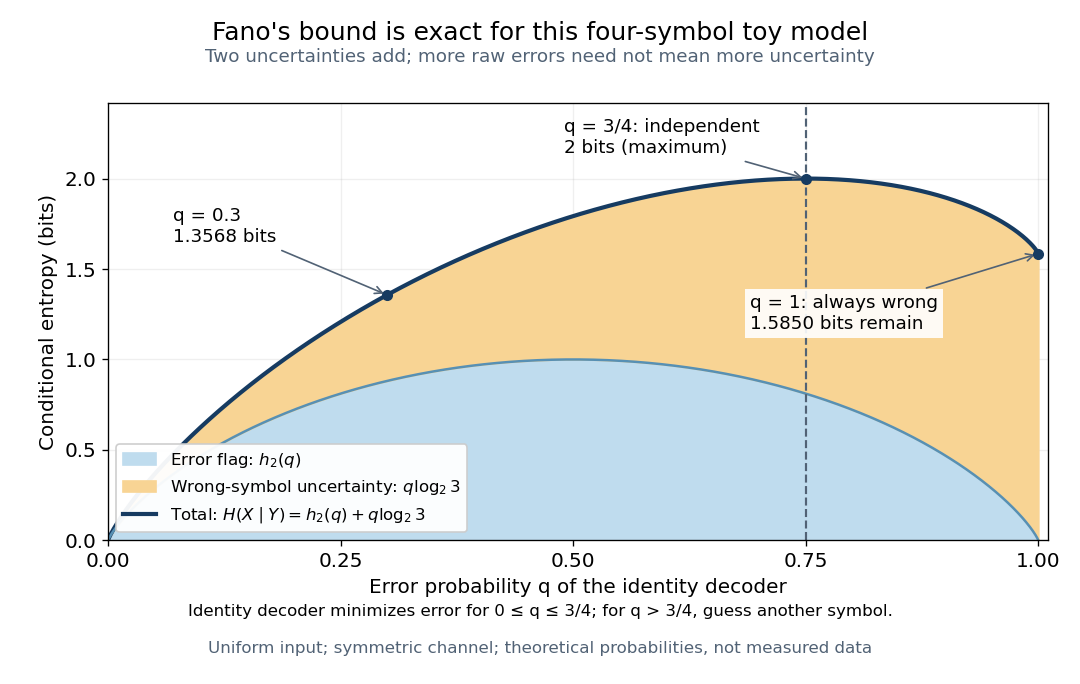
The four-symbol entropy budget peaks at chance-level error and separates the error flag from the three alternatives
. Details. 
The decomposition also explains equality. The first bound is exact when the indicator random variable and are independent random variables: knowing the report does not change the error probability. The second is exact when, for every report with positive error probability, the wrong-symbol conditional distribution is uniform on all alternatives. Both conditions hold in the four-symbol toy channel of Fano's inequality. At , the second condition is vacuous; at , the flag is constant but three alternatives remain, giving . For , there is just one alternative after an error, so the second term vanishes: all remaining uncertainty is whether the single alternative must replace the guess.
Articles by others on the same topic
There are currently no matching articles.