The finite volume method follows the amount of a conserved quantity inside each control volume. Its unknowns are cell averages, rather than values at isolated points: a cell's width times its stored average approximates that cell's total. A numerical flux transfers an amount across a face. Using one shared transfer for both neighboring cells makes the loss from one exactly the gain of the other, as explained in shared face flux cancellation.[ref]
Riemann Problems and Jupyter Solutions by David I. Ketcheson, Randall J. LeVeque, and Mauricio J. del Razo. Approximate solvers, §Finite volume methods, equation FVupdate and the following cancellation argument
For a one-dimensional scalar conservation law without sources, let , with conservation law flux . Fix cells of widths . Define the exact cell average and its numerical approximation byThe integral balance over one cell and one time interval of length isFor a smooth solution this follows by integration of the differential equation; with jump discontinuities, it expresses the conservation law in integral form, using appropriate face traces when they exist. Replacing each time-averaged face conservation law flux by a numerical flux givesThus the finite volume method implements a balance directly, without needing a pointwise derivative at a jump. The tube balance in Riemann Problems and Jupyter Solutions by David I. Ketcheson, Randall J. LeVeque, and Mauricio J. del Razo (Advection, §Conservation of mass) motivates this construction from conservation of mass.
This is useful for shock waves: their speed is constrained by the Rankine-Hugoniot condition, itself an integral balance. A nonconservative approximation can give a visibly plausible jump with the wrong speed. Conservation is one requirement; a nonlinear scalar conservation law also needs the correct entropy solution, and the chosen numerical flux and update need their own stability and accuracy analysis.[ref]
Riemann Problems and Jupyter Solutions by David I. Ketcheson, Randall J. LeVeque, and Mauricio J. del Razo. Approximate solvers, §§Finite volume methods, Godunov's method, High-resolution methods: wrong shock speeds, time-step restrictions and smeared jumps
The original periodic upwind finite volume advection example isolates the shared-transfer mechanism in a problem with a known translated solution.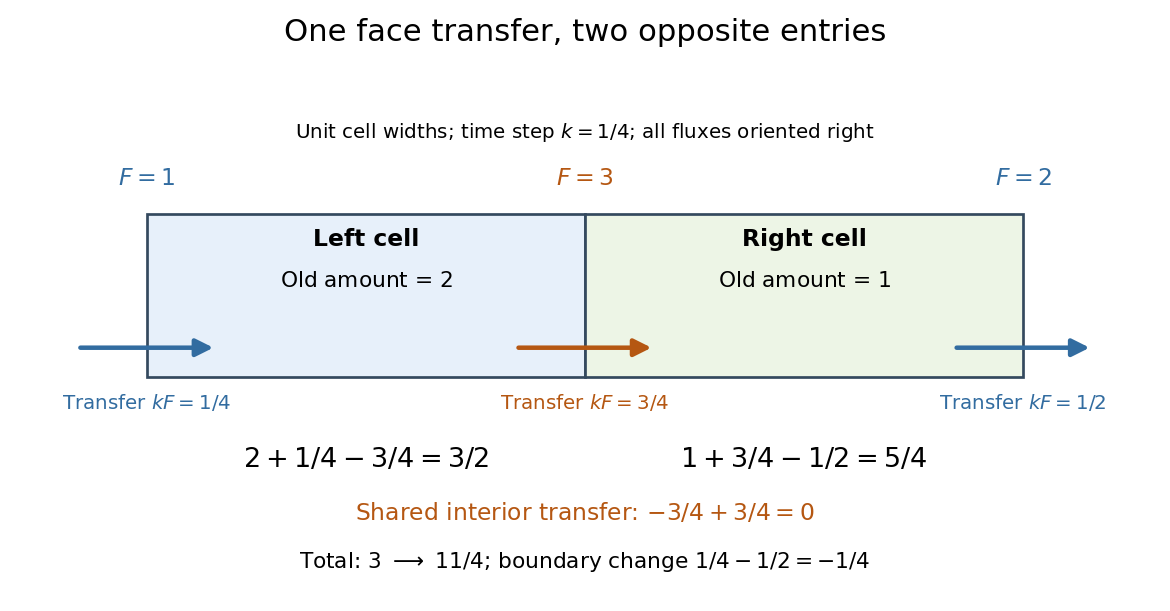
Consider the advection equation with constant speed , no sources, and periodic boundary conditions on . Use equal cells of width , time step , and indices modulo . The exact solution is the periodic translation . At a face, the Riemann problem transports the left state to the right, so the two-state upwind numerical flux is , with .[ref]
Riemann Problems and Jupyter Solutions by David I. Ketcheson, Randall J. LeVeque, and Mauricio J. del Razo. Advection, equations adv:advection and adv:solution, §The Riemann problem; Approximate solvers, §High-resolution methods: reduction to upwind advection
The finite volume method with this numerical flux and an explicit Euler method step givesHere represents a cell average; the recurrence also occurs in the upwind finite difference scheme. Impose the specific CFL condition . Each updated cell average is then a convex combination of two old ones. This proves preservation of their initial minimum and maximum, including nonnegativity for nonnegative data, and contraction of the maximum norm of the difference of two solutions on this periodic grid. These statements concern this constant-speed scalar update with this time step.
For an original synthetic example, take , , , , hence Courant number . Choose a function constant on each successive cell, with the following values, so these are exact initial cell averages. One step givesFor example, cell zero receives from cell seven across the periodic face: . All eight face transfers cancel in the total by shared face flux cancellation. More generally this periodic recurrence conserves the total algebraically for any , even though the CFL condition is needed for the convex combination argument. With the same initial data and , one step gives and , despite preserving the total.
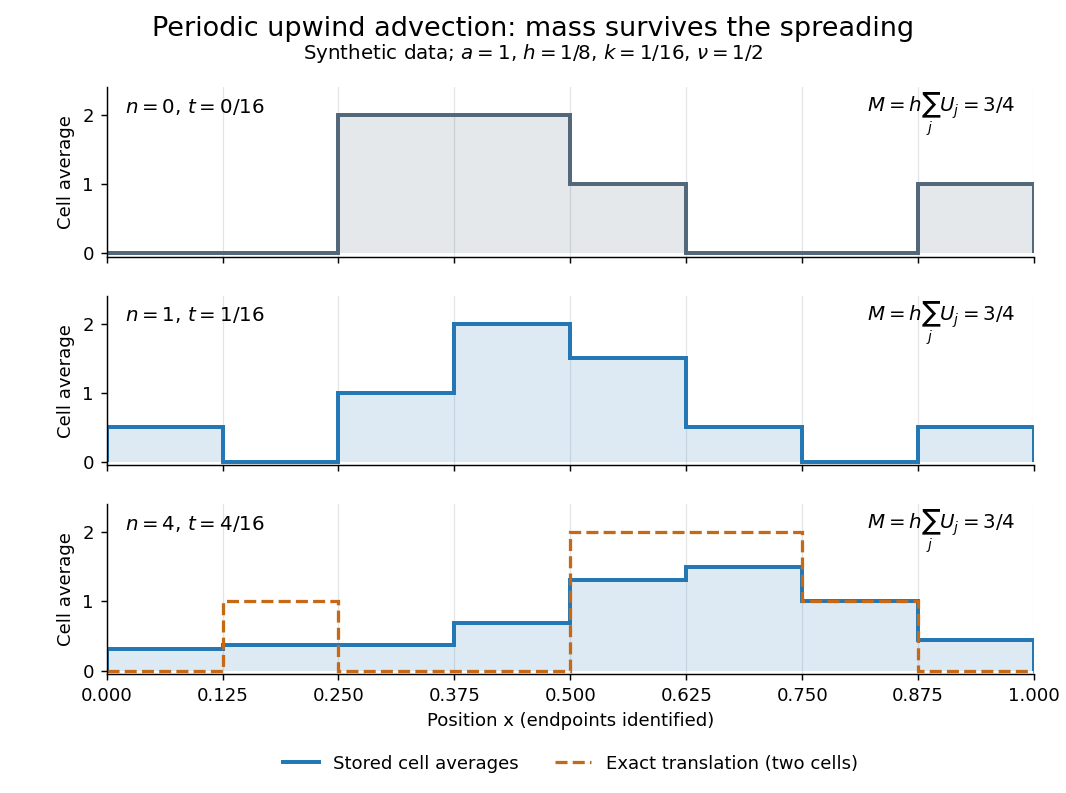
Original periodic upwind profile at zero, one and four steps: the integral remains three quarters while jumps spread
. Details. After four steps, , the exact translated profile has moved two cells to the right. Repeated averaging instead gives the explicit binomial coefficient formulawith all indices modulo eight. The diagram compares these computed cell averages with the exact translated cell averages. Their integrals agree, but the numerical jumps spread across cells. The finite volume method is useful for jump discontinuities because it retains the integral balance even at a jump; conservation alone does not guarantee a sharp profile. At this particular update is an exact one-cell shift, whereas for it mixes neighboring states. No accuracy conclusion at a jump follows just from the conserved total.
A scalar finite-volume update is monotone if increasing any input state cannot decrease any output state. A consistent conservative update preserves constants and has an invariant interval by comparison. On a periodic grid, or an infinite grid with summable perturbations, conservation and monotonicity imply L1 contraction of a monotone conservative scheme. Translation invariance then implies the total variation diminishing scheme property.
A translation-invariant conservative monotone update decreases discrete total variation. If is the one-cell shift, , and L1 contraction of a monotone conservative scheme applied to gives . This prevents creation of new total variation, though it does not make every discontinuity sharply resolved.
Let be a monotone conservative scalar update on a periodic grid. Since , one has . Conservation makes the sum of the right side equal to . Reverse and add to obtain . On an infinite grid the same proof holds for summable differences with a Lipschitz flux on the state range.
The Engquist-Osher method is the finite volume method using the Engquist-Osher flux. Under on the invariant state interval, its update is monotone. It preserves the state range, is contractive for summable perturbations in , and decreases discrete total variation.
Monotonicity of the explicit update requires on its invariant state interval. Convexity and a unique sonic point of a scalar flux do not remove this time-step restriction. For , linearization about a positive constant gives an upwind finite difference scheme for advection equation: , where . At Fourier frequency the multiplier is , whose modulus exceeds one when . Thus a CFL condition is essential to the claimed nonlinear stability.
The Engquist-Osher numerical flux is . It sends positive-speed contributions from the left state and negative-speed contributions from the right state. Its consistency and opposite monotonicities in the two arguments yield a monotone conservative scheme under the appropriate Courant–Friedrichs–Lewy condition. For the Inviscid Burgers equation, it is .
For a flux that is a differentiable convex function with unique minimum at , define for and zero otherwise, and for and zero otherwise. The Engquist-Osher flux is . Thus transsonic rarefaction wave states give , while reversed transsonic states give . This follows by integrating the positive and negative parts of .
A numerical flux estimates the rate of transfer across a cell face from nearby states. In the finite volume method update, approximates the conservation law flux averaged over the time step; is the transferred amount. For a two-state numerical flux approximating a scalar conservation law with conservation law flux , consistency of a numerical method requires . Thus equal states recover the physical transfer rate. With constant equal-width cells, this also preserves a constant state because its incoming and outgoing numerical fluxes agree.[ref]
Riemann Problems and Jupyter Solutions by David I. Ketcheson, Randall J. LeVeque, and Mauricio J. del Razo. Approximate solvers, §Finite volume methods, consistency paragraph after equation FVupdate
Consistency and shared face flux cancellation answer different questions: matching at equal states approximates the intended equation, while sharing one oriented face value preserves the total. The example periodic upwind finite volume advection uses for , so the arriving state comes from the left. The Godunov numerical flux uses an entropy solution of a local Riemann problem; the Engquist-Osher flux provides a different construction for a scalar conservation law. A monotone conservative scheme uses a numerical flux nondecreasing in its left state and nonincreasing in its right state, together with a time step that makes the complete update monotone. Neither two-state consistency nor conservation by itself supplies that time-step restriction or a general stability or order of a numerical method guarantee.
For a scalar conservation law whose flux is a convex function, the Godunov numerical flux is the physical flux at the origin of the entropy solution of the Riemann problem between states . It is for and for . For a rarefaction wave, the characteristic speed is monotone across its states, so the origin sees either an endpoint or a zero-speed minimizing state. For a shock wave, its speed is ; the origin sees the left state if this speed is positive and the right state if negative, selecting the larger endpoint flux. Unlike the Godunov flux, the Engquist-Osher flux at reversed transsonic states may equal .
Articles by others on the same topic



The Finite Volume Method (FVM) is a numerical technique used for solving partial differential equations (PDEs) that arise in various fields, including fluid dynamics, heat transfer, and other continuum mechanics problems. The method is particularly well-suited for problems involving conservation laws because it inherently conserves quantities over finite volumes, making it a powerful tool for simulating transport phenomena.