For a prime power and , count ordered lists of linearly independent vectors in . The first has choices. After independent choices, their linear span contains vectors, so the next has choices. Every -dimensional vector subspace has exactly ordered bases. Dividing the list count by this common multiplicity givesThe notation refers to the Grassmannian, here considered simply as the finite collection of these vector subspaces.[ref]
For , there are ordered independent pairs. Each two-dimensional vector subspace has ordered bases, leaving vector subspaces. There are only coordinate-selected vector subspaces; most of the 35 also contain vectors combining coordinates.
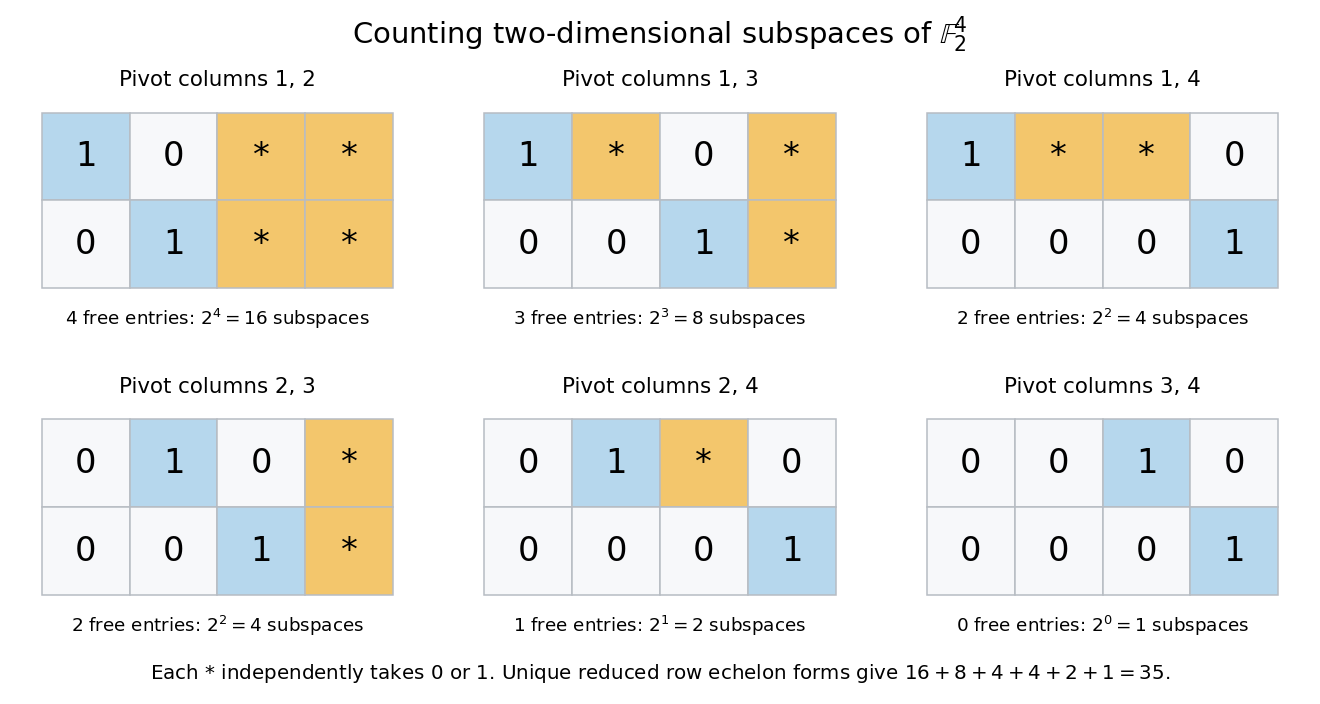
A unique reduced row echelon form gives another count. Its six possible pivot-column patterns have freely chosen entries. Each free entry lies in , giving vector subspaces, respectively. The diagram fixes the zero entries required to make each pivot the first nonzero entry in its row and the only nonzero entry in its column. Different choices describe different row spaces.

Articles by others on the same topic
There are currently no matching articles.