Repeated integration by parts gives the Gamma integralThe logarithm of its integrand is , whose unique maximum is at . Write . For fixed and large , a Taylor expansion givesThe Big O notation here is for a fixed , or uniformly for in a fixed bounded interval. It does not claim a uniform approximation over the entire growing integration domain. Consequently the peak, divided by its height, approaches .
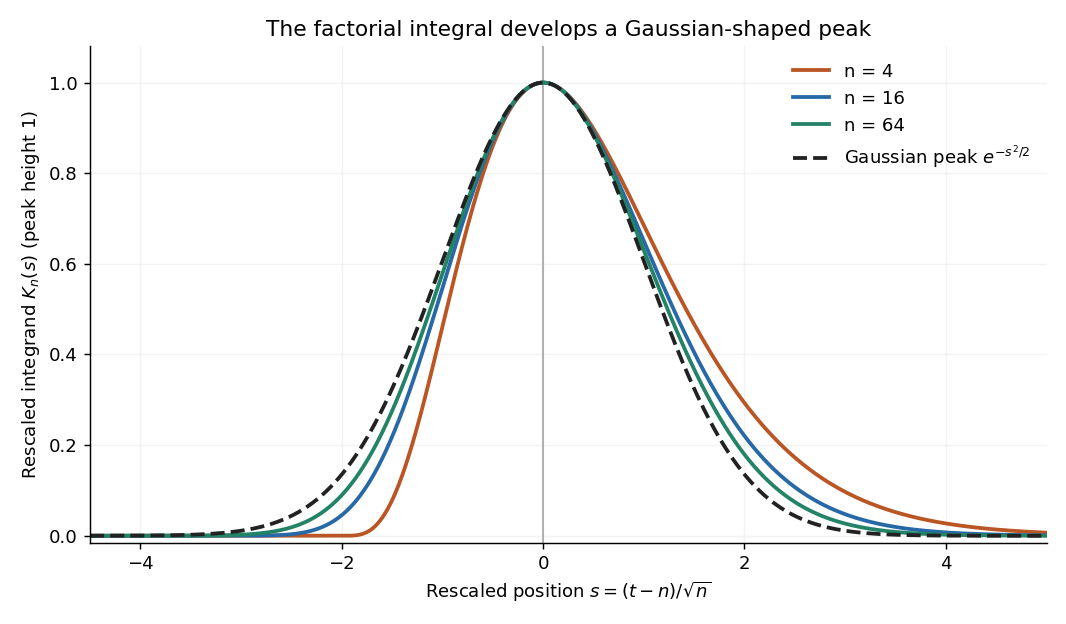

The exact substitution givesReplacing the integral by the Gaussian integral produces . Thus the estimate is peak height times width times the area of a standard Gaussian peak. This is Laplace's method in a concrete form; controlling the integral's tails justifies the replacement. The next terms, including their products after exponentiation, produce the Stirling correction by Gaussian moments.
Articles by others on the same topic
There are currently no matching articles.