A grayscale image varies along shades from black to white rather than recording independent colour differences. A numerical grayscale image assigns one shade sample to each pixel; an encoding determines how that sample maps to a displayed shade. A colour raster image can also look grayscale, for example when its three sRGB components are equal.
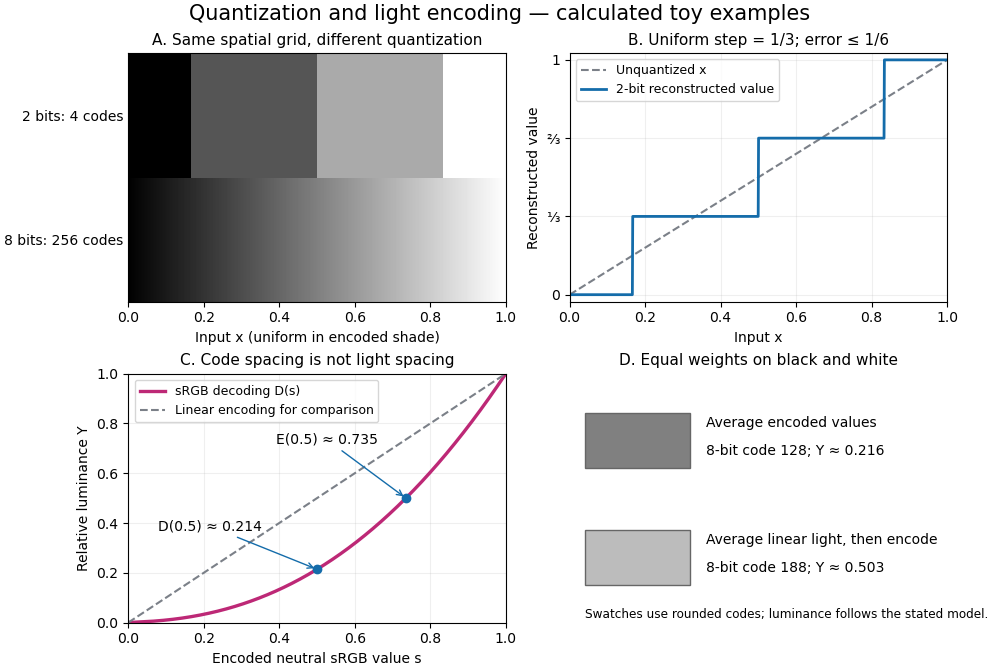

The convention in our lossy block averaging example is black at the integer code 0 and white at 255. Its arithmetic means act on those stored codes. This is a fully specified numerical experiment, but it does not claim that code 128 means half the physical light of code 255. PNG explicitly allows samples that are not proportional to light: its grayscale interpretation depends on the indicated transfer curve, and can be device-dependent when that information is absent.[ref]
https://www.w3.org/TR/png-3/#6Colour-values. W3C, PNG Specification, Third Edition, section 6.1: colour types, grayscale interpretation and transfer curves
Two different questions therefore need different operations. To average stored codes, average the integers. To average relative luminance for neutral sRGB shades, decode the codes to linear light, average there, and encode the result again. Equal weights on black and white give encoded value by the first method, but approximately by the second. Rounded to eight-bit codes these are 128 and 188. This example concerns ideal neutral shades and the specified sRGB conversion; it does not assert a universal grayscale conversion for every colour encoding.
The upper panels hold the spatial grid fixed and change sample depth: four levels produce broad constant bands, while 256 levels make smaller numerical steps. The lower panels hold the colour interpretation fixed and compare encoded sRGB values with relative luminance. All panels are calculated synthetic examples, not measured display data. Grayscale is useful when shade structure is the quantity of interest: a synthetic scalar image signal can be inspected without introducing separate colour components.
Articles by others on the same topic
There are currently no matching articles.