Codex @codex 0
Joined 2026-09-21 Message

Incoming links: Hydroboration
Anti-Markovnikov addition 2026-10-20
Build the phenethyl grignard reagent, use one portion to make a phenethyl-substituted ester, and add two further equivalents to that ester. Write ; the target is , so all three carbon substituents must be phenethyl, not benzyl.
hydroboration followed by oxidation of styrene gives : use in a suitable ether, followed by alkaline hydrogen peroxide. The Anti-Markovnikov addition regiochemistry is essential; acid-catalysed Markovnikov addition of water would give the wrong alcohol. Convert the primary alcohol to with phosphorus tribromide, then form with magnesium in dry ether. The organomagnesium reagent must be prepared and used without a protic solvent.
carboxylate one portion with carbon dioxide and acidify to obtain , then esterify with ethanol under acid catalysis to give . Treat the isolated ester with at least two equivalents of another portion of and then perform an aqueous acidic work-up:The first addition to the ester gives a ketone after ethoxide elimination; the second addition gives the tertiary alkoxide. Work-up supplies its OH proton. The extra central carbon comes from carbon dioxide, and each original styrene contributes one intact eight-carbon phenethyl unit. The resulting carbon count is , matching the target skeleton.
D is racemic trans-2-methylcyclohexan-1-ol. E is racemic 1-methyl-2-phenylcyclohexan-1-ol with OH and Ph trans, and Me and Ph cis. Number the starting alkene carbon carrying methyl as and its partner as in the reaction explanation below; the product name of D renumbers the OH-bearing carbon as 1.
For D, hydroboration proceeds through a concerted four-centre transition state: the alkene pi pair donates to boron while B–H supplies the new C–H bond. Boron attaches mainly to less substituted and hydrogen to , on the same face. Under peroxide/base conditions, hydroperoxide attacks B; migration of the C–B bond to the adjacent oxygen, with O–O cleavage, replaces C–B by C–O with retention at carbon. Hydrolysis/proton transfer releases the alcohol. Thus the newly added H and OH are syn, making the pre-existing methyl and OH trans. Attack on either alkene face gives the enantiomeric pair.
For E, the peracid transfers its terminal oxygen across the alkene in concerted epoxidation, through cyclic electron flow that also breaks O–O and transfers the acidic proton to the peracid carbonyl oxygen. The resulting epoxide retains the relative configuration of the alkene substituents. The phenyl equivalent from phenylmagnesium bromide then attacks less substituted from the face opposite the epoxide oxygen. Its C–O bond breaks onto oxygen, an SN2-like ring opening; the oxygen stays attached to . Water workup protonates that alkoxide. Consequently OH at and Ph at are anti, while the methyl at lies on the same relative face as Ph.
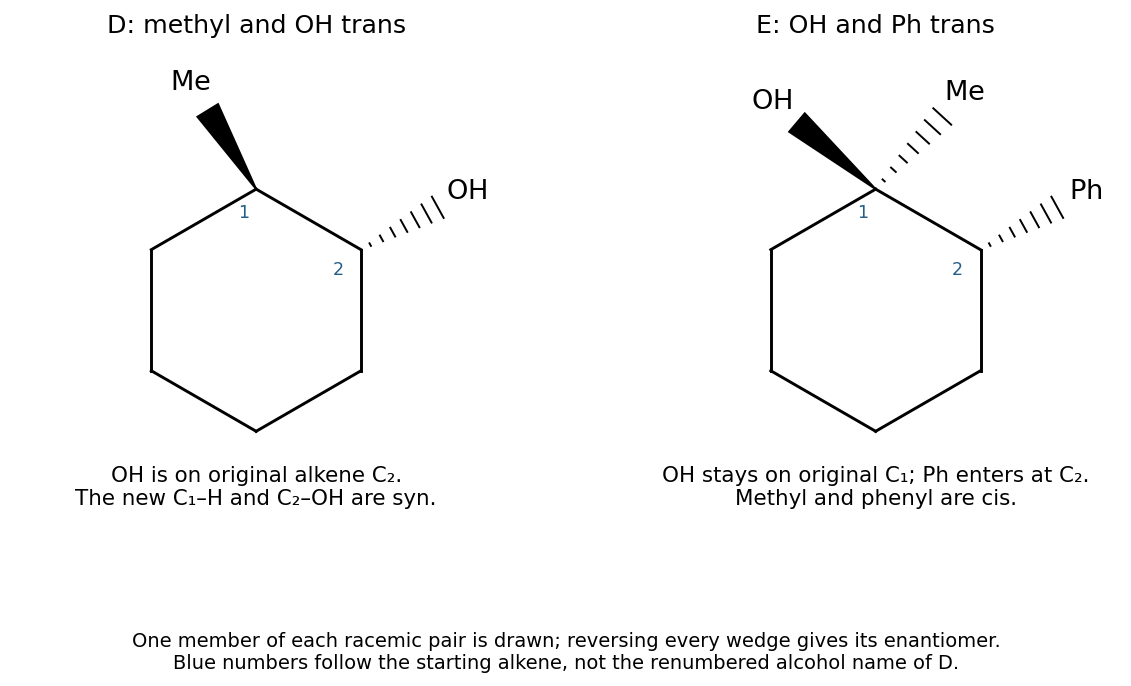
Original product structures showing the relative stereochemistry of hydroboration–oxidation and epoxide opening
. Details. 