For a discrete random variable with probability mass function , using base-two logarithms for both Shannon entropy and min-entropy,The first inequality says that average information content cannot be below the least information content of a possible outcome. For a finite alphabet, equality holds exactly when the probability mass function is uniform on its positive-probability outcomes. Impossible outcomes do not need to share that positive probability. In particular, has both quantities equal to bit, while has both zero. The same equality characterization holds for a countable alphabet: equality forces only finitely many positive-probability outcomes, because all must have the same positive mass. The uniform maximum of Shannon entropy is discussed in Shannon's original treatment.[ref]
A Mathematical Theory of Communication by Claude Shannon. Shannon, A Mathematical Theory of Communication, Section 6, definition of H and properties 1–2
For the proof, gives ; taking the expected value proves information entropy dominates min-entropy. More precisely, the nonnegative gap isIt vanishes precisely when every positive term vanishes, namely for every possible outcome. With such outcomes, normalization forces . If Shannon entropy is infinite, the inequality still holds and is strict, because min-entropy of a countable probability mass function is finite. No subtraction of two infinite quantities is needed.
An analytical family makes the gap visible. Give probability and each of probability , with . Then is a most likely outcome, so its probability is also the best single-guess success probability, andwhere is binary entropy. The entropy bound with one prescribed probability explains the second expression: it separates whether occurred from which of four equally likely alternatives occurred. At , all five outcomes are uniform and both quantities are bits. At , Shannon entropy is bits while min-entropy is bit, reproducing the biased example in min-entropy. At , both are zero; the four impossible alternatives contribute nothing. For every , the probability mass function is nonuniform on its possible outcomes and the gap is strictly positive.
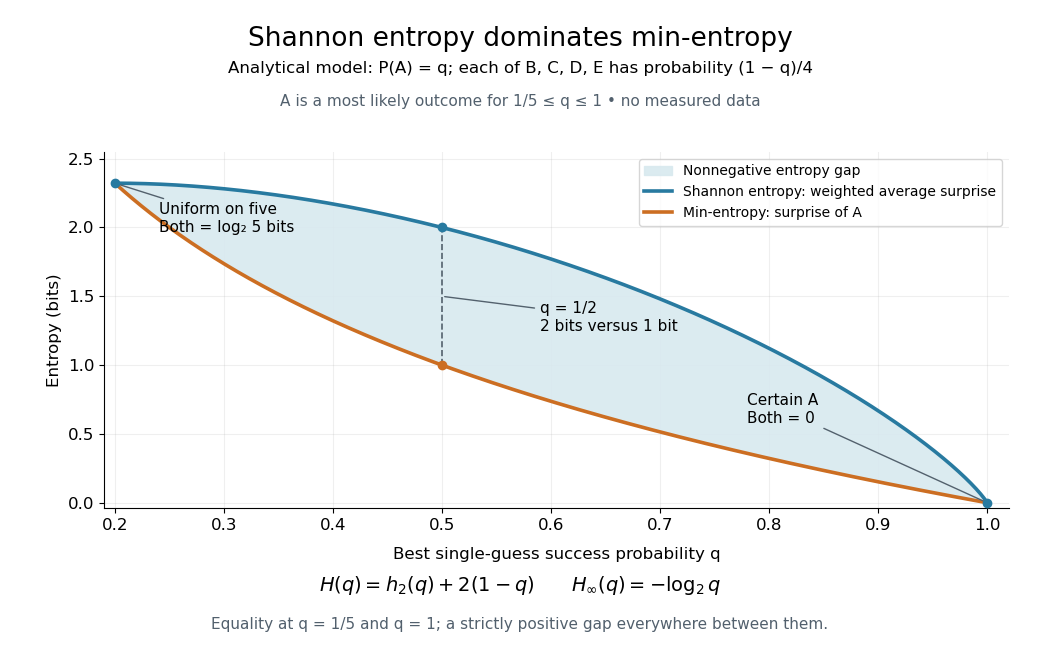
An analytical five-outcome model separates average surprise from the surprise of the most likely outcome
. Details. 
For finite Shannon entropy, exponentiating the inequality gives the useful but potentially loose bound . Equality holds exactly for a discrete uniform distribution on the possible outcomes. Thus Shannon entropy alone supplies a lower bound on optimal success, not the upper bound needed to promise that every guess is unlikely. Shannon's source coding theorem concerns average compression under its hypotheses, while min-entropy answers the single-guess question directly. The two quantities serve different tasks even when both are expressed in bits.
Articles by others on the same topic
There are currently no matching articles.