
A real-valued random variable is a measurable function from a probability space to the real numbers with their Borel sigma-algebra. More general targets give random elements. For every Borel set , measurability ensures that is an event, so the question "does the observed value lie in ?" has a defined probability.
The function is fixed; its input outcome is uncertain. This separates what we measure from how the uncertainty is modeled. A probability distribution is the resulting pushforward measure, . A cumulative distribution function, probability mass function, or probability density function describes that measure in an appropriate setting. The random variable and its probability distribution are different objects: the former also retains its relationship to other measurements on the same sample space.
For two independent uniform dice, let record their results and define and . The 36 ordered pairs are equally likely, but the resulting probability mass functions differ:For the sum, count the diagonal of the outcome grid having total . For the maximum, subtract the pairs with both results below from the pairs with both results at most . These examples show how a deterministic function transforms a simple input probability distribution into a nonuniform output one.
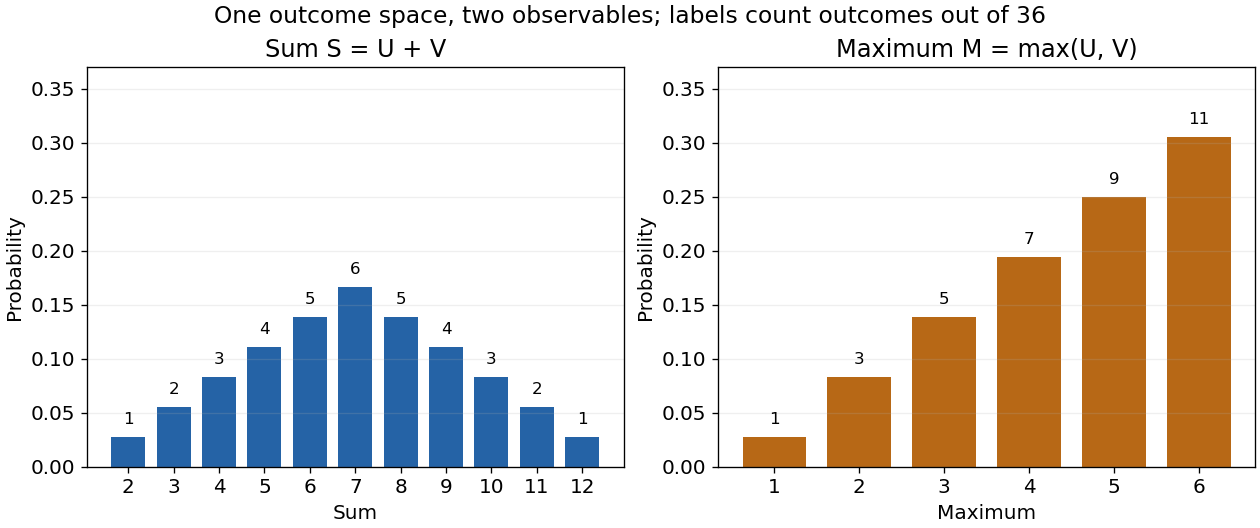

The corresponding expected values are and . The first follows immediately from linearity of expectation; the second follows from . Neither number must be an attainable result. An expected value describes an average under the probability measure, not a prediction that the next observation will equal it.
The distinction between a random variable and its probability distribution matters for dependence. and have the same discrete uniform distribution and are independent random variables. and a second copy of also have that same marginal probability distribution, but they always agree. Their joint probability distribution is concentrated on the diagonal; the marginals alone cannot say which relationship holds. This is why a model for several measurements must specify their joint law or an appropriate independence assumption.
Indicator random variables turn events into numbers: equals one on and zero elsewhere, and . This connects event counting with expected value and variance, and lets tools for random variables answer questions about probabilities. More complicated functions of observations can describe totals, waiting times, or estimation errors using the same framework.
New to topics? Read the docs here!