For a square integer matrix with nonzero determinant, the image is a subgroup of the integer lattice. Its index of a subgroup isIn particular, gives all points with even first coordinate. The quotient has two cosets, represented by and , and the fundamental cell has area two. A determinant of two therefore counts how much integer information is missing from the image.
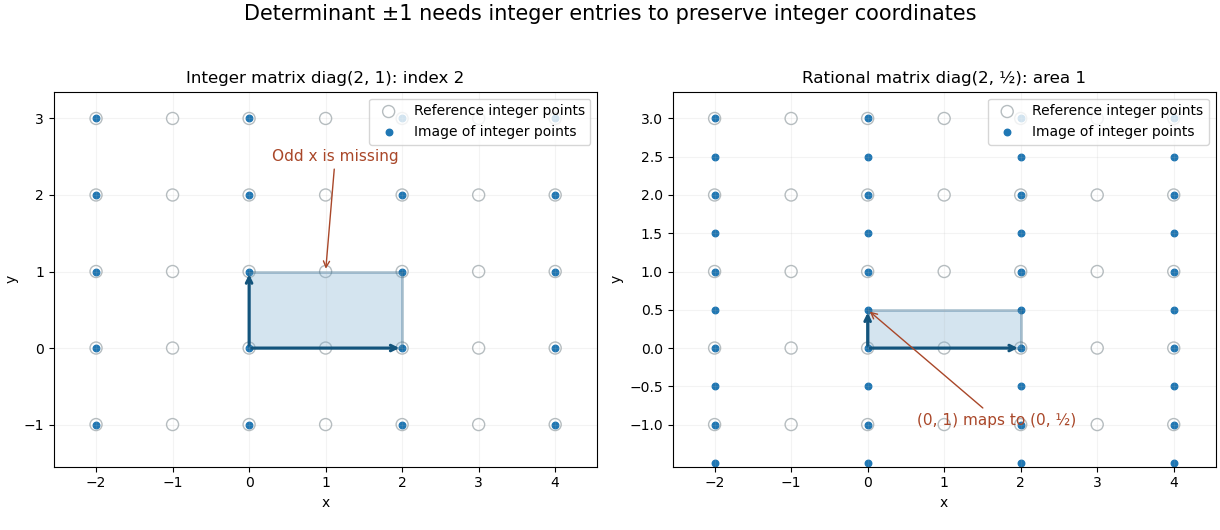

The integrality hypothesis is essential. The rational matrix has determinant one but sends to . Its generated Euclidean lattice has the same covolume as without being the same integer lattice. The unimodular matrix criterion combines an arithmetic condition with a geometric one.
A short proof of the index formula uses Smith normal form. Write , with unimodular matrices and positive integers . They preserve the relevant integer structure, so the quotient has the same size as , namely . No assumption that the matrix is orthogonal or its basis vectors are short is needed.
Articles by others on the same topic
There are currently no matching articles.