John Cowdery Kendrew helped establish how X-ray crystallography can reveal the three-dimensional arrangement of a protein. Nobel's primary nomination archive names John Cowdery Kendrew, also identifying J. C. Kendrew in its award-sharing comment.[ref]
John Cowdery Kendrew in the Nobel nomination archive. 1962 nomination64-0,nominee2 and Comments
His team's1960 myoglobin paper presented a Fourier analysis at2-angstrom resolution. Its opening recalls how earlier phase determination compared native crystals with heavy-atom derivatives containing localized mercury or gold sites. Such comparisons supply information missing from a simple measurement of diffraction intensity.[ref]
Structure of Myoglobin: A Three-Dimensional Fourier Synthesis at 2 Å. Resolution by J. C. Kendrew and others. Page422,opening discussion of earlier phasing and the2Å analysis
An original one-dimensional example explains that phase problem. Write a periodic electron density using Fourier series coefficients . The two positive densitieshave , and , with the final sign distinguishing them. Their squared coefficient magnitudes are identical:9 for mode zero,1/4 for modes and1/16 for modes . The relative phase of the second harmonic has changed while the first harmonic is fixed. Thus equal intensities need not identify one density.
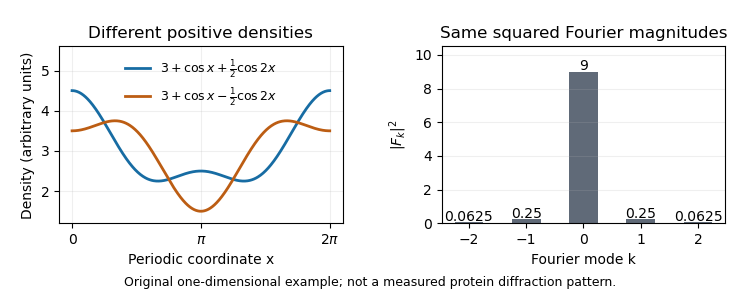
The myoglobin experiment was more demanding than this toy calculation, but the distinction motivates its chemical strategy: modifying crystals at known heavy-atom sites changes their scattering in a way that constrains phase information. Reconstructing an electron density map therefore requires both measured diffraction and a justified phase-determination method, rather than treating the recorded spots as a direct photograph of the molecule.


Articles by others on the same topic
There are currently no matching articles.