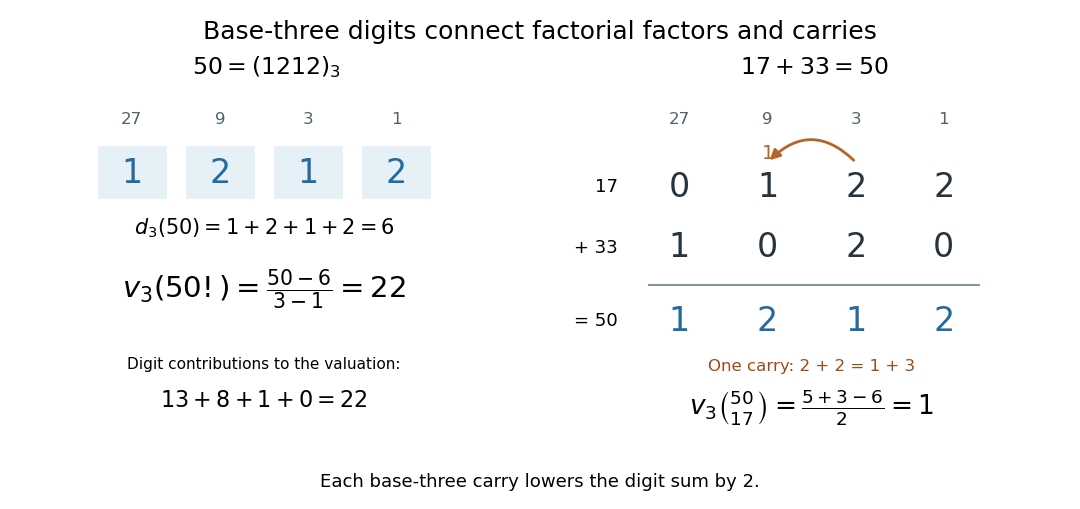
For a prime number and integers , the P-adic valuation of the binomial coefficient equals the number of arithmetic carries in the base- addition of and .[ref]
Number Theory for Mathematical Contests by David Anthony Santos. David A. Santos, Number Theory for Mathematical Contests, revision 31 October 2007, §8.3, Theorem 246, printed p. 90: carry count for a binomial coefficient
Indeed, subtract the two denominator factorial valuations in the Legendre formula:Each arithmetic carry accounts for one unit of this quotient by subadditivity of the base-p digit sum. In particular, the binomial coefficient is divisible by exactly when at least one carry occurs.For , the factorial counts giveThe matching base-p expansions are and . Their units add to two; the next column gives , sending one carry into the nines column. That column then gives , and no further carry occurs. The result is . The base-p digit sums check the same result: . Consequently is divisible by three but not by nine.
Articles by others on the same topic


Kummer's theorem is a result in number theory that deals with the generating function of a specific type of polynomial, known as Kummer polynomials, and is related to the combinatorial interpretation of binomial coefficients and hypergeometric functions. The theorem broadly states conditions under which certain series can be expressed in terms of known functions or simpler forms.