Every nonnegative integer is a sum of squares with four terms, with zero terms allowed. Precisely, for every integer , there exist nonnegative integers such thatAllowing arbitrary integer roots gives the same statement: changing a root to its absolute value leaves the resulting square number unchanged. Four is a uniform upper bound on the number of nonzero terms, rather than a demand for four positive terms. Repeated square numbers are allowed. Conrad states the positive case and explicitly explains the role of zero terms; follows by taking all four roots zero. [ref]
https://kconrad.math.uconn.edu/blurbs/ugradnumthy/descent.pdf. Keith Conrad, Proofs by Descent, Section 6, opening paragraph and Theorem 6.6
The small cases make the convention visible:In particular, could not be a sum of squares with four strictly positive roots, since each term would be at least one. Geometrically, a square of integer side length has area : the theorem says that any nonnegative whole-number total area can be split into at most four such square areas. It does not assert that those squares tile one larger square or a prescribed rectangle.
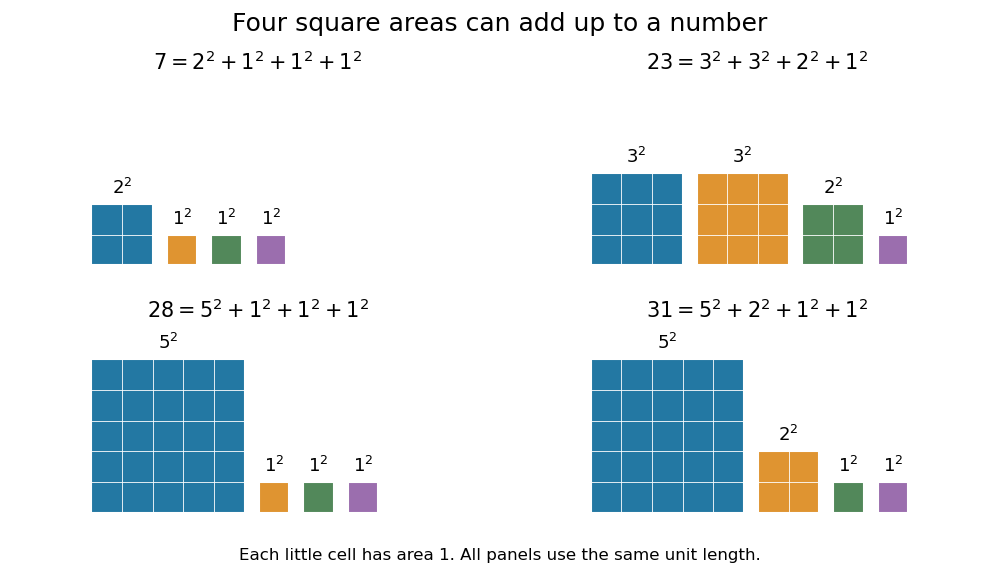
Why does the fourth term matter? Two square numbers do not suffice for : in modular arithmetic, a square number has remainder zero or one modulo four, so their sum cannot be three modulo four. The sum of two squares theorem gives a complete criterion for the positive integers representable with two terms. Even three terms leave gaps. A square number has remainder or modulo eight; adding three of these, with repetition allowed, never gives seven modulo eight. Thus cannot be sums of three square numbers, although Lagrange's four-square theorem represents all of them with four. This also proves that the bound four cannot be reduced to three.
The modulo-eight obstruction is not the only way that three terms can fail. For example, needs four: if three square numbers added to , their remainders modulo four would force all three roots even. Dividing by four would then express as a sum of three square numbers, contradicting the preceding calculation. These short checks explain the examples without requiring a full classification of sums of three square numbers.
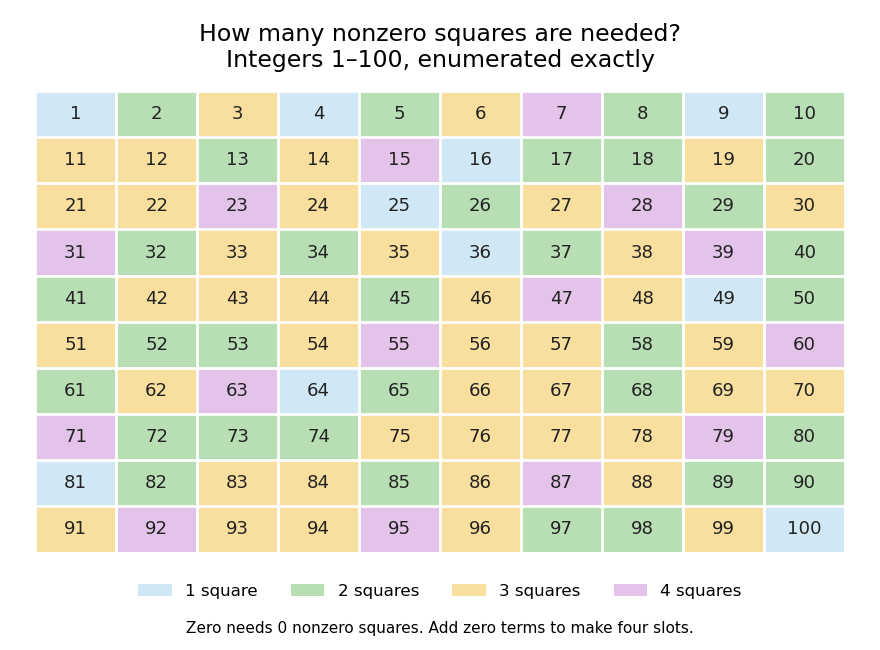
The practical benefit of Lagrange's four-square theorem is an existence guarantee for a family of Diophantine equations: for every nonnegative integer , the displayed equation has an integer solution. It does not specify a unique solution. For instance, . To find a representation by a finite search, enumerate and test the sum. The floor function supplies a finite bound because no single term can exceed , and sorting roots removes duplicate orderings without discarding any possible sum. The theorem guarantees that the search succeeds.
A greedy algorithm that repeatedly subtracts the largest available square number need not find four terms: for it chooses , while uses four. The appeal of the theorem is this gap between local choices and a global promise: individual square numbers become farther apart, and two or three terms leave arithmetic obstructions, yet four terms cover every nonnegative integer.
For historical orientation, Conrad dates Lagrange's four-square theorem to and identifies the memoir as Démonstration d'un théorème d'arithmétique: it appeared in the Berlin Academy's volume for the year , published in , pages –. Keeping the volume year and publication year distinct avoids an apparent conflict between dates. [ref]
https://kconrad.math.uconn.edu/blurbs/ugradnumthy/descent.pdf. Keith Conrad, Proofs by Descent, Theorem 6.6 and reference 11
Articles by others on the same topic

Lagrange's four-square theorem is a result in number theory that states that every natural number can be expressed as the sum of four integer squares.


