Choose the one-variable quadratic programWithout the optimization constraint, the global minimum is at . On the feasible set , write with : then . Hence is the unique primal optimizer and .
For any , completing the square in the optimization Lagrangian givesThe inner minimization problem is over all real numbers, so its unique optimizer is . ThereforeThe best lower bound is , attained at . At , the inner optimizer is , which is infeasible for the primal problem; nevertheless is a valid lower bound. At , the inner optimizer is , which is feasible, but is weaker than . Feasibility of an inner optimizer alone does not make the bound exact.
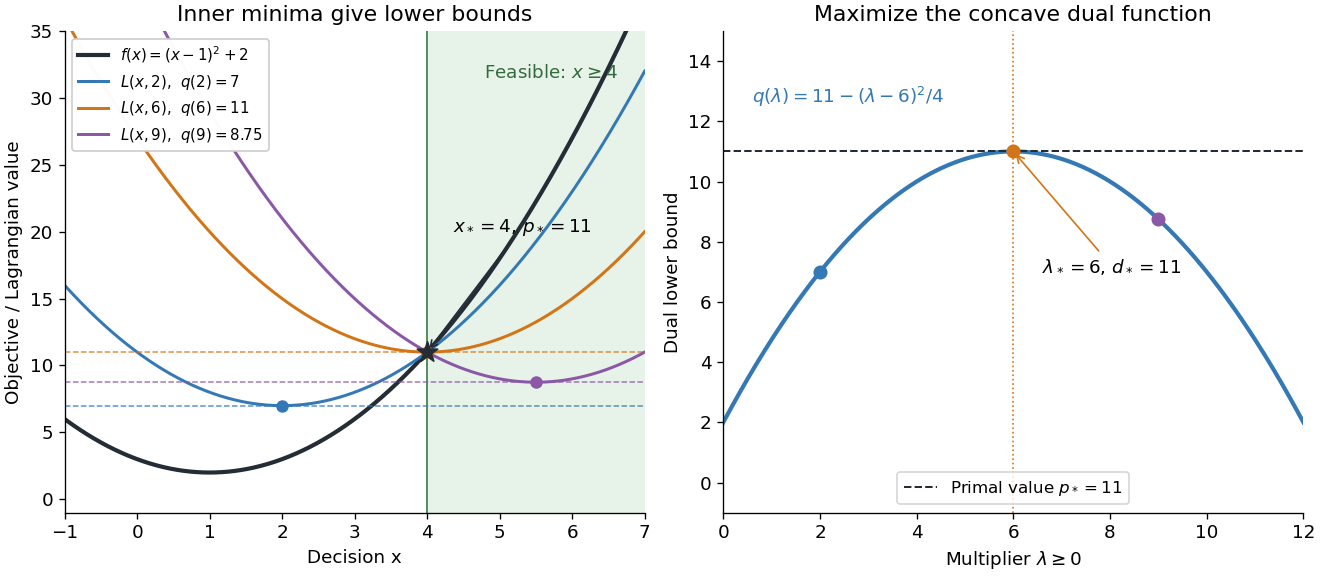

At , the Karush-Kuhn-Tucker conditions reduce toThe last equality is complementary slackness. The strongest certificate is visible without solving another optimization problem: , so every feasible point satisfiesThe same Lagrange multiplier simultaneously makes the inner optimizer feasible and removes the slack between and . This is a convex KKT optimality certificate; also verifies Slater's condition.
The domain in the inner infimum is essential. If one mistakenly keeps when computing , the restricted minimum becomes , whereas the actual Lagrange dual function has value . Constraints deliberately retained in are allowed in a Lagrangian relaxation, but that is a different choice of which restrictions to dualize.
Articles by others on the same topic
There are currently no matching articles.