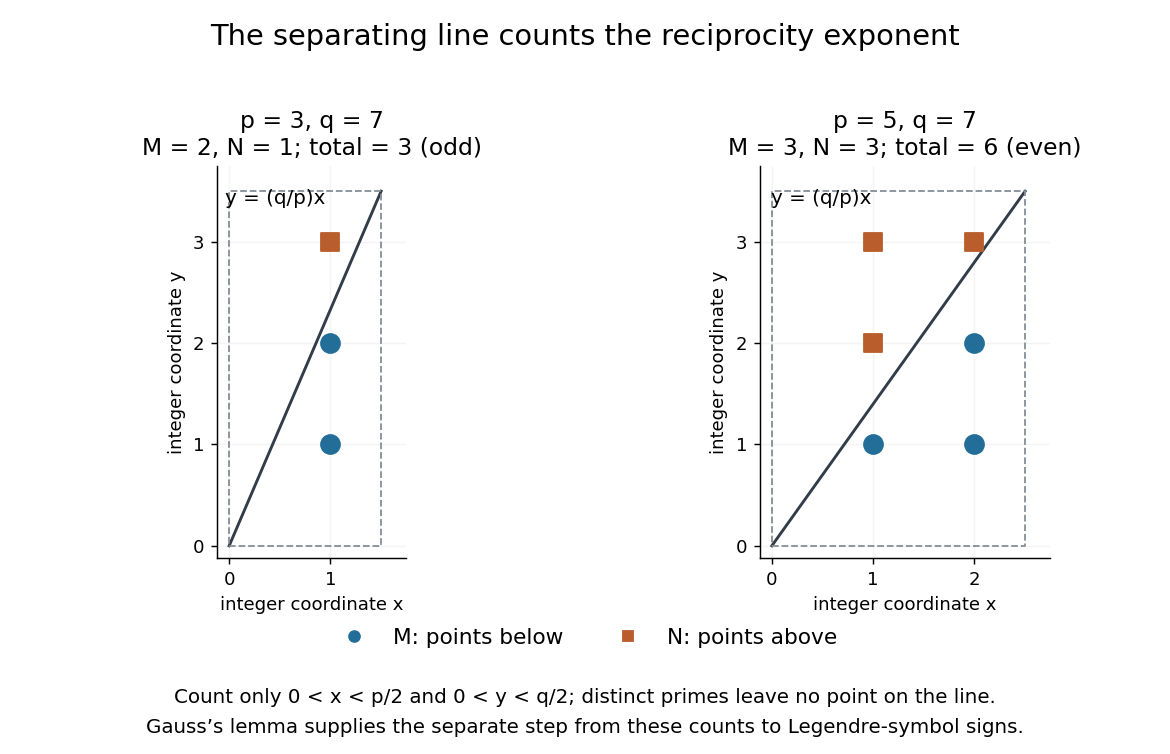
A short proof outline connects Gauss's lemma to counting points with integer coordinates. For distinct odd primes , define the two floor function sumsThe parity form of Gauss's lemma gives and . In the open rectangle , , the line separates points below it from points above it. None lies on the line, because and coprimality would force . The total is therefore . Combining that count with the parity identities gives quadratic reciprocity.[ref]
Quadratic Reciprocity by Ben Lynn. Ben Lynn, Quadratic Reciprocity, first theorem and proof of the Law of Quadratic Reciprocity: floor-sum parity and the separating-line count

Articles by others on the same topic
There are currently no matching articles.