Both players choose heads or tails without seeing the other's choice. The row player receives when the choices match and when they differ; the column player receives the opposite payoff. Thus matching pennies is a zero-sum game, with ordered payoff pairs:
| Row choice / column choice | ||
|---|---|---|
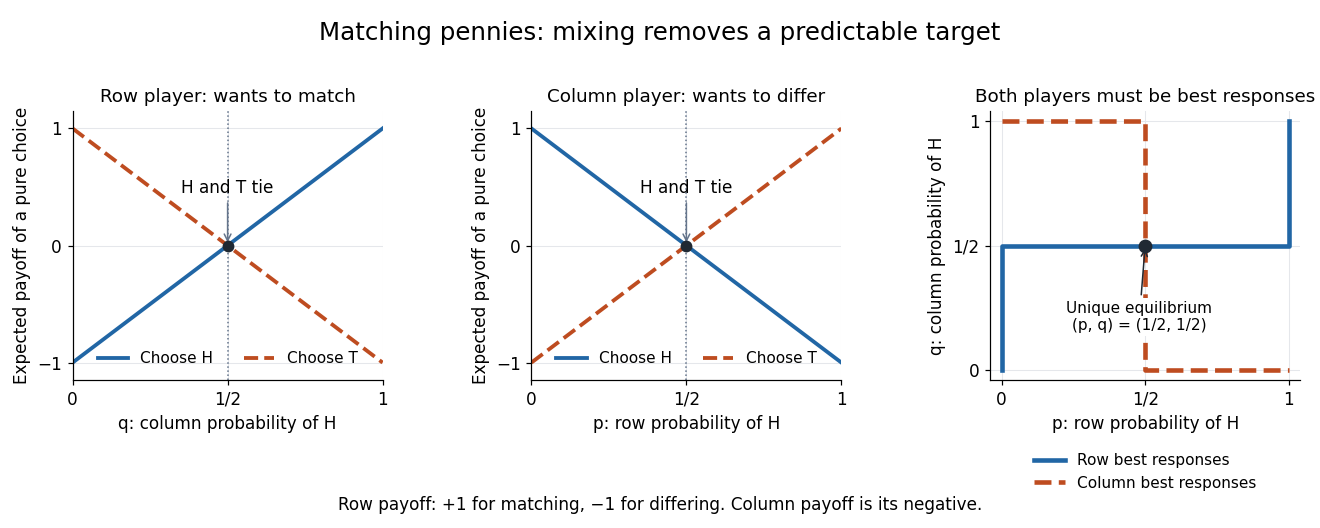
At the column player improves by switching to ; at the row player improves by switching to ; at the row player improves by switching to ; at the column player improves by switching to . Every pure strategy strategy profile therefore has a profitable unilateral deviation, so none is a Nash equilibrium.
Let be the row player's probability of heads and the column player's probability of heads. Their random choices are independent. Against fixed , the row player's pure-choice expected payoffs areAgainst fixed , the column player's pure-choice expected payoffs areConsequently the best responses, expressed as allowed heads probabilities, areHere means every mixture is a best response, including both pure strategies. If , the row player must choose , which makes the column player's best response , a contradiction. If , the row player must choose , which forces , also a contradiction. Hence ; for the column player to mix at this , the two column payoffs must tie, forcing . The unique Nash equilibrium is thereforeIndeed, for any , and . Holding gives the row player zero for every deviation ; holding gives the column player zero for every deviation . A player is indifferent against the equilibrium mixture, but choosing an arbitrary best response to it need not preserve the opponent's best response. This is why that indifference does not produce additional Nash equilibria.
For a teaching treatment with the same payoff convention, see MIT 17.810, lecture 3, slides 29–38, on mixed strategies and matching pennies.
Articles by others on the same topic


Matching pennies is a simple two-player game used in game theory to illustrate concepts of strategy and mixed strategies. ### Game Setup: - Each player has a penny and must simultaneously choose to display either heads (H) or tails (T). - The players reveal their choices at the same time. ### Outcomes: - If both players match (i.e., both choose heads or both choose tails), one player wins (usually designated as Player 1).