For an odd prime and any integers , the Legendre symbol obeysIn particular, if , then , where is a modular multiplicative inverse. Multiplication by a nonzero square also leaves the Legendre symbol unchanged: for .[ref]
Quadratic Residues by Ben Lynn. Ben Lynn, Quadratic Residues, The Legendre Symbol: multiplicativity and invariance under a nonzero square factor
The subgroup and coset arguments under quadratic residue and quadratic nonresidue prove the sign rule without computing a large power: square times square is square, square times nonsquare is nonsquare, and nonsquare times nonsquare is square. If either factor is zero modulo , both sides of the identity vanish. On , the Legendre symbol is thus a group homomorphism to whose kernel of a group homomorphism is the quadratic residue subgroup. Viewed on all integers, it is a completely multiplicative function and a Dirichlet character modulo .
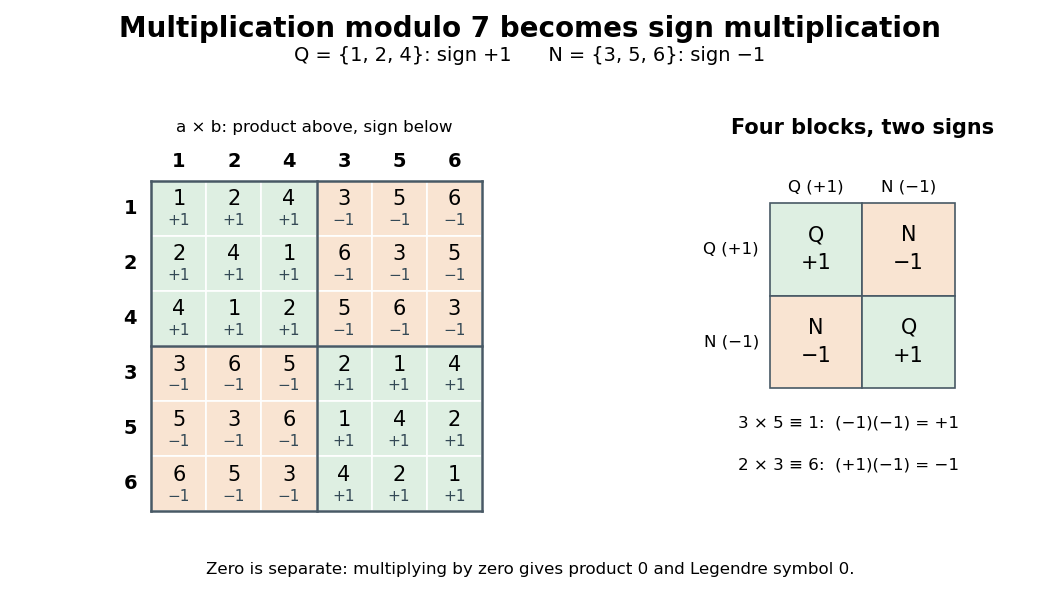

For an original calculation, factor the numerator . Modulo seven, , agreeing with . Modulo eleven, the signs are instead , giving , agreeing with . The same factorization can therefore certify different square behavior at different prime numbers.
Alternatively, Euler's criterion gives modulo . For nonzero factors both sides correspond to signs in . Since is odd, these signs are distinct modulo , so the modular congruence proves the asserted equality of integers, not merely an equality of representatives.
Articles by others on the same topic
There are currently no matching articles.