For a coherently prepared state proportional to , evolve each component with . The proper time is , and . Since both components reach the same final state, their decay amplitudes add before squaring. Factoring out and a common beam normalization gives the two-pion intensityThe last term is quantum interference. It vanishes upon averaging over an independently random preparation phase, but cannot be discarded from a coherent preparation. Summing the two positive contributions alone would lose the phase-sensitive information.
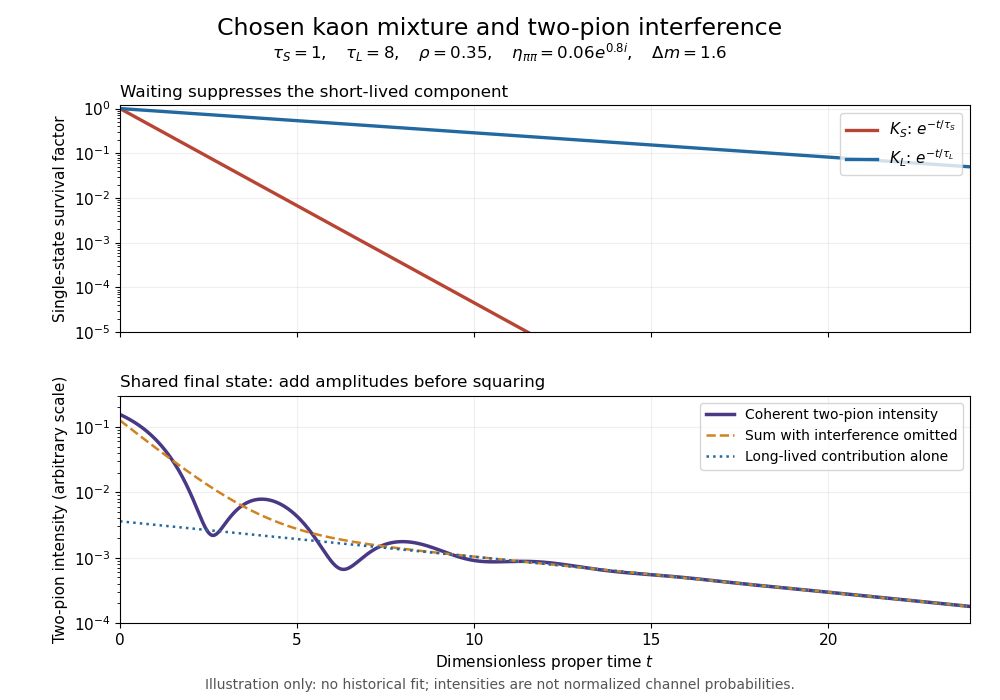

At late proper time, the short-lived contribution and the quantum interference term die away, leaving the long-lived tail . Such a tail is easier to identify after the initially abundant short-lived component has disappeared. The useful experimental balance is between eliminating that component and retaining enough long-lived decays to observe a rare decay channel.
Articles by others on the same topic
There are currently no matching articles.